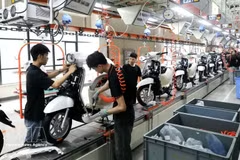
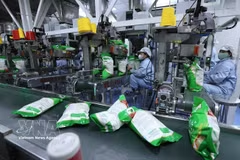
A worker is checking sausages before being packed at CPV company’s Phu Nghia food processing plant located in Hanoi’s Chuong My district. (Photo: CPV)
Hanoi (VNA) - The Vietnamese food market is witnessing an increasingly fierce competition between sausage manufacturers, with the participation of many famous brand names like VISSAN, Duc Viet and CPV.
It is no coincidence that more and more players are involved in producing and trading sausages. The business results of Vissan Limited Company (VISSAN), well-known both domestically and internationally for its various foodstuff products such as canned and processed foods, sausages, hams and frozen meat, partly show the reason why sausages are becoming increasingly attractive to many businesses.
In the first nine months of 2015 alone, profits earned by sausages reached 306 billion VND (13.6 million USD), accounting for about 60 percent of VISSAN’s total profit of 546 billion VND. In 2014, although revenues earned from sausages only accounted for 25.4 percent of VISSAN’s total revenue, the profit recorded by the sales of this product accounted for more than 60 percent of the company’s profit.
“For VISSAN, sausages are a staple product, contributing significantly to the profits of the company,” VISSAN General Director Van Duc Muoi said.
He added that VISSAN is now the leading company in providing packaged sterilised sausages, holding 65 percent of the domestic sausages market. In addition, VISSAN’s sausages are also exported to Laos and Cambodia.
To build its current reputation, apart from improving its product quality, VISSAN has also established a large and professional distribution network throughout the country.
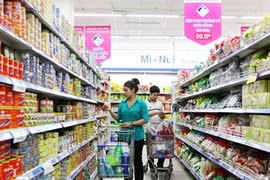
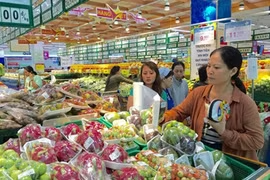
As of early March, the company’s products were already available in 223 supermarkets, 703 convenience stores, 59 showrooms and a wide range of distributors and agents.
Another kingpin of sausages whose has long since captured the loyalty of customers is the Duc Viet company. If VISSAN is famous for packaging sterilised sausages, Duc Viet is known as a powerful trademark of fresh sausages, a type of sausage that Vietnamese customers are much in favour of.
Duc Viet is the first enterprise trading and manufacturing German-style sausages from Vietnamese materials. Over the years, the company’s sausage products have become a favourite food of Vietnamese and have gradually solidified a position in the market.
According to Duc Viet General Director Hua Xuan Sinh, for 15 years of operation, Duc Viet’s top priority has always been ensuring food safety for customers.
“Our company pays much attention to quality, safety and hygiene. Duc Viet’s sausage production line was directly imported from Germany, worth millions of dollars. All stages in production must meet the strict requirements and standards of Germany,” Sinh said.
“We also care about customers’ preferences, hobbies and buying habits,” he said, adding that the company has a team of experienced and devoted experts working in researching and developing sausages to suit not only the tastes of Vietnamese, but also to comply with the quality standards of Germany.
“These are the differences that distinguish between Duc Viet’s products and others,” Sinh said.
Although VISSAN and Duc Viet are major and seasoned sausage manufacturers in the local market, they still face stiff competition from other heavyweight opponents, including the C.P. Vietnam Livestock Breeding Joint-Stock Company (CPV), which supplies both sterilised and fresh sausages.
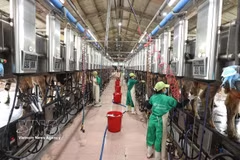
“Specialised in food processing with over 20 years of experiences, CPV is proud to be the pioneer in researching and successfully applying the self-contained production chain, called the Feed-Farm-Food or 3F model,” CPV Marketing Director Ho Doan Quoc Bao said.
According to Bao’s explanation, applying the 3F model means that the business covers all the production processes, from producing animal feed, building farms, and processing food from those farms.
CPV currently owns nine manufacturing plants producing animal feed, spreading over the provinces of Dong Nai, Binh Duong, Tien Giang, Can Tho, Ben Tre, Dak Lak, Hanoi and Hai Duong, with an annual capacity of 3.8 million tonnes.
The company also has three food and seafood processing plants located in Hanoi and the southern provinces of Dong Nai. Of them, the Phu Nghia food processing plant in Hanoi was designed and constructed under European standards with applied modern technology.
“With the 3F model, CPV can strictly control all stages of production to ensure nutrient security and food safety for people’s health,” Bao said.
Sharing the same idea, Muoi said that the most important thing for food producers is that they must ensure food safety.
“Sausages are made from animal flesh, which needs to be tightly monitored. The 3F model assists companies to ensure the product quality from raw material to final output, minimises production expenditure and protects reputation,” Muoi said, adding that VISSAN is also using this model for their production system.
VISSAN has built a food processing factory spanning an area of 22.4ha in the southern province of Long An’s Ben Luc district, with a total investment of 150 million USD.
According to VISSAN, the factory operates in a closed production chain, connecting all the procedures of slaughter, processing, packaging and storage.
Many other food producers are also aggressively pursuing the 3F model, including the Dabaco Group and Massan Group.
As Vietnamese consumers are often confused by information about food contamination, the 3F model helps businesses obtain a competitive advantage as consumers tend to buy products with a clear origin.
However, developing the 3F model requires businesses to have a strong financial potential, good infrastructure and extensive distribution system. Therefore, it is the common goal of all market players.
When the Trans Pacific Partnership agreement officially takes effect, many foreign enterprises will grasp the opportunity to penetrate the potential market of Vietnam. The rivalry in the sausage market, therefore, promises to be even fiercer in the future.-VNA