Seminar seeks to improve firms’ role in climate change response

A seminar on promoting the involvement of pioneering enterprises in natural disaster prevention and control, and response to climate change and epidemics was held in Hanoi on October 15.
Seminar seeks to improve firms’ role in climate change response ảnh 1At the event. (Photo: VNA)

Hanoi (VNA) -A seminar on promoting the involvement of pioneering enterprises in natural disaster preventionand control, and response to climate change and epidemics was held in Hanoi on October15.

Co-organised by the Vietnam Chamber of Commerce and Industry,the United Nations Development Programme (UNDP) and the Ministry of Agricultureand Rural Development’s Vietnam Disaster Management Authority (VNDMA), theevent aimed to respond to International Day for Disaster Risk Reduction (October13) in order to review the impacts of natural disasters, climate change andepidemics on Vietnamese businesses, as well as policy impacts on the role ofenterprises in the field.

In his opening speech, Deputy Resident Representative of UNDP in Vietnam Partrick Haveman said UNDP together with relevant agencies have encouraged technical working and research groups, organisations and business associations to acquire newinitiatives to help businesses improve their resilience to shocks like COVID-19 andmitigate the impacts of disasters and epidemics.

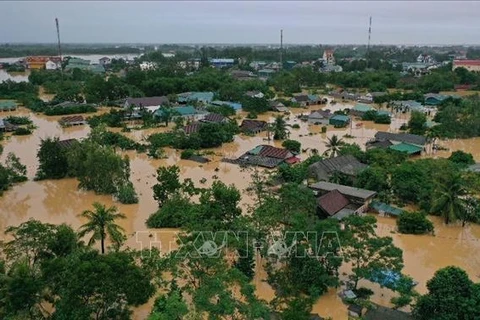
Citing the World Bank’s report on the role of the Vietnamesefirms in disaster prevention and climate change response, Head of the VCCI’s LegalAffairs Department Dau Anh Tuan said Vietnam is one of the countries hardesthit by extreme weather. Economic losses caused by natural disasters could amount tonearly 1.5 percent of its annual gross domestic product and could keep risingin the future, he said.

Agriculture suffers the most consequences of natural disasters whilenewly-established firms are also the most vulnerable to climate change. However,due to the COVID-19 pandemic, up to 71 percent of companies reportedyear-on-year decline in revenues this year, Tuan said.

According to the official, 63 percent of joint ventures and 49 percent offoreign-invested enterprises have actively joined in efforts to overcome consequences caused by natural disasters.Therefore, the building of a national strategy on disaster prevention and controlas well as the role of business community is needed at present.

VNDMA Deputy General Director Nguyen Van Tien said Vietnam hasbeen one of the five countries hardest hit by climate change over the pastthree decades. Each year, natural disasters leave about 400 dead and missing and cause economic losses of 1-1.5 percent of the GDP.

Since the beginning of this year,calamities have left more than 100 dead and injured, collapsed hundreds of houses anddamaged 8,000 houses across the country, he added./.
VNA

See more

The forum takes place in Hanoi on August 25, 2026. (Photo: VNA)

Vietnam, RoK promote cooperation to deliver on net-zero commitments

Sectors such as semiconductor manufacturing, nuclear power, science and advanced technologies are playing an increasingly important role in national competitiveness and economic development of each country. They also offer considerable room for Vietnam and the RoK to expand professional exchanges, share experience and promote cooperation, particularly among their energy experts.

Storm Narra's projected path as of 7:00 on August 22. (Photo: National Centre for Hydro-Meteorological Forecasting)

Storm brings heavy rains to northern Vietnam

Storm Narra, the fourth to hit the East Sea this year, brought strong winds and heavy rains to northern Vietnam on early August 22, with some areas forecast to receive more than 500mm of rain as the storm moves slowly over the northern waters of the East Sea.

A view of the meeting between Phu Tho authorities and a visiting delegation from Germany's KfW Development Bank in the province on August 20, 2026. (Photo: VNA)

Phu Tho, German bank discuss wastewater treatment plan for Da River's left bank

The project is being implemented in the former Hoa Binh city, now Hoa Binh ward. It has a total investment of 688.7 billion VND (26.38 million USD), including 507.3 billion VND in ODA and 181.4 billion VND in counterpart funding. Major components include a wastewater treatment plant, pumping stations, a collection network, and connection infrastructure.

Construction workers reinforce steel and pour concrete to cover the underground drainage channel, helping collect rainwater and tackle flooding in Da Nang. (Photo: VNA)

A new “shield” against climate change

Smart urban areas are no longer simply about technology; they are becoming a tool that enables authorities to forecast risks, adapt quickly and protect their residents.

Vietnam is exerting efforts to cope with climate change. (Illustrative photo: VNA)

Vietnam approves carbon credit pact with Singapore under Paris Agreement

Signed on September 16, 2025, the Implementation Agreement on carbon credits collaboration under Article 6 of the Paris Agreement on climate change affirms Vietnam and Singapore’s pioneering role and commitment to close cooperation in the international carbon market, making a substantive contribution to global climate response.

A view of Vo Cuong ward, Bac Ninh province (Photo: VNA)

Bac Ninh earmarks over 1.7 billion USD for environmental protection

By 2030, Bac Ninh aims to ensure that all operating industrial clusters and industrial parks have centralised wastewater treatment systems meeting standards, while at least 95% of wastewater in Grade-I urban areas and 70% in Grade-II urban areas is collected and treated to required standards.

Many inland canals in Can Tho city dries up following a prolonged period of extreme heat. (Photo: VNA)

Government adopts action programme on environmental protection, climate resilience

The programme aims to translate the Party's orientations into concrete actions while strengthening environmental governance, enhancing climate resilience, and promoting a green, circular and low-carbon economy. It will serve as the basis for ministries, sectors and localities to formulate implementation plans for the 2026–2030 period, with a vision to 2045.