Seminar talks Vietnam’s economic growth model

Deputy Prime Minister Vuong Dinh Hue highlighted the close links between growth models and economic restructuring during a seminar in Hanoi on March 20.
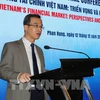
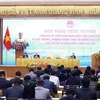
Seminar talks Vietnam’s economic growth model ảnh 1At the workshop (Photo: VNA)

Hanoi (VNA) –
Deputy Prime Minister Vuong Dinh Hue highlighted theclose links between growth models and economic restructuring during a seminarin Hanoi on March 20.

The seminar on Vietnam’s economic growth model for 2021-2030 with a visiontowards 2045 was jointly held by the Vietnam Academy of Social Sciences (VASS),the PM’s Economic Advisory Group, the Ho Chi Minh National Academy of Politics,the World Bank, and the Australian Embassy in Vietnam.

Attention should be paid to macro factors and restructuring focuses during theprocess of policy planning, Hue said.

The official said that at the 11th National Party Congress in 2011, the growthmodel was expanded in scale, with importance placed on growth, quality andefficiency. Meanwhile, at the 12th National Party Congress in 2016, the growthmodel was set towards both quality and quantity, focusing on in-depthdevelopment and sustainability.

Prof. Dr. Nguyen Quang Thuan, VASS President, also pointed out positiveeconomic changes over the past three years, with a rapid increase in the numberof equitised State-owned enterprises (SOE) and more firms divesting capitalfrom unnecessary sectors.

He stressed progress made in the restructuring of SOEs,the banking sector and public investment.

The Fourth Industrial Revolution and international economic integration throughnew-generation free trade agreements have generated both opportunities andchallenges for Vietnam’s economic growth model. How to optimise theopportunities and ease the challenges to promote economic growth model reformtowards higher quality for 2021-2030 with a vision towards 2045 has drawn the attentionof scientists, researchers and policymakers, he said.

Associate Prof. Dr. Bui Thang Tuan, head of the Vietnam Institute of Economics,said that although Vietnam’s economy is growing at a high rate of 6.3 percent,the country has failed to reach the annual target of 7-8 percent set under the2011-2020 strategy.

He, therefore, proposed shifting the growth model towards quality, changing theratio of resources contributing to the growth, prioritising science-technologyand innovation, and utilising opportunities offered by the Fourth IndustrialRevolution and the national golden population structure to make rapid andquality growth.-VNA
VNA
See more

Promoting stronger foreign direct investment (FDI) inflows is considered an important solution to help drive economic growth. (Photo: VNA)

Vietnam emerges as hub for high-quality FDI

Vietnam is gradually becoming a strategic destination for high-quality global FDI. Investment flows are increasingly directed toward sectors such as high-tech manufacturing, electronics, digital infrastructure, modern logistics, and industries that are closely linked to global supply chains.

Shrimp processing for export at Huy Nam company, An Giang province. (Photo: VNA)

Fisheries sector proactively adjusts to emerging challenges

In addition to food safety regulations, the US continues to closely monitor the origin of imported seafood through the Seafood Import Monitoring Programme (SIMP) administered by the National Oceanic and Atmospheric Administration (NOAA). Requirements linked to the Marine Mammal Protection Act (MMPA) are also a major concern for businesses.

Pham Van Cong, Chairman of the Vietnam Cashew Association, speaks in a conference reviewing the industry’s 2025 performance and deploying procurement plans for 2026 in HCM City on March 13. (Photo: VNA)

Cashew sector braces for challenges in 2026 amid global uncertainties

Vietnam’s cashew industry recorded export turnover of about 5.5 billion USD in 2025, the highest level ever. He noted that the result reflects the industry’s remarkable development, dynamism and timely adaptation to complex and unpredictable challenges both domestically and globally.

An Phát Complex Industrial Park in Hai Phong City is one of the eco-friendly industrial parks. (Photo: VNA)

Green industrial parks become new magnet for FDI

Statistics show that about 80% of FDI enterprises prioritise investing in industrial parks with green energy infrastructure, reflecting a growing shift in investment preferences amid tightening global environmental standards.

Wood panel production at the Thuan An Wood JSC in Ho Chi Minh City (Photo: VNA)

Vietnamese businesses ride wave of investment in green manufacturing

Recent developments in private investment show that as confidence in the private sector has grown and is a key driver of economic development, investors are strengthening support for enterprises not only through capital but also management expertise and market connectivity.

Officers and soldiers of Son Tra Border Guard Station, Da Nang City Border Guard Command tell local fishermen about IUU fishing. (Photo: VNA)

Fishing solidarity groups help Vietnam with IUU “yellow card” warning removal

Over the years, coastal authorities in Da Nang have intensified efforts to educate fishermen about regulations, particularly the need to avoid illegal fishing in foreign waters. Local administrations and competent forces have also strengthened vessel registration and inspection procedures, installed vessel monitoring systems and ensured transparent declarations of catches at ports.