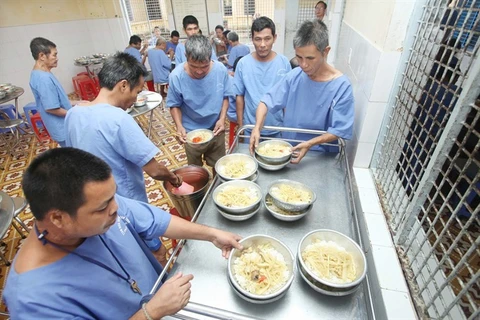
There has been a sharp year-on-year increase in the number of people suffering from serious mental illnesses, according to a senior official of the Ministry of Labour, Invalids and Social Affairs (MoLISA) (Photo vnexpress.net)
 Hai Phong (VNA) - There has been a sharp year-on-year increase in the number of people suffering from serious mental illnesses, according to a senior official of the Ministry of Labour, Invalids and Social Affairs (MoLISA).
Nguyen Van Hoi, head of the ministry’s Social Assistance Department, told a conference last week that an estimated nine million Vietnamese citizens, or roughly ten percent of the population, are suffering from mental disorders of various degrees, down one million compared to 2016.
However, this year has witnessed a sharp rise of the number of serious mental cases, with 300,000 or so citizens suffering severe psychological ailments against last year’s 200,000.
The conference on improving social work related to mental health aimed to improve the quality of advocacy and awareness-raising activities in the mass media.
Hoi said the most prevalent mental disorders included schizophrenia, epilepsy, depression, autism, intellectual disability, neurological disability, brain damage, alcohol abuse and drug addiction.
Referring to the Prime Minister’s Decision No 1215 (issued July 2011) approving a 10-year (2011-2020) project to improve community-based social assistance and rehabilitation for mental patients, he said there were 50 centres nationwide that provided care for mental patients.
Of these, 30 provided specialised care, while the other 20 focused on general care.
Currently, 200,000 people with severe mental illness are entitled to monthly benefits, and 13,000 mental patients from economically disadvantaged backgrounds who cannot take care of themselves and have no caretakers have been admitted into social welfare establishments.
These patients are provided with free health insurance cards, and given free vocational training classes if needed.
“Taking care of people with mental health problems is a difficult task. Even those with bachelors or masters degrees in social work needed to learn clinical tasks for at least two years before they can begin working at rehabilitation facilities,” Hoi said.
“Moreover, working at the rehab centres is a dangerous and onerous job. There have been some extreme cases recently where caretakers were beaten, even killed by mental patients,” he added.
At the same time, the quality of social workers serving people with mental health problems had improved steadily, Hoi asserted.
Dr Vu Cong Nguyen, deputy director of the Institute for Population, Health and Development, highlighted the “commonness” of depression among other disorders, calling it the “disease of the era.”
Nguyen said that while a nationally representative sample of those suffering from the disease has not been drawn, based on smaller cross-sectional studies in several localities throughout the country, it can be approximated that 8-15 percent of the population are suffering from depression in varying degrees.
Tran Ngoc Dien, Editor-in-Chief of the Labour and Society magazine, said the press played a critical role in raising mental health awareness.
“It is absolutely necessary that a reporter has a sympathetic heart and the right mindset, to use their work to help mental patients overcome their problems and find happiness,” he said.
"The press can ensure that not just the public, decision making officials also understand mental health issues better," he added
Dr Tran Ba Dung cautioned that reporters must be extra sensitive so as to avoid inadvertently hurting people’s feelings.
He also warned against unethical practices like publishing unverified stories or publishing stories without the consent of those involved (the mental patient and their families), click-baiting or using sensational, misleading headlines that might generate negative public perception of mental disorders, which are heavily stigmatised already.-VNA
VNA