Singapore dollar remains stable amid yuan adjustments

The trade-weighted Singapore dollar (SGD) has not been drastically affected by the devaluation of the Chinese yuan, according to the Monetary Authority of Singpore (MAS).
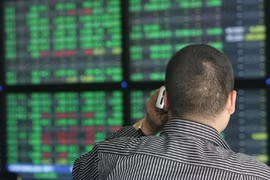
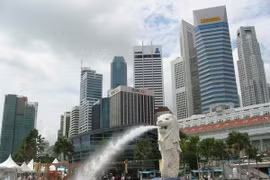
Singapore dollar remains stable amid yuan adjustments ảnh 1Illustrative photo. (Photo: tanwj.com)

The trade-weighted Singapore dollar (SGD) has not been drastically affected by the devaluation of the Chinese yuan, according to the Monetary Authority of Singpore (MAS).

Although the ​SGD fell as low as 1.415 to USD on August 12 – the lowest level for the currency since 2010, the MAS affirmed that the SGD exchange rate is under control.

SGD is managed against a trade-weighted basket of currencies within a policy band, which is not dependent on specific bilateral exchange rates. This mechanism allows SGD to adjust to short-term markets while staving off undue volatility in the foreign exchange market.

The MAS said that Singapore’s monetary market policy announced in April 2015 remains appropriate in relation to overall macroeconomic conditions.

Economic analysts recommend Singapore keep a close watch on yuan adjustments as continuous yuan devaluation will negatively impact regional currencies under pressure from the strong USD.

They also warned that weakened monetary markets and sluggish economic growth will result in capital flows fleeing to the US and the EU, where economic potentials are brighter.-VNA
VNA

See more

Professor Awang Azman Awang Pawi from the University of Malaya, who is also a senior research fellow at the National Academy of Malaysia (Photo: VNA)

Vietnam plays strategic role in strengthening ASEAN connectivity: Malaysian scholar

Malaysia should view Vietnam’s growing diplomatic and economic influence as a strategic opportunity rather than a competitive challenge. A Vietnam confident and dynamic in economic development and responsible in its diplomacy, would strengthen ASEAN’s collective bargaining position and contribute to regional peace, said Professor Awang Azman Awang Pawi from the University of Malaya.

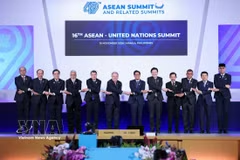
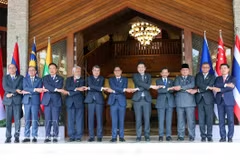
Prime Minister Le Minh Hung (fifth from left), other ASEAN leaders and UN Secretary-General Antonio Guterres (sixth from left) at the 16th ASEAN–UN Summit in Manila, the Philippines, on November 16, 2026 (Photo: VNA)

PM calls for stronger ASEAN–UN cooperation

PM Le Minh Hung called on the UN to continue supporting ASEAN centrality and work alongside ASEAN in developing mechanisms for proactive prevention, early warning and crisis management.

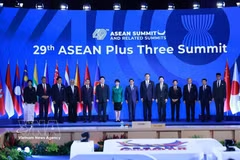
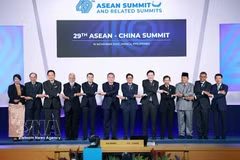
Prime Minister Le Minh Hung (fifth, left) and other ASEAN leaders and Chinese Premier Li Qiang at the 29th ASEAN-China Summit (Photo: VNA)

PM suggests priorities for elevating, deepening ASEAN-China cooperation

First, Prime Minister Le Minh Hung stressed that the two sides should continuously strengthen strategic trust and maintain an environment of peace and stability. The PM called for expanded exchanges and cooperation, stronger coordination in responding to emerging non-traditional challenges, and enhanced cooperation at the United Nations and other multilateral forums.

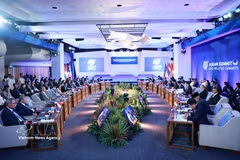
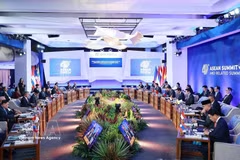
An overview of the dialogue between ASEAN leaders and the ASEAN Business Advisory Council (ASEAN-BAC) in Manila on November 15 (Photo: VNA)

Vietnam puts forward priorities to advance ASEAN cooperation

Appreciating ASEAN-BAC’s report and recommendations, Deputy Minister of Foreign Affairs Dang Hoang Giang, head of Vietnam’s ASEAN Senior Officials’ Meeting (SOM) delegation, called for simplifying procedures, reducing costs, accelerating digitalisation, upgrading the ASEAN Single Window (ASW) and effectively implementing the ASEAN Digital Economy Framework Agreement (DEFA) to make the regional market more accessible.

An overview of the ASEAN Leaders’ Interface with Representatives of the ASEAN Inter-Parliamentary Assembly (AIPA) in Manila on November 15 (Photo: VNA)

Vietnam proposes three key directions for ASEAN-AIPA cooperation

Prime Minister Le Minh Hung affirmed that close and effective coordination between the governments and parliaments of member states is a foundation and important driving force for ASEAN to realise its vision of a united, resilient, dynamic and people-centred community.

ASEAN signs Digital Economy Framework Agreement

ASEAN signs Digital Economy Framework Agreement

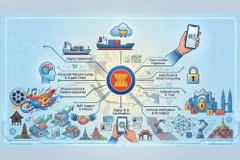
The Digital Economy Framework Agreement (DEFA), the bloc’s first standalone and legally binding digital economy agreement, establishes common rules covering digital trade, cross-border data flows, electronic payments, cyber security and artificial intelligence (AI).

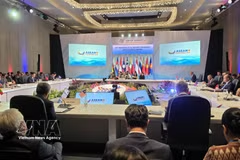
An overview of the ASEAN Foreign Ministers’ Meeting on November 14, 2026 (Photo: VNA)

Vietnam backs ASEAN culture of consultation, dialogue, preventive diplomacy

Deputy Minister of Foreign Affairs Dang Hoang Giang stressed that amid conflicts and instability in various parts of the world, ASEAN should give top priority to strengthening the foundations of peace and stability, uphold the rule of law and promote the bloc’s principles and norms of conduct, particularly the Treaty of Amity and Cooperation in Southeast Asia (TAC).

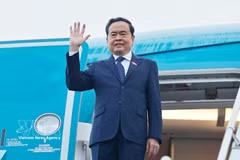
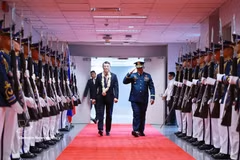
The welcome ceremony for Prime Minister Le Minh Hung at Ninoy Aquino International Airport on November 14 afternoon (Photo: VNA)

Vietnamese PM arrives in Philippines for 49th ASEAN Summit

PM Le Minh Hung’s attendance underscores Vietnam's sustained commitment to the bloc, which aligns consistently with the foreign policy set forth by the 14th National Party Congress, which defines ASEAN as a bloc of strategic importance and a top priority in Vietnam’s external relations.