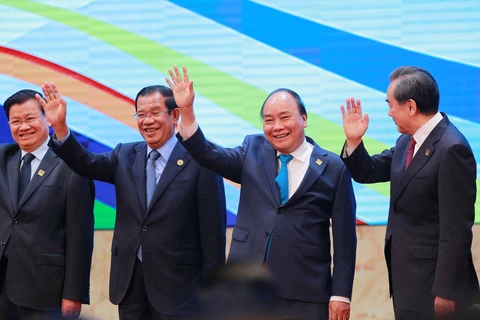
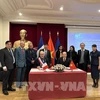
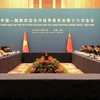
Prime Minister Nguyen Xuan Phuc (C) takes photo with heads of delegations of GMS countries (Photo: VNA)
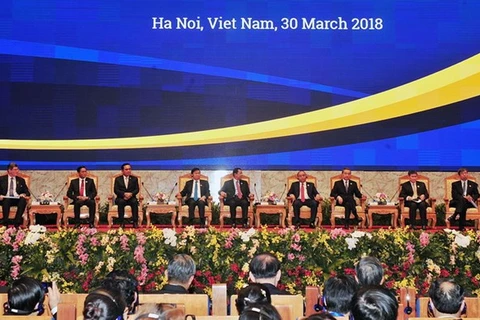
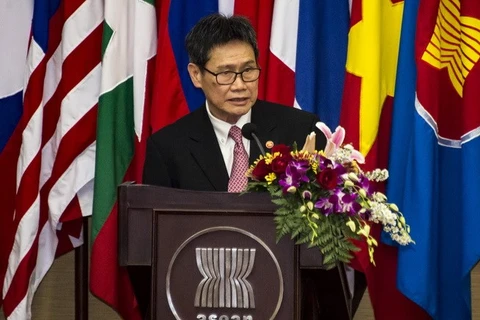
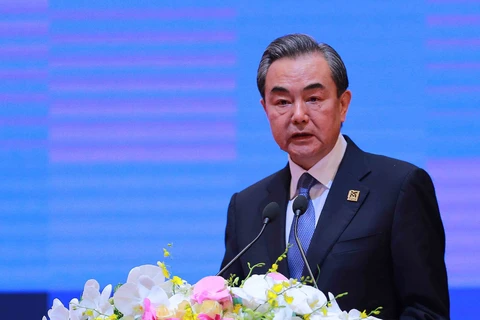
 Hanoi (VNA) – The sixth Greater Mekong Subregion (GMS) Summit took place in Hanoi on March 31, with the participation of leaders of the regional countries and representatives from ASEAN, the Asian Development Bank and the World Bank.
Themed “Leveraging on 25 years of Cooperation, and Building a Sustainable, Integrated, and Prosperous GMS”, the summit reviewed the 25-year path of GMS cooperation, and discussed opportunities and challenges the subregion is facing as well as major orientations for GMS cooperation in the coming time.
In his speech, Prime Minister of host Vietnam Nguyen Xuan Phuc said during one fourth of the past century, GMS cooperation has ceaselessly expanded in both depth and width, affirming its own identity as a prestigious regional cooperation mechanism with the 3C strategy “Connectivity, Competitiveness and Community”.
Hundreds of projects with a total capital of over 21 billion USD have been implemented in various fields from transport, energy and telecommunication to trade, agriculture and environment, he said, adding that there are also many overall collaboration strategies with long-term vision such as the East-West Economic Corridor (EWEC) and the Southern Economic Corridor (SEC).
Ever being a region of poor, underdeveloped and isolated countries in the last century, the GMS is now proud of housing the fastest growing economies in the world which are in active integration and have broad and busy markets with an increasingly developing middle class.
“The success of the GMS proves the aspiration and determination to build the Mekong region of peace, prosperity and sustainable development for the people, he stressed.
He expressed his thanks to the Asian Development Bank (ADB), the World Bank and development partners for their valuable and effective support for the Mekong region in general and Vietnam in particular.
According to the Vietnamese leader, over the past 25 years, Vietnam has always actively engaged in GMS cooperation and efforts to trade and investment facilitation, environmental protection, natural resources, and climate change adaptation. Many works connecting Vietnam and other GMS nations have proven effective, including the EWEC, roads and bridges connecting the Mekong Delta region, the SEC and the Noi Bai – Lao Cai – Yunnan expressway.
“We will continue working to make the GMS operation more effective, thus further promoting the potential of the Mekong region,” he affirmed.
The PM spoke highly of the building of the Hanoi Action Plan for 2018-2020 and the Regional Investment Framework 2022 (RIF-22) with a total of over 220 investment and technical support programmes and projects worth about 66 billion USD.
He suggested the building of the GMS Cooperation Vision by 2030 with the main tasks of improving competitiveness, supporting GMS countries in engaging more deeply and effectively in global value chain, and increasing coordination in responding to the region’s common challenges, especially climate change and environmental protection.
He also underlined the key cooperation areas among the GMS nations, with the first priority given to infrastructure development and boosting regional connectivity to ensure smooth connection within the region and between the region and outsiders.
Focus will be put on building green, high-quality, and smart infrastructure by using advanced and environmentally-friendly technology, in tandem with ensuring socio-environmental aspects and sustainable financing, PM Phuc said.
Connection at local level will be strengthened in terms of roads, railways, aviation, maritime, and waterways to maximise the efficiency of the GMS’s economic corridors in the new stage.
The GMS nations will also forge ahead with regional connectivity in information – telecommunication and energy to use natural resources and manage production more effectively, he said.
They will also boost reciprocal support in trade and investment, thus better connecting regional investors, production and business facilities to reduce regional competition and increase the regional competitiveness, particularly in agro-forestry-fisheries products, he added.
GMS countries must focus on improving the quality of human resources and take it as a top priority in the context of the fourth industrial revolution.
The improved quality of labourers would help the GMS economies upgrade international competitiveness, as their skills remain simple and their productivity is still low, Phuc added.
He suggested the GMS countries share their database and conduct shared researches on efficient, sustainable exploitation, use and management of natural resources that include the Mekong River.
He also said that the GMS nations and their developed-economy partners should improve their cooperation and increase the effectiveness of sustainable development and environmental protection.
The GMS governments should include their green growth strategies in their own national development plans, he said, adding the subregion should expand its relations to other developed economies, international financial institutions and the business community to benefit all members.-VNA
VNA