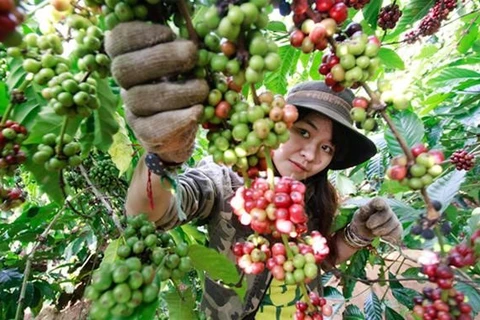
Participants browse coffee products at a discussion on the mountain region coffee industry held in the northern province of Son La last week (Photo: VNA)
 Son La (VNA) - Lo Thi Phong in Chieng Chung commune in Mai Son district in the mountain province of Son La, has cultivated coffee for more than 10 years on 5,000 square metres of land, but she still finds life difficult.
A decade seems long enough to improve farming practices by trial-and-error, however, according to the middle-aged Thai woman, “even now, we still cannot keep proper financial accounts”.
During discussions hosted by CARE International last week, stakeholders in the mountain coffee industry touched on deeper obstacles facing the industry.
CARE has worked in Vietnam since 1989, concentrating on supporting rights and sustainable development among vulnerable groups, particularly remote ethnic communities, poor women and girls and people vulnerable to climate change.
Nguyen Vinh Duc, deputy director of the Son La branch of the Minh Tien Coffee Export Joint Stock Company, spoke on the drawbacks of small production in the development of local coffee.
“Since coffee plantations in Son La are limited, farmers have not established cooperatives like those in the Central Highlands provinces of Dak Lak and Lam Dong," he said.
"Moreover, different techniques used by farmers to process their own beans leads to variation in quality, making it challenging for export companies,” he said.
Duc said that specialisation during production stages was critical to enhance the quality and increase the value of local coffee.
Phong is a typical coffee farmer in Son La province. According to Lo Minh Hung, vice chairman of the provincial People’s Committee, there are about 12,000 ha of coffee belonging to about 400 households in the locality, small compared to the more than 180,000 ha in Dak Lak province.
At present, the province is known for its hydro-electricity industry and has the largest power generating dam in the nation. But when all hydro-electric projects have been completed, authorities have marked agriculture, particularly fruit and coffee, as the key industry.
The establishment of Son La Tea and Coffee company in 1987 introduced Arabica to the province. This is a strain of coffee more popular in the west than Robusta, the well known Vietnamese coffee. With more than 30 years of experiences and the advantage of good soil, farmers produce the special beans popular in Germany, Japan and the United States.
Son La authorities aim to raise the coffee-growing area to 14,000 ha by 2020. However, current practices have led to soil degradation and a lowering of bean quality.
Moreover, most ethnic farmers in the province are household units, not collectives. This leads to poor bargaining and limited access to inputs such as fertiliser, seeds and information on improving profits.
Therefore, local authorities aim to develop a sustainable coffee-growing area by tightening the links among farmers, processers and traders.
Hung said coffee farmers should form co-operatives to gain better technology transfer and an exchange of experiences.
Duc said that farmers should accelerate good agricultural practices, tighten farm management and protect the environment to acquire international certifications of sustainable farming including UTZ and 4C. "They are a strong foundation for Son La coffee to enhance its quality and access international markets," he said..
“As a trader, our company creates more favourable conditions for households planting UTZ or 4C certified coffee products. Also, we call for the participation of banks in offering preferential loans and keeping farmers informed about market price,” Duc added.
In the past 10 years, Phong and her husband, like several other coffee-growing households in Son La province, have struggled to find markets for their coffee so that they can expand the farming area.
Now, CARE International in cooperation with the Son La and Dien Bien Departments of Agriculture and Rural Development, is implementing a project to support ethnic women in the coffee value chain. It is referred to as Technologically Enhanced Agricultural Livelihoods, or TEAL.
With about 3 million USD funded by the Australian Government, it is expected to promote the potential of coffee products in Muong Ang district of Dien Bien province and Mai Son district of Son La province over the next three years.
“Son La province has identified Arabica coffee as one of the core commodities to reduce and eradicate poverty and to lift living standards. The project supports farmers growing coffee sustainably and plays an important role in improving their lives,” said Hung.
At the same time, the role of women in making economic decision is expected to improve under the CARE programme .
By making ethnic women the main stakeholders, CARE is helping support village savings and loan associations. Simultaneously, a common platform for farmers, traders, consumers and relevant parties will be created to increase productivity and output and to attract further investment in the local coffee industry.
Empowering women and improving coffee value are the two core factors under TEAL, an ambitious project to promote agricultural products.
“With our experiences in promoting gender equality via agricultural value chains, we believe in the project’s ability to improve the living standards of ethnic households,” said Le Kim Dung, country director of CARE International in Vietnam.-VNA
A decade seems long enough to improve farming practices by trial-and-error, however, according to the middle-aged Thai woman, “even now, we still cannot keep proper financial accounts”.
During discussions hosted by CARE International last week, stakeholders in the mountain coffee industry touched on deeper obstacles facing the industry.
CARE has worked in Vietnam since 1989, concentrating on supporting rights and sustainable development among vulnerable groups, particularly remote ethnic communities, poor women and girls and people vulnerable to climate change.
Nguyen Vinh Duc, deputy director of the Son La branch of the Minh Tien Coffee Export Joint Stock Company, spoke on the drawbacks of small production in the development of local coffee.
“Since coffee plantations in Son La are limited, farmers have not established cooperatives like those in the Central Highlands provinces of Dak Lak and Lam Dong," he said.
"Moreover, different techniques used by farmers to process their own beans leads to variation in quality, making it challenging for export companies,” he said.
Duc said that specialisation during production stages was critical to enhance the quality and increase the value of local coffee.
Phong is a typical coffee farmer in Son La province. According to Lo Minh Hung, vice chairman of the provincial People’s Committee, there are about 12,000 ha of coffee belonging to about 400 households in the locality, small compared to the more than 180,000 ha in Dak Lak province.
At present, the province is known for its hydro-electricity industry and has the largest power generating dam in the nation. But when all hydro-electric projects have been completed, authorities have marked agriculture, particularly fruit and coffee, as the key industry.
The establishment of Son La Tea and Coffee company in 1987 introduced Arabica to the province. This is a strain of coffee more popular in the west than Robusta, the well known Vietnamese coffee. With more than 30 years of experiences and the advantage of good soil, farmers produce the special beans popular in Germany, Japan and the United States.
Son La authorities aim to raise the coffee-growing area to 14,000 ha by 2020. However, current practices have led to soil degradation and a lowering of bean quality.
Moreover, most ethnic farmers in the province are household units, not collectives. This leads to poor bargaining and limited access to inputs such as fertiliser, seeds and information on improving profits.
Therefore, local authorities aim to develop a sustainable coffee-growing area by tightening the links among farmers, processers and traders.
Hung said coffee farmers should form co-operatives to gain better technology transfer and an exchange of experiences.
Duc said that farmers should accelerate good agricultural practices, tighten farm management and protect the environment to acquire international certifications of sustainable farming including UTZ and 4C. "They are a strong foundation for Son La coffee to enhance its quality and access international markets," he said..
“As a trader, our company creates more favourable conditions for households planting UTZ or 4C certified coffee products. Also, we call for the participation of banks in offering preferential loans and keeping farmers informed about market price,” Duc added.
In the past 10 years, Phong and her husband, like several other coffee-growing households in Son La province, have struggled to find markets for their coffee so that they can expand the farming area.
Now, CARE International in cooperation with the Son La and Dien Bien Departments of Agriculture and Rural Development, is implementing a project to support ethnic women in the coffee value chain. It is referred to as Technologically Enhanced Agricultural Livelihoods, or TEAL.
With about 3 million USD funded by the Australian Government, it is expected to promote the potential of coffee products in Muong Ang district of Dien Bien province and Mai Son district of Son La province over the next three years.
“Son La province has identified Arabica coffee as one of the core commodities to reduce and eradicate poverty and to lift living standards. The project supports farmers growing coffee sustainably and plays an important role in improving their lives,” said Hung.
At the same time, the role of women in making economic decision is expected to improve under the CARE programme .
By making ethnic women the main stakeholders, CARE is helping support village savings and loan associations. Simultaneously, a common platform for farmers, traders, consumers and relevant parties will be created to increase productivity and output and to attract further investment in the local coffee industry.
Empowering women and improving coffee value are the two core factors under TEAL, an ambitious project to promote agricultural products.
“With our experiences in promoting gender equality via agricultural value chains, we believe in the project’s ability to improve the living standards of ethnic households,” said Le Kim Dung, country director of CARE International in Vietnam.-VNA
VNA