Social housing: Loan interest rate maintained at 5 percent

The State Bank of Vietnam (SBV) has decided to keep preferential loan interest rate unchanged at 5 percent for purchase, rent or hire of social housing projects in 2018.
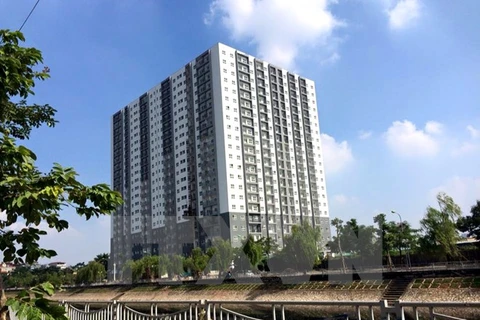
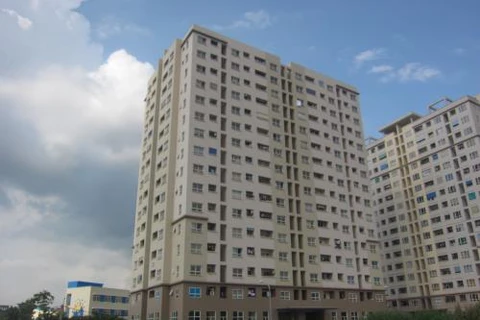
Social housing: Loan interest rate maintained at 5 percent ảnh 1The Dong Mo-Dai Kim social housing project in Hoang Mai district, Hanoi (Photo: VNA)

Hanoi (VNA) - TheState Bank of Vietnam (SBV) has decided to keep preferential loan interest rateunchanged at 5 percent for purchase, rent or hire of social housing projects in2018.

The decision took effectfrom the beginning of this year, replacing Decision No 2544/QĐ-NHNN, datedDecember 30, 2016, on interest rate for loans applicable in 2017 forsocial housing projects.

The interest rates willbe applied for house buyers who have already sought loans from the 30trillion VND (1.32 billion USD) housing stimulus package launched in 2013 asthe minimum repayment term is 15 years, and from the Vietnam Bank forSocial Policies (VBSP).

The 30 trillion VND housingstimulus package aimed primarily at social policy beneficiaries and estatedevelopers of such projects. Of which, 21 trillion VND, accounting for 70 percentof the package’s total has been given to home buyers of projects. The remaining30 percent has been provided to social housing projects’ investors.

Following three years ofimplementation, the housing stimulus package ended in 2016. 

In the middle of lastyear, the National Assembly Standing Committee submitted a proposal to add 2trillion VND to the Vietnam Bank for Social Policies (VBSP) formiddle-term public investment in the 2016-20 period. A part of the capitalwould be used for social housing projects.

Some 1.2 trillion VND ofthe investment has been disbursed, so far. However, both social housing projectdevelopers and low-income earners have found it hard to access the preferentialcredit.

Deputy Minister ofConstruction Le Quang Hung said the ministry proposed to the VBSP toquickly implement the lending this year.-VNA
VNA
See more

According to the Vietnam Coffee Cocoa Association (Vicofa), Vietnam exported nearly 1.7 million tonnes of coffee in the first eight months of 2026, earning more than 6 billion USD. (Photo: VNA)

Vietnamese coffee exports poised for strong finish toward year-end

According to the Vietnam Coffee Cocoa Association (Vicofa), Vietnam exported nearly 1.7 million tonnes of coffee in the first eight months, earning more than 6 billion USD. Export volume rose by over 10% year on year, while export value fell by 11.2% due to lower export prices.

Ciputra is one of the landmark projects representing the presence of Indonesian investment in Vietnam since the first wave of FDI. (Photo: bietthu-ciputra.vn)

Foreign capital seeks stronger foothold in Vietnam through M&A

Foreign investors carried out 1,815 capital contribution and share purchase transactions in Vietnam in the first seven months of 2026, with total capital exceeding 6.5 billion USD. While the number of transactions fell 8.4% year-on-year, their value rose 61.6%.

At the Vietnam- Myanmar Business Forum in Hanoi on September 6 (Photo: VNA)

Myanmar President pledges to facilitate Vietnamese investment

Myanmar calls for Vietnam's cooperation in digital infrastructure development, cybersecurity, digital transformation, public services, information technology, and digital payment systems, as well as in fostering an innovation-driven business environment.

Using AI to search and process legal information (Photo: VNA)

Legal profession reshaped in age of artificial intelligence

In Ho Chi Minh City, digital transformation in the legal profession is not simply about introducing more technology into professional practice. It must also create ways of working that ensure technology serves people, while lawyers retain control and responsibility for the quality of legal services. This is particularly important in a metropolis with a large-scale economy and diverse legal needs.

Activities in Chan May Bay, part of the Chan May–Lang Co Economic Zone in Hue city. (Photo: VNA)

Hue steps up investment drive in Chan May–Lang Co Economic Zone

Covering more than 27,000ha, the Chan May–Lang Co Economic Zone is emerging as a key economic, urban, industrial and eco-tourism centre in southeastern Hue, with functional areas dedicated to seaports, industry, non-tariff activities, urban development and tourism.

The Ministry of National Defence's inter-agency inspection team visits La Gi Fish Port in Phuoc Hoi ward, Lam Dong province. (Photo: VNA)

Lam Dong's IUU fishing prevention efforts inspected

According to the Lam Dong provincial IUU Fishing Prevention Steering Committee, all 8,177 fishing vessels measuring at least 6 metres in length have been registered and updated in the national fisheries database VNFishbase.

A member of Minh Quang Cooperative in Hung Yen province works on a farm. (Photo: VNA)

Vietnam aims to link half of farm cooperatives with enterprises by 2030

The Ministry of Agriculture and Environment will promote links between cooperatives, enterprises, science and technology organisations and other economic entities along with carrying out programmes to develop concentrated agricultural, forestry and fisheries raw material areas and enhance value chain production.

The night-time economy is increasingly seen as an important avenue for Vietnam’s tourism sector to extend visitors’ stays (Photo: VNA)

Revitalising growth momentum for night-time economy

The night-time economy has moved beyond being merely an add-on service to become a new growth driver for tourism. Night-time activities can “awaken” familiar heritage spaces and breathe new life into them. Art, light and music experiences after dark can create distinctive attractions while meeting the desire of middle- and high-end visitors to explore cultural depth.

A livestream session promotes green-skinned pomelos grown in Cho Lach commune, Vinh Long province. (Photo: VNA)

E-commerce reshapes rules of game

Once fixed fees, payment fees, infrastructure charges and service packages are included, sellers may have to spend around 24.5-27.6% of their revenue on platforms. The figure shows that the era of easy selling and low costs in e-commerce has officially come to an end.