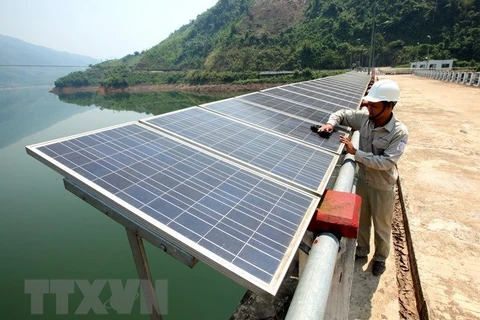
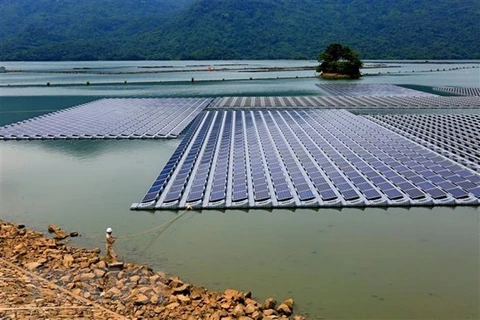
Solar panels of the Krong Pa solar power plant in Krong Pa district, Gia Lai province (Photo: VNA)
 Hanoi (VNS/VNA) – Vietnam’s solar power plants are facing a crisis in consumption of their electricity because there has not been synchronous development of power transmission infrastructure or a suitable operation mechanism.
The National Load Dispatch Centre under the Electricity of Vietnam (EVN) has just announced it is considering reducing the volume of electricity transmitted from all solar plants into the national grid to deal with overloaded transmission lines.
The move would force all solar power plants to reduce their production below capacity, causing significant damage to investors, said Nguyen Duc Cuong, Director of the centre.
The transmission line overloads are due to the rush with which investors moved to back solar projects, precluding synchronous planning and suitable renewable energy development policies, Cuong said.
Electric transmission systems in Ninh Thuan and Binh Thuan are overloaded because they were not designed to handle the large number of solar plants located in the two central provinces, he said.
The central region is not one of the biggest electricity consumers in the country. The power sources must be connected to 220 KV and 500 KV grids to transmit electricity to far-away places.
According to the amended National Power Development Master Plan VII (for 2011-30) that was approved in 2016, the country’s power production from all resources will reach a total capacity of 60,000 MW in 2020, 96,500 MW in 2025 and 129,500 MW in 2030, with an average growth rate of 6,000-7,000 MW per year. However, the proposed solar power capacity is just 850 MW in 2020, about 4,000 MW in 2025 and about 12,000 MW in 2030, reported Nguoi Lao Dong (The Labourer) newspaper.
[Challenges facing solar power development in Vietnam]
At present, Vietnam has 332 power plants in operation and under construction with a total estimated capacity of 26,900 MW. The country’s solar plants are mainly located in Binh Thuan and Ninh Thuan provinces in central Vietnam, Cuong said.
According to the centre, purchase negotiations are ongoing for 749.63 MW of solar power from plants in Binh Thuan and 1,732.82 MW from plants in Ninh Thuan.
The market has seen a wave of investment into solar power plants since the decision to set the purchase price of solar power at 9.35 US cents/KWh from April 2017.
Tran Viet Ngai, Chairman of the Vietnam Energy Association, said that because the country has already exploited nearly all of its hydropower resources, the development of renewable energy sources such as wind and solar power is essential.
While solar energy is widely available, Ngai said work must be done to use it effectively. Without well-planned investment schemes and operating mechanisms, solar power will merely destabilise the electrical system and could lead to grid collapses.
Solar power plants only work when the sun is shining and storage batteries are functioning properly. For large-scale projects, the system works for three to five hours; however, Ngai cautioned that advanced storage systems are very expensive.
Meanwhile, adding thousands of MW from solar power plants to the national grid requires suitable load dispatch plans in case the solar plants stop generating energy.
This is a complicated process because solar power plants, localities and the electricity sector must work together to build the dispatch plans, Ngai said.
The rapid development of solar and wind power plants has reduced the country’s reliance on power from resources that cause pollution.
However, Ngai said developing too many solar projects at the same time in certain places could lead to higher strain on the electrical grid, necessitating the construction of more transmission grids and transformer stations. Of course, these investment costs will be calculated into electricity prices.
Nguyen Duc Cuong said investment could not be executed too quickly because it takes a lot of time to plan projects, arrange investment capital and get investment licences.
To accelerate the construction of transmission lines, Minister of Industry and Trade Tran Tuan Anh has asked the Government to allow the use of capital from private investors to develop some transmission stations and grids for solar and wind power plants. After construction, the investors will hand the facilities over to the electricity industry to manage and operate them.-VNS/VNA
VNA