Southernmost province to resettle 5,600 households

More than 5,600 households in erosion-prone areas in the southernmost province of Ca Mau need to be relocated by 2020 but local authorities are struggling to find capital and land, according to the provincial People’s Committee.
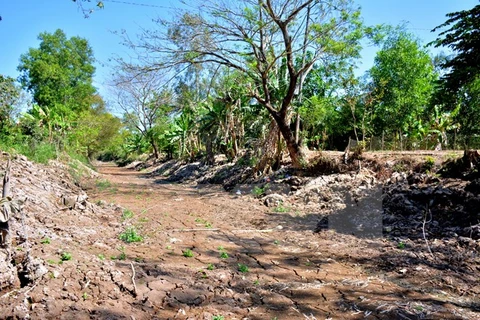
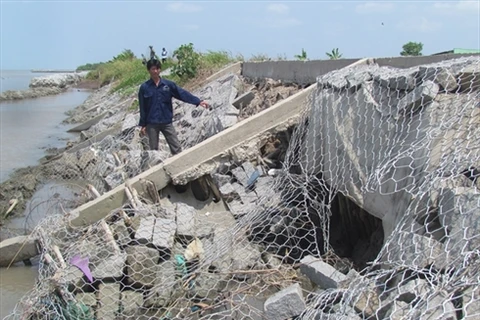
Southernmost province to resettle 5,600 households ảnh 1An erosion site in C​a Mau province’s U Minh district.(Photo: VNA)

Ca Mau (VNA) - More than 5,600 households in erosion-prone areas in the southernmost province of Ca Mau need to be relocated by 2020 but local authorities are struggling to find capital and land, according to the provincial People’s Committee.

The districts of U Minh, Tran Van Thoi, Dam Doi, Phu Tan, Nam Can and Ngoc Hien have a high number of households living in erosion-prone areas that need to be relocated.

In addition, several resettlement areas funded with the province’s budget have not been operating effectively as the resettled households have not been able to have a stable livelihood. Many of these resettled households have returned to live in the erosion-prone areas.

Du Be Ba, Chairman of the U Minh District People’s Committee, said the province should have policies that would provide a stable livelihood for resettled people in zoned areas.

U Minh district plans to call for investment in building a 5-7ha resettlement area in Khanh Tien commune’s Vam Tieu Dua area that will be worth nearly 100 billion VND (4.4 million USD). If this resettlement area is built by 2020, the district can resettle hundreds of households in coastal areas.

The district will create conditions for relocated households to stabilise their livelihoods by providing vocational training and jobs for them, Ba said.

Le Van Su, Vice Chairman of the provincial People’s Committee, said the province had paid attention to relocating households in areas affected by natural disasters but the relocation process was still slow and ineffective.  

The lack of investment capital and land are the major reasons for the slowness and ineffectiveness, Su said.

In addition, many relocated households are poor and do not have a stable job so it is difficult for them to ensure their livelihood in resettlement areas.

The provincial People’s Committee has ordered agencies and departments to resolve difficulties in existing resettlement areas. It told the district People’s Committees to review and classify poor households so that plans to support them can be drawn up. -VNA
VNA
See more

Quang Tri recently received two endangered pangolins from local resident. (Photo published by VNA)

Two pangolins handed over to authorities in Quang Tri

At around 8:30 pm on April 12, Le Thanh Tung, a resident of Thuong Nghia hamlet in Cam Lo commune, and his friend spotted the two pangolins, weighing over 4 kg, while working near the Cam Lo–La Son Expressway.

A view of Phong Nha - Ke Bang National Park in Da Nang city (Photo: VNA)

Phong Nha – Ke Bang: untapped biological treasure in Truong Son mountains

Unlike ecosystems where species inventories are largely complete, Phong Nha–Ke Bang National Park remains scientifically “open,” with each survey revealing new findings. Recent studies - from local research projects to international collaborations - have recorded additional bird species and identified the rare parasitic plant Sapria himalayana, which only survives in intact primary forests.

The interface of Vietnam Weather KTTV mobile application (Photo: baochinhphu,vn)

Application of dangerous weather warning introduced

All unusual weather events, from widespread thunderstorms, lightning strikes, landslides, flash floods, tropical depressions to strong winds at sea, are continuously updated from official data sources of the NCMHF and meteorological stations and prominently displayed on the main interface.

An overview of the kick-off meeting for the “Sustainable Management of Substances Controlled by the Montreal Protocol” project (Photo: VNA)

Vietnam launches 13 mln USD project to phase out ozone-depleting substances

Funded by the Multilateral Fund for the Implementation of the Montreal Protocol and implemented through the World Bank (WB) and the United Nations Environment Programme (UNEP), the project aims to help Vietnam meet its international commitments in managing and phasing out controlled substances. It will run from 2026 to 2031 with a total budget of over 13 million USD.

Tram Chim National Park and the Mekong Conservancy Foundation (MCF) organise the workshop on sustainable restoration of wetland ecosystems in the Mekong Delta on March 24. (Photo: VNA)

Solutions sought to restore Mekong Delta wetland ecosystems

Experts at the workshop described wetlands as the “ecological heart” of the Mekong Delta, playing a vital role in water storage and regulation, climate moderation, carbon sequestration, biodiversity conservation, and livelihoods for millions of people through aquaculture, agriculture, and ecotourism. These ecosystems also help reduce disaster risks and enhance climate resilience.

Deputy Minister of Agriculture and Environment Le Cong Thanh speaks at the ceremony to launch major environmental campaign. (Photo: VNA)

Vietnam calls for collective action on water, air, climate and sustainable future

Deputy Minister of Agriculture and Environment Le Cong Thanh underscored that water, climate, and energy are fundamental pillars of sustainable development. In Vietnam, water resources and weather patterns influence every aspect of life, from food and water security to livelihoods, ecosystem stability, and economic growth.