State-owned blue chips not right for covered warrants

Securities companies participating in the new covered warrant market may find it less attractive to trade covered warrants of large-cap State-owned companies due to their low free-floating ratios.
State-owned blue chips not right for covered warrants ảnh 1A Phu Nhuận Jewellery store in District 1, HCM City. The company is among the six stocks being traded on the covered warrant market. (Photo: pnj.com.vn)

Hanoi (VNS/VNA) - Securities companies participating in the newcovered warrant market may find it less attractive to trade covered warrants oflarge-cap State-owned companies due to their low free-floating ratios.

Covered warrants are a new investment tool that allows holders to buy or sell aspecific amount of equities, currency or other financial instruments, usuallyto or from a bank or similar financial institution, at a specified price andtime. The underlying assets could also be stocks, commodities or indices. Theyoffer lower investment costs and higher leverage ability than conventionalfinancial products, and are expected to help investors limit losses and makehigher profits.

A firm's free float ratio is the percentage of outstanding shares that areavailable for trading on the stock market. The higher a company's free-floatratio is, the more attractive the shares are to investors and the lessvulnerable they are to price manipulation, tinnhanhchungkhoan.vn reported.

In addition, securities companies are accountable for hedging risks whenissuing covered warrants for the selected companies’ stocks. Therefore, anystock with a high free-float ratio and large number of shareholders will have amore attractive and safer covered warrant.

Large-cap State-owned companies are becoming less attractive to investorsbecause of their low free float ratios.

Having a large portion of shares owned by the State makes companies vulnerableto big deals, so they have a large impact on the stock market. Minorityshareholders are rarely able to influence the way a company is run, limitingthe quality of corporate governance and efficiency and making their shares lesssuitable to be traded on the covered warrant market.

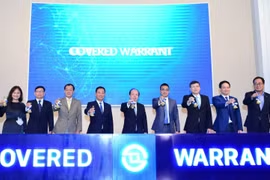
The new covered warrant market was launched on June 28. Sixteen coveredwarrants of six listed stocks, including dairy producer Vinamilk (VNM), PhuNuan Jewellery JSC (PNJ), steel producer Hoa Phat (HPG), Military Bank (MBB),retailer Mobile World (MWG) and tech group FPT (FPT), are being traded on thenew market.

Those private equity firms may not have the biggest volumes of listed shares orthe biggest market values but they have very high ratios of free-float shares,which makes it easier for investors to trade their shares and covered warrants.FPT has a free float ratio of 78.97 percent. The numbers for PNJ, WMG and MBBare 78.14 percent, 62.81 percent and 57.17 percent, respectively.

At the moment, 26 of the 30 largest stocks by market capitalisation and tradingliquidity in the VN30 basket are eligible for covered warrant trading.

Those 20 other firms meet the guidelines but have not yet had their coveredwarrants issued by securities firms. If the first covered warrants aresuccessful, the other 20 will likely be issued soon.

To be traded on the covered warrant market, a stock must be a large-cap in theVN30 basket, have a high daily average trading volume and a minimum free floatratio of 20 percent.

The four other blue chips – Vietcombank (VCB), Vietinbank (CTG), brewer Sabeco(SAB) and PetroVietnam Gas (GAS) – are not yet available because theirfree-float ratios are below 10 percent.

The State, through the Vietnam National Oil and Gas Group (PVN or PetroVietnam)is the major shareholder in PV Gas, holding a 95.76 percent stake. Majorshareholders in Vietcombank, Vietinbank and Sabeco own at least 90 percent ofeach company.

But after the VN30 basket review by the Ho Chi Minh Stock Exchange takes effecton August 8, the number of large-cap firms’ stocks available for coveredwarrant trading will be reduced to 24.

The bourse last week announced that Bank for Investment and Development ofVietnam (BID) and insurance group Bao Viet (BVH) will be added to the VN30basket to replace DHG Pharmaceutical JSC (DHG) and HCM City InfrastructureInvestment JSC (CII).

But BID and BVH will not be eligible for covered warrant trading for the samereason as Vietcombank, Vietinbank, Sabeco and PV Gas.

The State Bank of Vietnam is the biggest shareholder in BIDV, holding a 95.28 percentstake, while the Ministry of Finance and the Japanese group Sumitomo Life hold89.5 percent of Bao Viet. – VNS/VNA
VNA


See more

Vietnam exports about 1.4 million tonnes of coffee worth 6.54 billion USD in the first nine months of 2026. (Photo: VNA)

Vietnam seeks to boost value, expand markets for coffee sector

Acording to VICOFA, Vietnam needs to focus on exporting green coffee beans that meet EUDR criteria, particularly as compliance levels among some other producing countries remain low. At the same time, it should develop specialty and organic coffee lines as well as deeply processed products to serve the premium segment in Europe.

Part of Khanh Hoa province in central Vietnam (Photo: VNA)

Malaysian economist upbeat about Vietnam’s growth outlook

Among ASEAN’s “Fabulous Five”, namely Vietnam, Malaysia, Indonesia, Thailand and the Philippines, Vietnam demonstrates how industrial depth and effective investment can underpin rapid growth, Shan Saeed said, noting strong investment momentum.

Automobile production at the Honda Vietnam factory in Vinh Phuc ward, Phu Tho (Photo: VNA)

Vietnam’s auto market accelerates amid growing electrification trend

According to data released by PwC in late September, total vehicle sales across the six ASEAN-6 markets, namely Vietnam, Indonesia, Thailand, Malaysia, the Philippines and Singapore, reached about 1.755 million units in the first half of 2026, up 11% year on year. Vietnam recorded the highest sales growth in the group at 31.1%, followed by Indonesia at 15.9% and Thailand at 15.1%.

The headquarters of the Vietnam International Financial Centre in Da Nang (Photo: VNA))

VIFC-DN gradually establishes position on global financial centre map

According to Dang Dinh Duc, Standing Vice Chairman of the VIFC-DN Executive Agency, the ranking marks an important milestone, reflecting the foundations that VIFC-DN and Da Nang authorities are gradually building to connect with international capital flows, institutions and markets.

Quy Nhon Port, located in Quy Nhon Bay of Gia Lai province, offers highly favourable conditions for vessel anchoring and cargo handling throughout the year. (Photo: VNA)

Vietnam Logistics Forum 2026 to be held in early November

The Vietnam Logistics Forum 2026 will take place on November 6-7 in Gia Lai province, bringing together management agencies, local authorities, associations, experts and businesses to identify opportunities and challenges and discuss logistics development solutions suited to the new period.

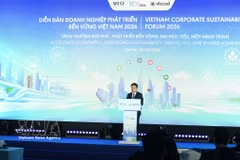
VCCI Chairman Ho Sy Hung speaks at the Vietnam Corporate Sustainability Forum (VCSF) 2026 in Hanoi on October 5, 2026. (Photo: VNA)

Vietnam’s corporate sustainability forum calls for new growth paradigm

Breakthrough growth and sustainable development should be pursued as a shared journey in which the State creates an enabling environment, localities support businesses, enterprises take the pioneering role, science and technology provide momentum, and society as a whole participates.

Khanh Hoa province is rolling out infrastructure projects for the Van Phong Economic Zone. (Photo: VNA)

Khanh Hoa targets green, smart marine economy

The province aims for average annual GRDP growth of 11-12% during 2026-2030, with the digital economy accounting for 35% of GRDP and total factor productivity contributing more than 55% to growth. Labour productivity is expected to rise by an average of 11% annually.

Comb honey produced using Le Loc Quan’s interlocking-frame technique is well regarded for its quality and popular in the Korean market (Photo: VNA)

Scientific initiatives add value to Vietnamese farm produce

In 2026, the Vietnam Farmers’ Union (VFU) Central Committee honoured 42 “Scientists for Farmers” and presented 24 “Farmers’ technical innovation” awards for initiatives developed from practical production needs. The recognised works demonstrate the growing role of science and technology in improving production efficiency, increasing the value of farm produce and helping farmers access new markets.

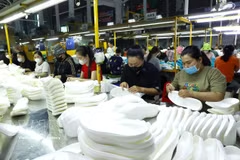
Shoe sole production at Kepai Co., Ltd. (a Japanese-invested enterprise) in Tan Kim Industrial Park (Tay Ninh) (Photo: VNA)

Tay Ninh expands industrial space to attract investment

To date, Tay Ninh has 3,234 domestic investment projects with total registered capital of nearly 800 trillion VND and 2,152 FDI projects with total registered capital exceeding 27 billion USD, ranking seventh nationwide in FDI attraction.