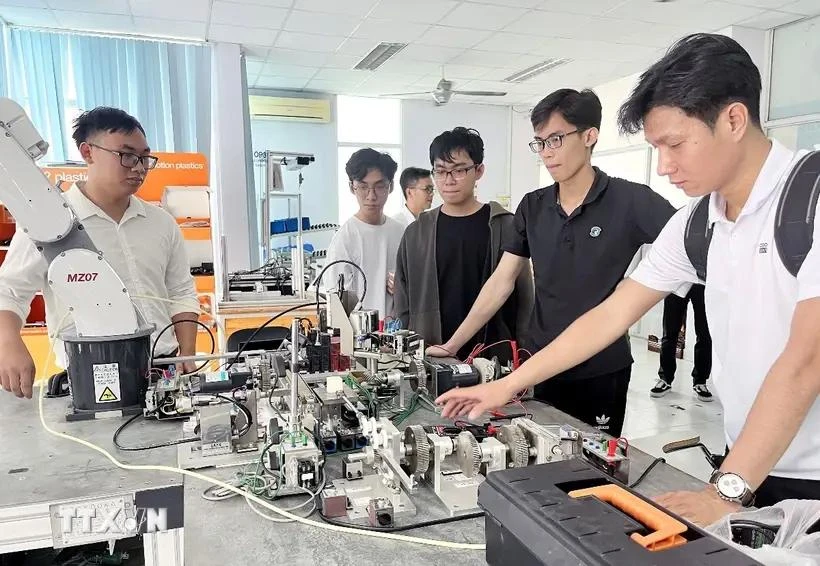
Hanoi (VNA) – Prime Minister Pham Minh Chinh has signed a decision issuing the strategy for developing Vietnam’s semiconductor industry by 2030, with a vision to 2050.
The strategy outlines a roadmap for developing the industry according to the formula of C = SET + 1 (C stands for Chip, S for Specialised, E for Electronics, T for Talent, and + 1 for Vietnam, which will strive to become a new and safe destination of the global semiconductor supply chain).
The country plans to develop the industry in three phases.
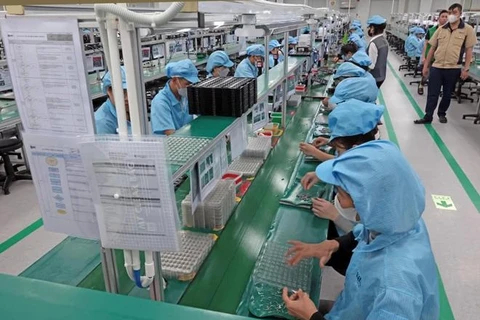
In the first from 2024 - 2030, it will make use of geopolitical and workforce advantages, selectively attract foreign direct investment (FDI), establish itself as one of the global semiconductor manpower centres, and grow fundamental capacity in all steps, from research, design, and manufacturing to packaging and testing.
In the second from 2030 - 2040, Vietnam will work to become a global semiconductor and electronics centre while developing the semiconductor and electronics industries that combine both self-reliance and FDI.
For the third phase from 2040 - 2050, it looks to become one of the world’s leaders in the semiconductor and electronics industries, and master research and development (R&D) in these fields.
Identifying concrete targets for each period, in Phase 1, the country will selectively attract FDI; form at least 100 design companies, one small-scaled manufacturing factory, and 10 packaging and testing plants; and develop some specialised semiconductor products for several sectors.
The semiconductor industry is hoped to secure annual revenue of more than 25 billion USD and an added value growth rate of 10 - 15%. Meanwhile, the electronics industry targets over 225 billion USD in annual revenue and also 10 - 15% in added value growth.
The semiconductor workforce will include more than 50,000 engineers and graduates, with an appropriate structure and number, to meet development demand during 2024 - 2030.
In Phase 2, Vietnam will develop a semiconductor industry combining both self-reliance and FDI, with at least 200 design companies, two manufacturing factories, and 15 packaging and testing plants, and gradually ensure self-sufficiency of design and production technologies for specialised semiconductor products.
It targets respective annual revenues of over 50 billion USD and 485 billion USD for the semiconductor and electronics industries, which are expected to record an added value growth rate of 15 - 20%.
Meanwhile, more than 100,000 semiconductor engineers and graduates will be available during 2030 - 2040.
In Phase 3, there will be at least 300 design companies, three manufacturing factories, and 20 packaging and testing plants. The country is also set to master semiconductor R&D.
The semiconductor and electronics industries are expected to post respective annual revenues of more than 100 billion USD and 1.045 trillion USD, as well as a growth rate of 20 - 25% in added value.
At that time, the semiconductor workforce will feature an appropriate structure and number meeting development demand.
Besides, Vietnam will complete a self-reliant semiconductor industry ecosystem taking the lead in some steps and segments of the production chain during 2040 - 2050, according to the strategy.
To that end, five major tasks with detailed implementation measures are also specified in this strategy./.
See more
SCIC to divest all stakes in 66 companies
Under the plan, 21 companies have been identified as investments that SCIC will continue to hold for the next five years.
Vietnam, RoK discuss technology transfer, investment cooperation
Businesses from the Republic of Korea (RoK) paid particular attention to Vietnam’s 2025 Law on Science, Technology and Innovation, which for the first time recognises technology as an asset that can be contributed as capital.
Hyundai Thanh Cong expands global footprint with exports to Mexico, Australia
From 2030, Hyundai Thanh Cong targets becoming a global export hub for Hyundai Motor, with annual volume surpassing 60,000 units.
Dung Quat EZ, Quang Ngai IPs draw nearly 19.4 bln USD
The Dung Quat Economic Zone and Quang Ngai industrial parks have so far attracted 441 projects worth around 19.4 billion USD, according to the Dung Quat Economic Zone and Quang Ngai Industrial Parks Authority (DEZA).
Hue courts capital to turn industrial zones into growth engine
The economic and industrial zones in Hue city host more than 200 active investment projects worth over 152 trillion VND (5.84 billion USD), with 139 already operational. Since the start of 2026, they have generated about 32 trillion VND, contributed 4.2 trillion VND to the state budget and brought in 730 million USD in exports, while employing more than 46,000 workers.
Chinese auto investment tests Vietnam’s industrial ambitions
Chinese carmakers are putting new pressure on prices and technology while testing Vietnam’s ability to retain more value.
Authorities join corporate bond oversight under new framework
Under the Government's Decree No. 200 on corporate bonds, provincial and municipal People's Committees are now specifically assigned responsibilities for managing and supervising bond issuers operating within their jurisdictions.
Vietnam’s exports to New Zealand post strong growth
According to the Customs Department, two-way trade reached 844 million USD in the first half of 2026, of which Vietnam’s exports to New Zealand totaled 399.7 million USD, up 18.8% year-on-year, while imports stood at 444 million USD.
Investing in logistics to boost agricultural production and exports
Logistics is increasingly becoming a major bottleneck for exports as transport costs rise and requirements for data management, low emissions and supply chain transparency become more stringent, requiring coordinated investment in logistics infrastructure, data infrastructure and transport capacity.
Reference exchange rate down 5 VND on August 14
The State Bank of Vietnam set the daily reference exchange rate at 25,561 VND/USD on August 14, down 5 VND from the previous day.
Vietnam seen as gateway for Canadian farm produce to ASEAN
As Canada steps up trade diversification and seeks to reduce its dependence on the North American market, Vietnam could serve both as a market for Canadian goods and a base for Canadian businesses to build production capacity and expand operations in the region.
Vietnam – strategic growth pillar among ASEAN’s ‘Fabulous Five’: expert
Thanks to its strengths in manufacturing momentum, human capital, and income convergence, Vietnam is not just joining; it is helping shape ASEAN’s next growth cycle.
Turkish cooperatives open sourcing channel for Vietnamese businesses
The Vietnam Trade Office recommended that Vietnamese businesses in agriculture and food actively study cooperative networks in different localities in Türkiye and consider them an additional channel for accessing raw materials, processing partners, and distribution networks.
VPI, Beicip-Franlab Asia deepen oil, gas cooperation
Under the MoU, VPI and Beicip-Franlab Asia will undertake advanced studies in geology, geophysics, and reservoir engineering to support exploration, field development, and oil and gas resource assessment.
Lam Dong steps up tourism cooperation with Indian partners
According to the provincial Department of Culture, Sports and Tourism, Lam Dong welcomed around 9,000 Indian visitors in 2025 and another 6,000 in the first six months of 2026.
Vietnam pushes coffee, farm produce at Hong Kong food expo
After nearly 200 years, especially since the Doi Moi (renewal) began in 1986, Vietnamese coffee is now exported to more than 100 countries and territories and supports about 2.6 million jobs. Vietnam remains the world’s second largest coffee exporter, holding roughly 19-21% of the global market, and is the top producer of Robusta coffee.
Da Nang hosts 2026 International Logistics Forum
Co-hosted by the Ministry of Industry and Trade and the Da Nang People’s Committee, the forum put modern logistics, strategic infrastructure, digital transformation, green growth and international connectivity at the centre of discussions.
Monetary policy must ensure macro stability, support growth: PM
The SBV was required to keep policy interest rates steady and add liquidity so lenders can access cheaper funding. It must manage the exchange rate in line with market developments, coordinate monetary tools, and intervene to stabilise the foreign exchange market, while maintaining close oversight of gold. Lenders must continue cutting costs, stabilising lending rates, and delivering substantive reductions.
Petrol prices cut from 15:00 on August 13
The price of E5 RON92 petrol is capped at 21,235 VND (0.81 USD) per litre, down 493 VND, while E10 RON95-III is priced at no more than 22,119 VND per litre, down 205 VND.
Int'l sports exhibitions, export trade fair open in Ho Chi Minh City
A series of events opened at the Saigon Exhibition and Convention Centre (SECC) in Ho Chi Minh City on August 13, including the Vietnam Sport Show 2026, Vietnam Cycle Expo 2026 and the 14th Zhejiang Export (Vietnam) Fair 2026. They feature 520 booths operated by 400 businesses from 15 countries and territories.