AEF 2026 calls for action to unlock growth potential
Discussions focused on connecting capital and technology with the capacity to implement development initiatives.
Discussions focused on connecting capital and technology with the capacity to implement development initiatives.
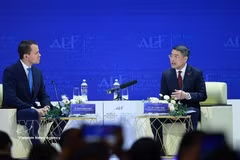
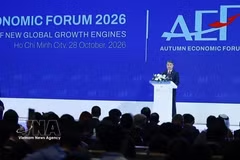
The Autumn Economic Forum (AEF) 2026 provides a platform for connecting economies into value chains and shaping long-term development strategies, Chairman of the Ho Chi Minh City People’s Committee Nguyen Van Duoc said at its closing session.
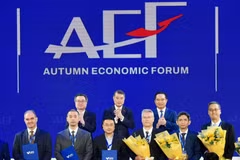
The Ho Chi Minh City People’s Committee announced the first 10 members of the Vietnam International Financial Centre in Ho Chi Minh City on October 28, in the presence of Prime Minister Le Minh Hung, as part of the Autumn Economic Forum 2026.

With Vietnam-China trade reaching USD 256.4 billion in 2025 and the two economies having complementary strengths, the two countries' businesses have ample opportunities to become more deeply involved in regional and global production networks.
The State Bank of Vietnam was asked to coordinate with the centre’s executive body to finalise guidance on applications, procedures and licensing conditions, with the aim of admitting an official member bank in November 2026.

Vietnam has built an impressive growth model, becoming a major manufacturing hub, an investment destination and an increasingly interconnected economy. It now needs to move beyond simply building connections and become a smartly connected economy.
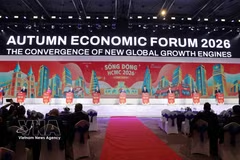
Over three working days, more than 20 in-depth sessions and dozens of technology showcases produced concrete results, showing cooperation moves beyond vision into substantive links and action. The sessions generated strategic insights and recast thinking on new growth forces, core drivers and breakthrough cooperation models as the global economy shifts deeply.
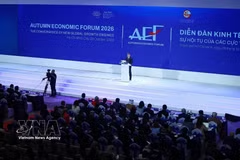
Global investment in new digital projects has nearly tripled since 2020, while the digital economy has recorded annual growth of 10–12% for several years, significantly outpacing global GDP growth, she said, adding that industrial digitalisation and cross-border digital services are also expanding rapidly.
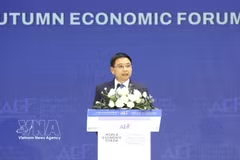
Thang stressed that Vietnam could not remain a passive recipient or an outside observer. Instead, it must build its own capacity and actively define its role in global production networks. The goal is not simply to join existing or emerging value chains, but to create the conditions, mechanisms and capabilities for Vietnam and its international partners to participate more directly in value creation.
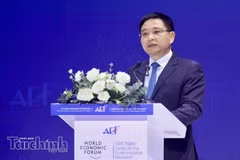
For Vietnam, the urgent requirement now is not only to connect and bring the economy into existing or emerging value chains but, more importantly, to create the environment, mechanisms and capacity so that Vietnam and international partners could plug more deeply and directly into the process of creating and building value in the new value chains, said Deputy Prime Minister Nguyen Van Thang.

Ho Chi Minh City hopes the WEF will continue promoting this message among the global investment community. It also expects the WEF’s Annual Meeting in Davos, Summer Davos in China and Autumn Forum in Vietnam to form a more comprehensive and in-depth ecosystem.
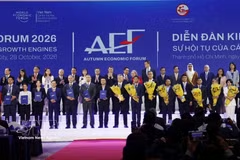
Ho Chi Minh City announced 12 projects granted investment policy approval or investment registration certificates on October 28, with total investment exceeding 337.22 trillion VND (about 13.58 billion USD), at the Autumn Economic Forum 2026.
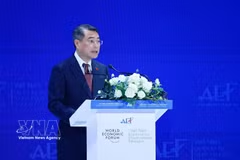
Vietnam wants international partners not merely to “invest in Vietnam”, but to “invest with Vietnam”; not merely to “manufacture in Vietnam”, but also to engage in research and development (R&D), promote innovation and create new value chains competitive at both regional and global levels.

Bui Ba Nghiem, senior expert at the Ministry of Industry and Trade’s Import-Export Department, outlined five priorities, including improving institutions and coordination, promoting multimodal transport, applying digital technologies to emissions management, supporting SMEs in the green transition, and piloting measurable green logistics models.

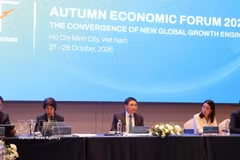
At a panel discussion on policy frameworks for the digital economy, held as part of the Autumn Economic Forum 2026 on October 27, speakers said ASEAN needed to ensure national systems could work together while protecting data and facilitating business, rather than impose uniform rules across the region.

ASEAN is becoming increasingly attractive thanks to its market of more than 680 million people, rapid urbanisation and growing demand for electrification and digital infrastructure.
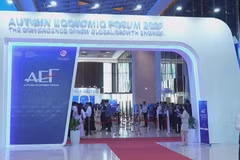
The 18th Asia-Pacific Roundtable on Sustainable Consumption and Production and the Vietnam-India Future Technology Forum, held in Ho Chi Minh City on October 26 as part of the Autumn Economic Forum 2026, highlighted efforts to turn scientific research and bilateral technology agreements into practical solutions, advancing digital and green transformation and sustainable development.
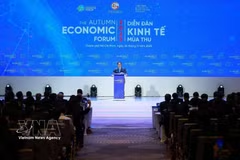
On October 27, the forum will host 16 thematic sessions across three parallel venues, focusing on AI – quantum, finance – digital economy – autonomy, and manufacturing – sustainability – next generation. Two sessions will be jointly organised with the WEF, addressing “Repositioning Vietnam and ASEAN in Global Value Chains” and “From AI Deployment to Future Manufacturing Workforce Readiness”.