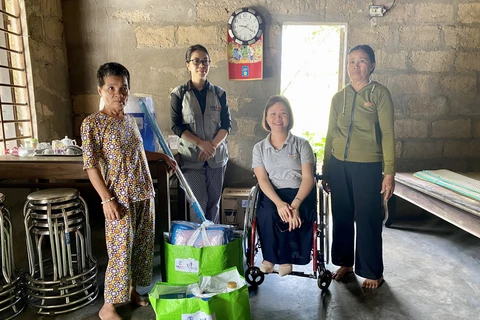
People with visual impairment learn digital skills during a course in Hanoi supported by UNDP and the Japanese Government. (Photo courtesy of UNDP)
 Hanoi (VNS/VNA) - Twenty-two people with visual impairments are attending a digital business training and coaching course for four months in Hanoi to help them adapt to the fourth industrial revolution and co-exist with COVID-19.
The trainees are mostly selling products online or working to become sale co-ordinators of brands.
Despite losing their eyesight, they believe they can take advantage of digital entrepreneurship opportunities and technology empowerment to have stable jobs during the turbulence of the pandemic.
Luong Thi Hai Yen, a visually-impaired trainee, said blind people like her, with voice assistance and support from others, can use computers to learn digital business knowledge and skills to approach customers and how to advertise products.
Like many other blind people, Yen’s main job used to be at a massage parlour in Hanoi.
More than 100 massage parlours and other service venues which provided jobs for visually-impaired people in the capital city were closed as non-essential services during the COVID-19 social distancing period earlier this year.
Being among millions of people with disabilities nationwide who lost their jobs due to the COVID-19 pandemic, with consultation from others, Yen decided to learn marketing skills and sell perfume online.
She acts as a sale co-ordinator who advertises products, orders the perfume and has it delivered to customers and can earn a stable source of income during the pandemic.
“For visually-impaired people, selling products online has some difficulties. For example, we cannot advertise products through images. Instead of doing that, we livestream, write descriptions to make advertisements or directly consult customers,” she said.
“The disabled have limited ability to move around. Thanks to technology, we are connected with the outside world so that we know how the world is developing and what chances, including job opportunities, are available for us,” she told Vietnam News.
Tran Trung Hieu, Chairman of the Vocational Training Centre of the Hanoi Blind Association, said those with visual impairment and the disabled in general are among the hardest hit by the pandemic.
According to the United Nations Development Programme (UNDP)’s Rapid Assessment on Socio-Economic Impacts of COVID-19 which interviewed more than 900 people with disabilities in Vietnam in May, 30 percent lost their jobs during COVID-19. Neatly half had their work hours reduced, and almost 60 percent had their pay cut.
Up to 72 percent of the interviewees had an income of less than 1 million VND (44 USD) in March when the first wave of the pandemic peaked in Vietnam.
“Not only facing challenges during the COVID-19, but people with disabilities also have difficulties in the fourth industrial revolution. They have little access to information technology,” Hieu said.
With the support of the UNDP and Japanese government, the four-month course will provide digital skills training for people with different disabilities to adapt for digitalisation after COVID-19.
Many of the trainees have already started to run their businesses or practise online marketing skills.
“We [the disabled] have been present on the internet and are ready to engage in the supply chain,” Hieu said.
Dao Thu Huong, UNDP Vietnam’s disability rights officer, said working online from home helps people with disabilities cut travel costs and minimise travel difficulties caused by traffic. While working at home, they can get personal assistance when needed, face less discrimination and be better protected from psychological pain.
Nguyen Hanh Thu, a disabled English teacher in Hanoi, believed that with tools like computers or tablets, people with disabilities can do their jobs, earn incomes and reduce the pressure on their families.
Thu suffers from spinal cord injuries and has been in a wheelchair for 30 years. Over the past 30 years, she has been running free English classes for poor students, those in disadvantaged circumstances and people with disabilities like her.
Due to the impacts of COVID-19, she has made use of the internet to offer online classes to her students.
“I always encourage my disabled children to learn English and information technology skills and then use digital technology to earn money. That’s how technology works for the disabled,” she said./.
The trainees are mostly selling products online or working to become sale co-ordinators of brands.
Despite losing their eyesight, they believe they can take advantage of digital entrepreneurship opportunities and technology empowerment to have stable jobs during the turbulence of the pandemic.
Luong Thi Hai Yen, a visually-impaired trainee, said blind people like her, with voice assistance and support from others, can use computers to learn digital business knowledge and skills to approach customers and how to advertise products.
Like many other blind people, Yen’s main job used to be at a massage parlour in Hanoi.
More than 100 massage parlours and other service venues which provided jobs for visually-impaired people in the capital city were closed as non-essential services during the COVID-19 social distancing period earlier this year.
Being among millions of people with disabilities nationwide who lost their jobs due to the COVID-19 pandemic, with consultation from others, Yen decided to learn marketing skills and sell perfume online.
She acts as a sale co-ordinator who advertises products, orders the perfume and has it delivered to customers and can earn a stable source of income during the pandemic.
“For visually-impaired people, selling products online has some difficulties. For example, we cannot advertise products through images. Instead of doing that, we livestream, write descriptions to make advertisements or directly consult customers,” she said.
“The disabled have limited ability to move around. Thanks to technology, we are connected with the outside world so that we know how the world is developing and what chances, including job opportunities, are available for us,” she told Vietnam News.
Tran Trung Hieu, Chairman of the Vocational Training Centre of the Hanoi Blind Association, said those with visual impairment and the disabled in general are among the hardest hit by the pandemic.
According to the United Nations Development Programme (UNDP)’s Rapid Assessment on Socio-Economic Impacts of COVID-19 which interviewed more than 900 people with disabilities in Vietnam in May, 30 percent lost their jobs during COVID-19. Neatly half had their work hours reduced, and almost 60 percent had their pay cut.
Up to 72 percent of the interviewees had an income of less than 1 million VND (44 USD) in March when the first wave of the pandemic peaked in Vietnam.
“Not only facing challenges during the COVID-19, but people with disabilities also have difficulties in the fourth industrial revolution. They have little access to information technology,” Hieu said.
With the support of the UNDP and Japanese government, the four-month course will provide digital skills training for people with different disabilities to adapt for digitalisation after COVID-19.
Many of the trainees have already started to run their businesses or practise online marketing skills.
“We [the disabled] have been present on the internet and are ready to engage in the supply chain,” Hieu said.
Dao Thu Huong, UNDP Vietnam’s disability rights officer, said working online from home helps people with disabilities cut travel costs and minimise travel difficulties caused by traffic. While working at home, they can get personal assistance when needed, face less discrimination and be better protected from psychological pain.
Nguyen Hanh Thu, a disabled English teacher in Hanoi, believed that with tools like computers or tablets, people with disabilities can do their jobs, earn incomes and reduce the pressure on their families.
Thu suffers from spinal cord injuries and has been in a wheelchair for 30 years. Over the past 30 years, she has been running free English classes for poor students, those in disadvantaged circumstances and people with disabilities like her.
Due to the impacts of COVID-19, she has made use of the internet to offer online classes to her students.
“I always encourage my disabled children to learn English and information technology skills and then use digital technology to earn money. That’s how technology works for the disabled,” she said./.
VNA