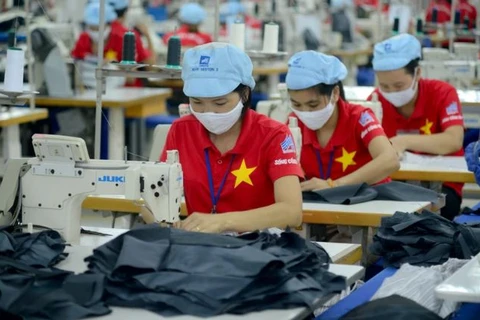
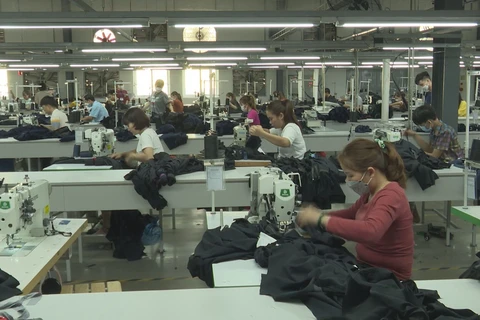
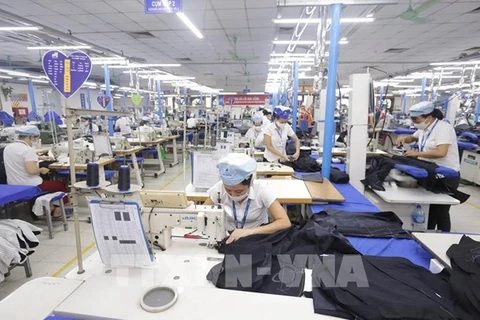
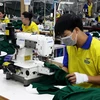
Clothing items made from coffee grounds. Fashion products nowadays must not only cater to the needs of customers to dress well, but also be close to nature, protect the environment and be safe to users’ health. (Photo: courtesy of Faslink)
 Fashion Link JSC (Faslink), a pioneer in supplying green materials to the fashion industry since 2008, constantly researches to come up with a variety of sustainable materials for the fashion industry, including yarns made from bamboo, lotus, seashell, coconut, mint, and coffee grounds.
Faslink CEO Tran Hoang Phu Xuan said the company has partnered with Singtex, one of the leading providers of eco-friendly functional textiles in Taiwan (China), to produce yarns and fabrics from coffee grounds.
Faslink is the first company in the world to commercialise shirts made from coffee yarns and sells them in the domestic market.
She said this high-tech yarn, made from used plastic bottles and coffee grounds, is environmentally friendly, deodorising, fast drying, and UV-resistant and has many different applications.
Xuan added that more than 40 fashion brands in the domestic market have used this sustainable material to produce millions of products.
Her company has a project in collaboration with Singtex to collect coffee grounds in Vietnam, she said, pointing out that since Vietnam is the world’s second largest coffee exporter it could supply a huge amount of this raw material.
Nguyen Thi Tuyet Mai, General Secretary of the Vietnam Textile and Apparel Association, said: “Green transformation in the garment and textile industry is mandatory to catch up with commitments under new generation FTAs.
“Vietnam's textile industry has embarked on a transformation since 2018 with the ‘Greening Vietnam’s Textile Sector’ programme. In this … journey, many businesses, including Faslink, have researched and launched environment-friendly fabrics made from lotus, mint, pineapple, and, especially, coffee grounds."
Huge potential market
Xuan cited a recent report by Coherent Market Insights as saying the global sustainable fashion market was worth 7.8 billion USD in 2023 and is projected to reach 33.05 billion USD by 2030, a compounded annual growth rate of 22.9%.
Sustainable fashion encompasses various practices aimed at reducing environmental and social impacts, such as excessive water consumption, pollution, unethical labour practices, and the production of vast amounts of waste.
Rising consumer awareness of environmental sustainability and social responsibility has caused a surge in demand for sustainable fashion alternatives.
Simultaneously, stringent governmental regulations mandating sustainable practices further foster market expansion, according to the report.
While many countries around the world have gone a long way in sustainable fashion, it is still in its infancy in Vietnam, according to experts.
Traditional clothing production is resource-intensive and contributes to pollution and greenhouse gas emissions. Sustainable fashion brands focus on minimising these impacts by using eco-friendly materials, reducing waste and adopting responsible manufacturing practices, they said.
Pham Chi Nhu, CEO of Coolmate, a Vietnamese menswear brand, said: “Sustainable fashion is an inevitable trend. The new generation of consumers, especially Gen Z ones, not only pays attention to design and material when choosing a fashion item but also cares a lot about the product’s story, especially its sustainability aspect.”
He said coffee fabric has the advantages of cooling, quick drying, UV protection, and odor control. It is suitable for making men's clothing and is widely accepted among eco-conscious consumers.
But the prices of sustainable clothing products are admittedly relatively high, making them less accessible to the masses, he said.
He added that coffee grounds fibre is mainly used to make fabrics for formal clothing and not sportswear, reducing customers’ choices.
Mai said: “This is the time for businesses to go green and make the digital transformation. Fashion products nowadays must not only cater to the needs of customers to dress well, but also be close to nature, protect the environment and be safe to users’ health.”
To enable businesses to overcome cost barriers and promote sustainable fashion, she said policymakers need to consider tax incentives for firms involved in collecting and producing recycled and environment-friendly products./.
VNA