More than 220 migratory and water bird species, including nine in the IUCN Red List, have been recorded in the Xuan Thuy National Park, part of the Red River Delta World Biosphere Reserve.
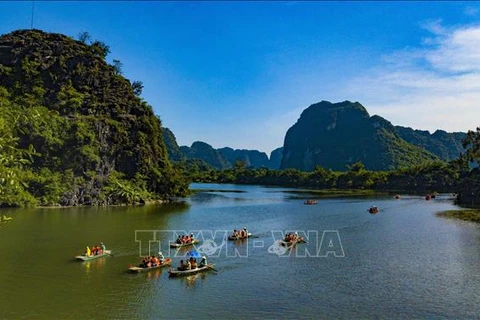
 Hanoi (VNA) – The Hong (Red) River Delta World Biosphere Reserve is considered a potential ecotourism destination. There, visitors can explore the magnificence of nature and experience the special culture of rivermouth areas.
The home of wild, rare birds
The Red River Delta Biosphere Reserve consists of the northern part, which is the coastal area of the Red River mouth (commonly called the Ba Lat Estuary), and the southern one - the coastal area of the Day River mouth (also called the Day Estuary). It was recognised as a world biosphere reserve on December 2, 2004.
Stretching over 105,000 hectares, the reserve covers southern areas of Vietnam’s northern coastal region that are located in the mouths of the Day, Red, and Thai Binh rivers, in Ninh Binh, Nam Dinh, and Thai Binh provinces.
Its two core zones are the Xuan Thuy National Park and the Tien Hai Wetland Nature Reserve. They are surrounded by a buffer zone, a transition zone, and a corridor zone.
 Part of Con Vanh Islet in the Red River Delta Biosphere Reserve (Photo: Vietnam Pictorial)
 The reserve holds great significance to biodiversity conservation in Southeast Asia, especially the protection of wild and rare bird species. It was recognised by UNESCO as the habitat of a large number of rare water and migratory birds and a typical rivermouth wetland ecosystem in the north of Vietnam.
In particular, it is also the first biosphere reserve in Southeast Asia to apply the co-management model among three provinces in a large coastal area from Thai Thuy district of Thai Binh to Kim Son district of Ninh Binh.
This place habours about 200 bird species, including nearly 60 migratory species and more than 50 water species. Many of them have been named in the IUCN Red List such as the black-faced spoonbill (Platalea minor), Saunders's gull (Larus saundersi), spoon-billed sandpiper (Tringa orchropus), and Swinhoe's egret (Egretta eulophotes).
Given this, the Xuan Thuy National Park was recognised as a Ramsar site - a wetland site designated to be of international importance under the Ramsar Convention - in 1989. It is also the first Ramsar site in Southeast Asia.
The Red River Delta Biosphere Reserve boasts thousands-of-hectares of mangrove forests, wetlands, alluvial grounds, and river mouths, providing the habitat for about 500 aquatic animal and plant species.
It is also highly important to natural disaster response and climate change adaptation and acts as a “safety shield” for the sea dyke system, helping to protect residents in coastal areas of Thai Binh, Ninh Binh, and Nam Dinh.
Potential for ecotourism development
Thanks to its rich biodiversity, the reserve holds considerable potential for ecotourism and countryside tourism.
To experience the wild nature there, from the Xuan Thuy National Park, visitors can sail along the Vop River to reach the Ba Lat Estuary or visit the lighthouse on the coast of Tien Hai district (Thai Binh province) and the islets of Con Ngan, Con Lu, and Con Xanh.
 Con Vanh Islet is home to a rich mangrove forest ecosystem (Photo: Vietnam Pictorial)
 There, visitors can learn about the life of rare migratory bird species and enjoy beautiful landscapes of mangrove forests.
If they are lucky, tourists will have a chance to see migratory birds seeking food on rivers and living harmony with humans in shrimp farms. Walking through natural forests and setting foot in shrimp farms, they can both watch wild birds and aquacultural practices of locals.
Coming to fishing villages in the reserve, travellers can also see local residents making nets or producing fish sauce, explore the busy life of fishermen of the Giao Hai fishery wharf (Nam Dinh province), and visit the Giao Hai fish market.
Conserving and sustainably developing the Red River Delta Biosphere Reserve is an important goal receiving special attention from local communities, scientists, the Vietnamese Government, and international organisations.
The provinces of Nam Dinh, Thai Binh, and Ninh Binh look to enhance their joint management over the reserve so as to concurrently protect biodiversity, maintain sustainable livelihoods, and adapt to climate change.
Developing an environmentally friendly economy, especially green and low-carbon economic models, is considered a good and feasible measure for the Red River Delta Biosphere Reserve, helping the conservation and promotion of a world biosphere reserve’s values achieve long-term and sustainable effectiveness./.