Three central localities see wildlife violation reduction

At least 86 percent of advertisements for illegal wildlife products in hotels, restaurants, bars, pet shops and herbal medicine shops in Thua Thien-Hue, Da Nang and Quang Nam were removed by local authorities in 2019 and 2020.
Three central localities see wildlife violation reduction ảnh 1An expert from Da Nang-based Douc Langur Foundation and local rangers release an Asian water monitor to nature after being rescued from captivity. (Photo courtesy of Douc Langur Foundation)
Hanoi (VNS/VNA) - At least 86 percent ofadvertisements for illegal wildlife products in hotels, restaurants, bars, petshops and herbal medicine shops in Thua Thien-Hue, Da Nang and Quang Nam were removed by local authorities in 2019 and 2020.

A survey from the Education for Nature Vietnam (ENV) was recently released froma wildlife violation reduction campaign that took place at 1,369 sites in thethree localities in 2019 and 2020.

ENV said Da Nang had the highest rate with 94 percent of violationcases successfully dealt with, while Thua Thien-Hue and Quang Nam followed with88 percent and 77 percent, respectively.

It said 81 restaurants and herbal medicine shops out of 1,369 sites had madewildlife-related violations, 5.9 percent, lower than the figures in Hanoi (11 percent)and Ho Chi Minh City (8 percent).

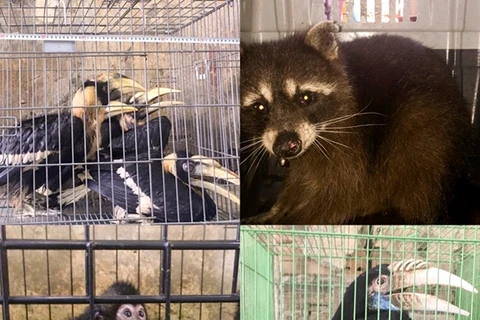
Wildlife-related crimes agencies in the three central localities hadeffectively punished and seized wildlife products in 23 of total 38 violationcases, saving 27 living animals from restaurants and pet shops.

ENV also said wildlife-related crime agencies had received 51 calls from localresidents on wildlife violations in the localities in 2019 and 2020 and 49cases were then arrested or destroyed, saving living animals in 22 of 38 cases.

The successful prevention of wildlife violations in the region resulted fromthe efforts of wildlife-related crime agencies during the two-year campaign.

Da Nang was the first city in central Vietnam to launch the campaign ‘Say No towildlife consumption’.

Da Nang'slocation and traffic connections make it a hub of wildlife trafficking routesfrom the Central Highlands region to northern provinces.

Thua Thien-Hue, Da Nang and Quang Nam are the richest biodiversity sites in Vietnamwith two conservation centres of saola – the Vu Quang ox, spindlehorn, or Asianbicorn, the saola – one of the world’s rarest large mammals found only in theTruong Son Mountain Range of Vietnam and Laos.

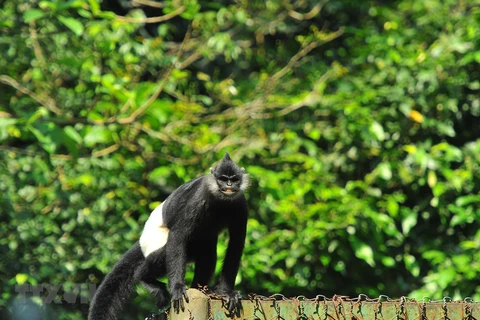
The region is home to the national parks Bach Ma in Thua Thien Hue and Song Thanhin Quang Nam province, while Da Nang has Son Tra and Ba Na-Nui Chua reserves with thelargest population of the endangered red-shanked douc langur in Vietnam. /.
VNA
See more

At a ceremony to donate 100,000 trees to the Naval Region 4 (Photo: HANE)

Tree planting programme spreads green momentum in islands

The Ho Chi Minh City Association for Conservation of Nature and Environment (HANE) on January 11 announced 10 outstanding green programmes and activities carried out in 2025, including a programme to plant 1 million trees in Vietnam’s island areas.

Lam Dong releases hundreds of wild animals into the wild. (Photo: VNA)

Lam Dong releases hundreds of wild animals back into the wild

According to the Ta Dung National Park Management Board, the park has for years served as a trusted destination for authorities and residents to hand over and release wildlife. Such actions not only contribute to biodiversity conservation but also help reduce illegal hunting and captivity of wild animals.

According to the Hanoi Department of Agriculture and Environment, air quality index (AQI) readings have at times reached poor and very poor levels. (Photo: VNA)

Hanoi targets 20% reduction in PM2.5 levels

Hanoi has affirmed its commitment not to trade environmental protection for economic growth. The city is moving to establish low-emission zones (LEZs) as a core measure to control emissions and promote green, sustainable urban development.

A waste collection area. (Photo: VNA)

Ca Mau approves investment policy for waste-to-energy plant

The waste-to-energy plant is planned for construction in Dat Moi commune, covering a total area of about 20 hectares. It will have a waste treatment capacity of approximately 600 tonnes of household waste per day and a power generation capacity of 6MW.

Ice coats the summit of Fansipan in the northern province of Lao Cai in the early morning of December 25. (Photo: Published by VNA)

Peak Fansipan blanketed in ice on Christmas Day

With temperatures hovering between 1 and 3 degrees Celsius, frost and ice covered the summit area, creating an ideal condition for tourists eager to admire icy scenery, clouds and experience a Christmas atmosphere amid a sea of cold mist.