Tien Giang’s coastal area manages to cope with drought

The coastal area of Go Cong Dong, a major agricultural hub in the Mekong Delta province of Tien Giang, has taken effective measures against drought and saltwater intrusion into rivers this year.
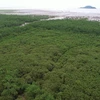
Tien Giang’s coastal area manages to cope with drought ảnh 1The coastal area of Go Cong Dong, a major agricultural hub in Tien Giang province, has taken effective measures against drought and saltwater intrusion into rivers this year. (Source: VNA)

Tien Giang (VNA) - The coastal area of GoCong Dong, a major agricultural hub in the Mekong Delta province of Tien Giang,has taken effective measures against drought and saltwater intrusion intorivers this year.

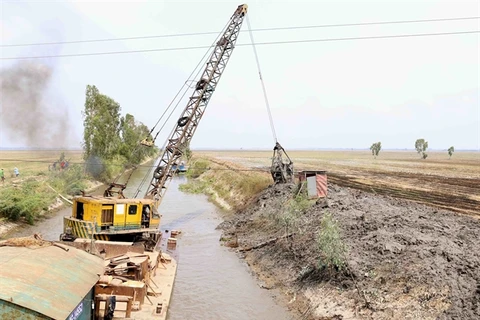
Ung Hong Nghi, Deputy Director of the provincialDepartment of Agriculture and Rural Development, said to cope with seawaterintrusion in Go Cong Dong, the province had built dams and sluice gates to keepout saltwater and keep in freshwater during the early part of the dry seasonthis year.

The province had also set up cropping schedulesfor the 2018-2019 winter – spring crop to mitigate the damage caused bydrought, he said.   

Rice fields in areas near the coast or lackingwater for irrigation had switched to drought - and saltwater- resistant cropsfor winter – spring, he added.

Nguyen Van Quy, head of Go Cong Dong district's Divisionof Agriculture and Rural Development, said farmers in the district had a bumperharvest in the winter – spring rice crop with an average yield of 6.9 tonnesper hectare.

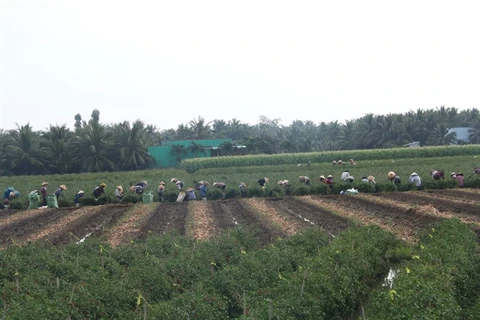
The district’s farmers also planted more than5,000ha of other crops such as water melon, squash and gourds, earning highincomes, he said.

Nguyen Van Ga, Director of the Kieng PhuocGlobal GAP Dragon Fruit Co-operative in Go Cong Dong district’s Kieng Phuoc commune,said dragon fruits had been cultivated in recent years and it grew well in thedistrict’s coastal areas.

Farmers earned 500-600 million VND (21,530-25,840USD) per hectare of the fruit annually, he said.

Go Cong Dong farmers had turned nearly 130ha oflow-yield rice fields into dragon fruit orchards and export the fruit, he said.

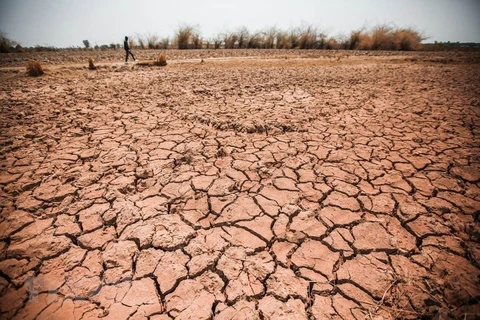
Go Cong Dong often suffers from severe droughtand saltwater intrusion in the dry season, affecting rice, vegetable and fruitproduction.

Under the province’s plan to restructureagriculture in the coastal areas of Go Cong Dong from now through 2025, threerice crops will not be grown and, instead, one to two rice crops will berotated with other crops. 

This is aimed at helping Go Cong Dong cope withdrought and saltwater, improving farmers’ incomes and developing agriculturesustainably.

Go Cong Dong has around 30,000ha under rice andan annual output of nearly 500,000 tonnes of paddy.

In 2016 it faced severe drought and saltwaterintrusion, which destroyed more than 5,000ha of rice and thousands of hectaresof vegetables and fruits, according to the provincial Department of Agricultureand Rural Development.-VNA
VNA

See more

A stump-tailed macaque (Macaca arctoides) is handed over to the Cam Lo–Dong Ha forest ranger station in Quang Tri province on January 27, 2026 (Photo: VNA)

Rare primate handed over to Phong Nha - Ke Bang National Park

A stump-tailed macaque (Macaca arctoides) was handed over to the Centre for Rescue, Conservation, and Development of Creatures under the Management Board of Phong Nha - Ke Bang National Park in Quang Tri province on July 21, for rehabilitation and eventual release into the wild.

Two Red Lories (Eos rubra) found among the 104 wild animals being kept without documentation proving their lawful origin in Phuoc Thanh commune, Tay Ninh province. (Photo published by VNA)

Criminal proceedings launched against case of illegal keeping, trading of 104 wild animals

They recorded a total of 104 wild animals, comprising 92 African spurred tortoises (Geochelone sulcata) of various sizes, six Red Lories (Eos rubra) and six Green-cheeked Parakeets (Pyrrhura molinae). Authorities said the animals are subject to management under Vietnam's forestry legal regulations and are listed in Appendix II of the Convention on International Trade in Endangered Species of Wild Fauna and Flora (CITES).

BUYO Bioplastics' biodegradable plastic products are made from brewer's grains and sugarcane bagasse. (Photo: nhandan.vn)

Vietnam urged to shift from plastic waste treatment to full life-cycle management

For years, efforts to tackle plastic pollution in Vietnam have focused mainly on waste collection, recycling and disposal. However, as sustainable development and green trade standards become increasingly important, specialists argued that a broader approach is needed, covering everything from product design and material selection to production, consumption and recycling.

Bang Mo volcano in Lam Dong province (Photo published by VNA)

Lam Dong optimises value of UNESCO Dak Nong Global Geopark

Alongside conservation, Lam Dong aims to tap the geopark's tourism potential through geological, ecological and community-based tourism. Infrastructure and tourism development projects must ensure that heritage values, landscapes and the natural environment are preserved.

Dr. Dang Trung Phuoc (left) is introducing the history and origin of the Pinhey sand dunes (Photo: VNA)

Vietnamese Canadian scientist revives forgotten ecosystems

From restoring an ancient sand dune ecosystem in Canada to promoting the conservation of Vietnam's coastal dunes, native forests and ecological corridors, Vietnamese-born scientist Dang Trung Phuoc has remained committed to using science to revive ecosystems long misunderstood or neglected. His quiet but sustained efforts reflect both a scientist's responsibility to the communities he serves and the enduring commitment of a Vietnamese expatriate to his homeland.

Police and military forces work together to rescue people and assist local residents in affected areas. (Photo: VNA)

PM orders proactive response to heavy rainfall in northern mountainous region

To minimise casualties and damage to public and private property, the PM instructed ministries, sectors and local authorities to strictly implement directions issued by Party General Secretary and State President To Lam, as well as the Government's directives on strengthening disaster prevention and response in 2026.

A view of the Ea So Nature Reserve in Dak Lak province (Photo: VNA)

Rare wild animals released into natural habitat in Dak Lak

Among them are two species classified under Group IB of Vietnam's protected wildlife list, namely the Bengal slow loris (Nycticebus bengalensis) and the Sunda pangolin (Manis javanica). Both are endangered forest species protected under Vietnamese law and are prohibited from commercial exploitation or use.

A large-timber plantation model in Gia Lai province (Photo: VNA)

96-million-USD project promotes agroforestry to cut emissions

The Reduction of Emissions in the Central Highlands and South Central Coast of Vietnam (RECAF) project will run from 2026 to 2031 across the provinces of Dak Lak, Gia Lai, Lam Dong, and Khanh Hoa covering about 145,000ha, according to the International Fund for Agricultural Development (IFAD).

Crested goshawks are handed over by the People's Committee of Dong Le commune, Quang Tri province. (Photo: VNA)

Quang Tri rescues six rare wild animals

The animals are now receiving quarantine, treatment and specialised care. Once recovering their physical condition and wild behaviour, they will be reassessed for release back into the wild.

The Ministry of Industry and Trade has reported initial signs that the fuel is helping reduce emissions and protect the environment. (Photo: VNA)

E10 biofuel shows initial environmental benefits: Ministry

An official said the initial results indicate the nationwide rollout has begun to achieve its intended objectives, but more comprehensive monitoring over a longer period, with a wider observation network and more frequent measurement, is needed for a precise and objective assessment.

Forest development in Phan Son commune, Lam Dong province. (Photo: nhandan.vn)

Vietnam lays groundwork for transparent carbon market

Experts say the launch of the trading platform is only the first step. The long-term success of the market will depend on a transparent system backed by robust measurement, reporting and verification (MRV) standards to ensure every transaction reflects genuine emissions reductions.