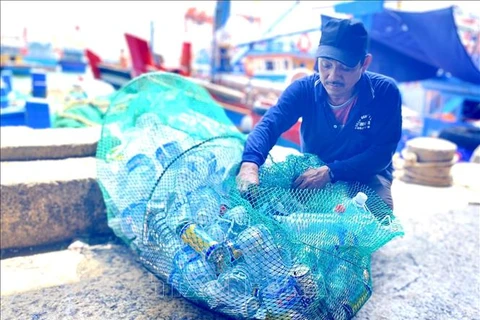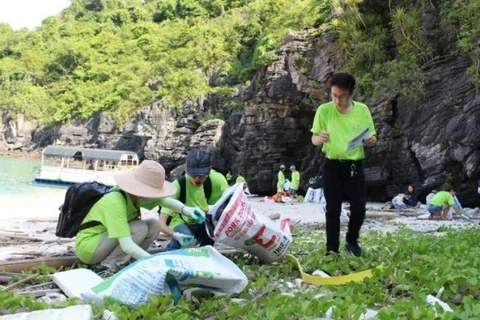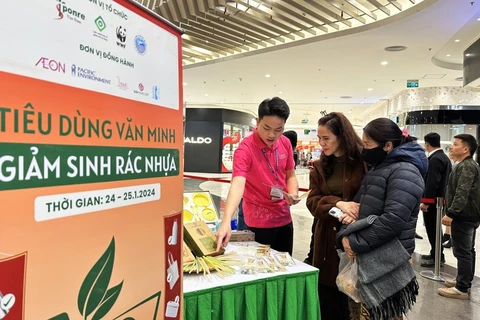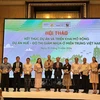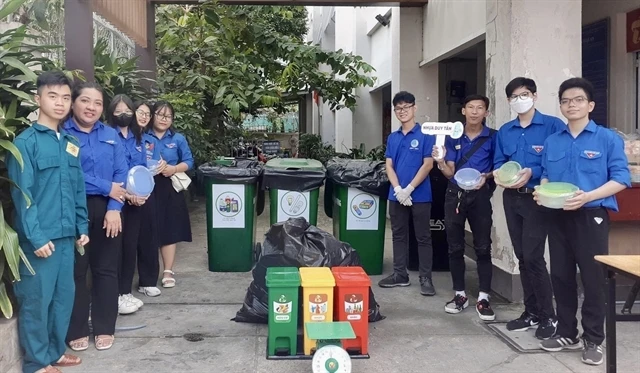
HCM City (VNS/VNA) - In order to address the growing issue of pollution, Ho Chi Minh City has been launching various joint dissemination campaigns and activities with businesses to encourage its dwellers to reduce the use of single-use or non-degradable plastic bags, and collect and recycle plastic waste.
Nguyen Thi Thanh My, Deputy Director of the municipal Department of Natural Resources and Environment, said the problem of plastic pollution has become a tough challenge for Vietnam, and asked for collaboration between the State and businesses to solve it.
The city has introduced a project to promote a circular economy for plastic waste in Can Gio district, sponsored by Coca-Cola Fund and operated by GreenHub; and a project to collect used plastic packaging in District 7 in co-operation with Unilever Vietnam, she said.
GreenHub, an NGO supporting green development, reported that after two years of carrying out the above project in Can Gio district, positive signs have been seen regarding establishing a recycling value chain in the district that promotes a cleaner and greener environment for local residents.
Accordingly, five scrap yards experienced an increase in their income after receiving project support to improve their facilities. 51 female scrap collectors received occupational safety training and were provided with work tools to enhance their performance. The project raised awareness about plastic waste collection, classification and recycling, and responsible tourism for 2,000 tourists.
It also provided information on plastic waste collection and classification to more than 76,500 individuals.
Unilever Vietnam has always pioneered and committed to environmental protection, working closely with agencies and other organisations to solve environmental-related problems.
Besides the current project in District 7, it has worked with Central Retail Vietnam on waste sorting at source to help form a meaningful habit in the community.
At the national level, the Ministry of Natural Resources and Environment has collaborated with Nestlé Vietnam to launch a project to neutralise plastic waste by 2025 that focuses on raising public awareness and promoting responsible plastic waste management practices.
The Ministry has also collaborated with Unilever Vietnam and other partners on the scheme ‘Public-Private Partnership Programme for Building a Circular Economy in Plastic Waste Management’.
The scheme welcomes the participation of 27 businesses specialising in waste gathering and recycling along with educational institutes sharing the same vision and mission on plastic waste management.
These groups have actively contributed to implementing the national action plan for ocean plastic waste management by 2030.
Environmental experts say businesses always play a critical role in reducing plastic waste and facilitating activities for environmental protection.
They not only observe environmental laws but also actively implement various innovative measures to optimise input material used to help decrease emissions.
Confirming its willingness to cooperate with the Natural Resources and Environment Ministry in adopting feasible solutions for reducing plastic waste, Nestlé Vietnam has already switched from plastic to paper straws for its drink cartons.
Only just 2021 and 2022, the company was able to cut down its plastic usage by approximately 2,400 tonnes.
More than 90% of its product packaging is designed for recycling.
Similarly, Coca-Cola Vietnam has officially announced its ambitious sustainable packaging goals to collect and recycle the equivalent of every bottle/can sold globally, and use at least 50% of recycled materials in packaging by 2030.
The Environmental Protection Law identifies the business community as a vital factor in environmental protection.
Effectively implementing environmental protection measures not only turns these enterprises into socially responsible businesses (SRBs) but also enhances their competitiveness, facilitates international market entry, and ensures sustainable development.
The Ministry highly appreciates the collaboration of businesses, particularly in the private sector, in partnering with the government to share the responsibility of addressing waste issues specifically and environmental protection in general.
Assoc Prof Dr Nguyen Hong Quan, head of the Institute of Circular Economy Research and Development under Vietnam National University-HCM City, said the participation of businesses and international organisations in plastic waste management, and environment matters in general, brings several practical benefits.
Thanks to their financial and technological advantages, along with their high level of responsibility, plastic waste gathering and treatment will be achievable goals.
However, the Government should introduce policies and mechanisms to incentivise plastic waste recycling, develop markets for recycled products, and provide tax breaks and preferential loans.
Statistics from the Ministry of Natural Resources and Environment show that the country generates over 1.8 million tonnes of plastic waste annually, with HCM City alone producing around 80 tonnes per year.
The amount of non-biodegradable plastic bags is increasing non-stop each year, leading to such a heavy burden to the environment that people consider it ‘white pollution’.
This pollution will negatively affect human beings’ physical health.
Under the city’s plan to strengthen the management of plastic waste reduction and recycling and reuse for the 2022-25 period, the city People’s Committee chairman Phan Van Mai is directing relevant state units to intensify propaganda activities about the harmful effects of single-use plastic products and non-biodegradable plastic packaging on marine ecosystems, the environment, and human health.
He asked them to control and limit plastic waste from the source; organise the classification, collection, reuse, recycling, and treatment of plastic waste; promote international co-operation, scientific research and application, and technology transfer; and encourage organisations and individuals with the qualifications to carry out plastic waste collection, reuse, and recycling activities in the city.
He also asked the city’s Department of Natural Resources and Environment to provide preferential loans in accordance with regulations from the city's environmental protection fund for individuals, organisations, and businesses that collect, transport, recycle, and treat plastic waste; and produce environmentally friendly products awarded the Vietnam Green Label by the Ministry of Natural Resources and Environment in the city./.