Tra fish nets impressive export growth

Tra fish exports recorded impressive growth in the first 10 months of 2022, with turnover eclipsing the 2.2 billion USD mark.
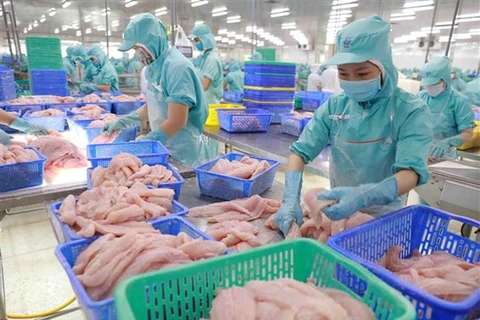
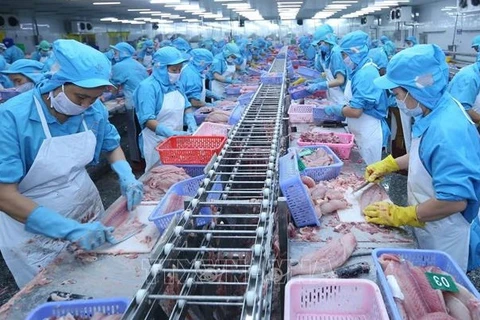
Tra fish nets impressive export growth ảnh 1Tra fish processing for export (Photo: VNA)

Hanoi (VNA) - Tra fish exports recorded impressive growth in the first 10 months of 2022, with turnover eclipsing the 2.2 billion USD mark.

The yearly export turnover is forecast to top 2.5 billion USD, up 58% compared to that of the same period last year.

According to businesses, in 2022, global inflation and the Russia-Ukraine conflict have sharply increased the export of affordable white fish products such as tra fish. The import value of tra fish products from Vietnam have increased by 40-200% this year.

At present, the two biggest importers of Vietnamese tra fish are China and the US, accounting for 30% and 23% of the Southeast Asian country’s total export volume, respectively. In the January-October period, the value of tra fish exports to China reported a year-on-year rise of 110% to 647 million USD.

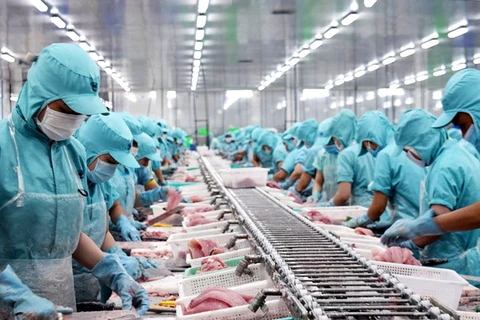
Tra fish nets impressive export growth ảnh 2Tra fish processing for export (Photo: VNA)

Those two members of the Comprehensive and Progressive Agreement for Trans-Pacific Partnership (CPTPP) and several Asian, North, and South American markets such as Australia, Singapore, Malaysia, Canada, and Chile also recorded impressive growth. Notably, the export to Canada posted a fourfold increase compared to that of the same period last year.

At present, Vietnam has over 400 businesses engaged in the export of tra fish, most of them have reported growth over the same period last year, mainly thanks to increases in export prices.

Tra fish exporters are advised to continue their negotiations to expand their markets, and take advantage of opportunities brought about by free trade agreements (FTAs) to boost exports and promote brand./.
VNA

See more

Tran Ngoc Quan, Trade Counsellor and head of the Vietnam Trade Office in Belgium and the EU (Photo: VNA)

Belgian firms suggested to expand presence in Vietnamese market

Entering 2026 – the first year of implementing the Vietnam – EU Comprehensive Strategic Partnership, the Vietnam Trade Office in Belgium and the EU views this as a pivotal time to inject new momentum into trade ties, said Trade Counsellor Tran Ngoc Quan.

Saigon Marina IFC, an emerging landmark, reflects Ho Chi Minh City’s pioneering spirit.

Saigon Marina IFC – The light of Ho Chi Minh City’s new icon

Saigon Marina IFC, an emerging landmark, reflects Ho Chi Minh City’s pioneering spirit. Designed to become an International Financial Centre, this new architectural icon along the Saigon River is envisioned not only as a premium commercial complex, but as a central platform supporting financial institutions, international investors and cross-border capital flows in the years ahead.

Shoppers at a supermarket in Hung Yen (Photo: VNA)

Retailers see tax compliance, AI as key to survival in 2026 survey

The annual survey, conducted at the end of 2025 among retail and food and beverage (F&B) sellers nationwide, found that businesses are shifting their focus from rapid growth to operational efficiency, cost control and legal compliance amid increasingly stringent regulatory standards.

Visitors shop at Glorious Spring Fair 2026 (Photo: VNA)

Spring Fair 2026 opens broader prospects for Vietnam–UAE trade cooperation

For Vietnam, the UAE serves not only as a consumer market but also as a gateway to the Middle East and North Africa. Vietnamese agricultural products such as cashew nuts, pepper, cinnamon and rice have steadily gained market share, while aquatic products, including tra fish and tuna, are increasingly present in the UAE’s hospitality sector.

Bao Viet Bank's employee counts Vietnamese banknotes at a transaction counter in Hanoi. (Photo: VNA)

Credit quota reform, tighter capital rules may widen gap among banks

Yuanta Vietnam Securities estimates that to achieve GDP growth above 10%, credit growth would need to exceed 16%. This suggests bank credit is no longer expected to be the main growth driver, with greater reliance on fiscal policy, public investment and capital markets.