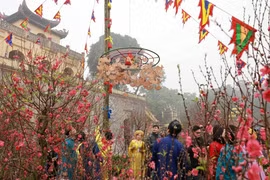
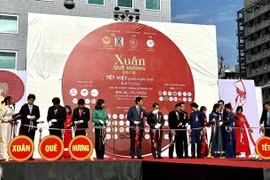
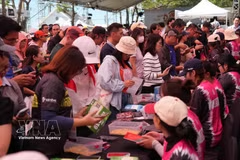
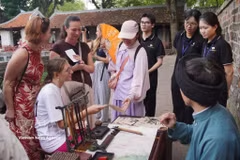
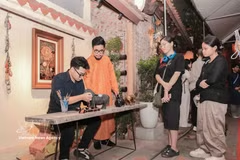
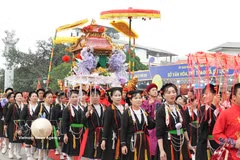
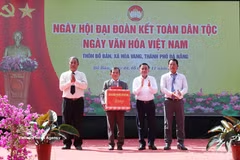
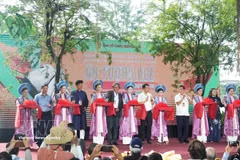
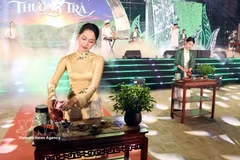
As Tet approaches, the festive atmosphere covers every corner of Vietnam. (Photo: VNA)
Hanoi (VNA) - As Tet approaches, the festive atmosphere covers every corner of Vietnam. Each ethnic group has its own way of celebrating in terms of timing, rituals, customs and cuisine, creating a colourful panorama in the tapestry of national Tet celebrations.
Vietnam is home to 54 ethnic groups, each with its own Tet customs, rituals, and attire. But all share common aspirations for a prosperous and happy New Year with favourable weather, bumper crops, and many fortunate encounters.
The Tet celebration often includes a series of special rituals and activities taking place during the transition from the old year to the new according to the traditional calendar of each ethnic group.
New Year colours
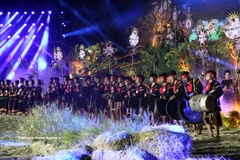
For the Thai group, in addition to traditional rituals celebrating the New Year and commemorating ancestors, drums and gongs play an indispensable role during the festive days.
In Nghia Lo, the northern mountainous province of Yen Bai, each Thai hamlet possesses a set of gongs and drums displayed at a public place. On New Year’s Eve, the sound of drums and gongs resound throughout hamlets to welcome the spring. During the festival, locals visit their relatives and friends to extend their New Year wishes during the daytime, and gather in the evening for folk games, singing and playing gongs.
For the Ha Nhi people, their traditional New Year is called Ho Su Cha, the most important festival in the year.
Artisan Po Dan Xinh from Ta Ko Khu hamlet, Sin Thau commue, Muong Nhe district, the northern mountainous province of Dien Bien, said Ho Su Cha is celebrated before Tet Nguyen Dan (the Lunar New Year), usually around December when the farming work is done. During the festival, the Ha Nhi people cheer bumper crops and pray for good luck.
The Ha Nhi people’s New Year festival begins early in the morning. Local women make "banh troi" (a cake made of bits of brown sugar wrapped in glutinous rice paste and cooked by scalding in boiling water) as an offering to Gods, asking for their permission to slaughter pigs to celebrate the festival. It is the tradition of the Ha Nhi people to slaughter pigs and use their livers to determine auspicious and inauspicious events for the upcoming year.
After that, the host takes a small portion from each part of the pig's body to make porridge and offers it to ancestors and Gods, praying for bumper crops, strong livestock, and good luck. Subsequently, family members gather to enjoy the New Year, then they visit and extend greetings to their relatives and other residents.
As night falls, amidst the sounds of gongs and drums, locals come together, holding hands and dancing around the fire until late at night. The New Year celebration of the Ha Nhi people spans three days.
Diverse forms of New Year celebration
Dr. Tran Huu Son, Director of the Institute for Research on the Application of Vietnamese Folk Arts, said ethnic minorities in Vietnam celebrate Tet in three specific time frames, following their traditional calendars.
The Lunar New Year is celebrated by such groups as Muong, Tho, Chut, Mang, Khang, Xinh Mun and Kho Mu in the northwestern region; O Du in the central province of Nghe An; Tay, Thai, Nung, San Chay, Cao Lan-San Chi, Giay, Lu, Bo Y, La Chi, La Ha, Co Lao, Pu Peo, Dao, Pa Then and Mong in the northeastern region; and the Hoa, Ngai, San Diu, Phu La and Ha Nhi in the northern mountainous province of Lao Cai. These groups maintain their own traditional customs, but the time to celebrate Tet is consistent with that of the Kinh people.
Some celebrate the traditional New Year according to their own calendars, including Mong in the northwestern and north-central regions with Nao Po Trau; Ha Nhi Hoa in Lai Chau and Dien Bien with Ho Su Cha; Cong in Dien Bien with Uy La Long; La Hu in Lai Chau with Kho Xo; Si La in Lai Chau and Dien Bien with O Xi Gia; Cham with Rija Nugar; and southern Khmer people with Bon Chol Chnam Thmay.
Meanwhile, others in Truong Son and Central Highlands like Ede, Ba Na, Xo Dang, Co Ho, Hre, Mnong, Raglai, Xtieng, Co Tu, Gie Trieng, Ma, Co, Cho Ro, Chu Ru, Brau, and Ro Mam celebrate the New Year from January to March each year in the lunar calendar.
Son said most indigenous ethnic groups follow an agricultural calendar. They consider the time after the dry season, when the first raindrops accompanied by the first thunder signal the upcoming rainy season (the cultivation season, usually around the end of February or early March in the lunar calendar), the beginning of the New Year.
In addition to the three aforementioned unique New Year celebration forms, some ethnic minority groups, such as Ta Oi and Bru-Van Kieu, used to celebrate Tet during the dry season like those in the Central Highlands. However, in recent decades, they have shifted to celebrating both Tet Nguyen Dan and their own Tet.
The New Year celebration is a series of unique rituals and cultural activities that take place at the transition between the old year and the new according to the calendar of each ethnic group. It is a set of distinctive cultural activities that reflect the diversity of ethnic cultures, manifested in the timing, spatial organisation, as well as customs, traditions, cuisine, clothing, and more. Additionally, Tet is always associated with spiritual and cultural aspects, integral components that cannot be overlooked./.