Training for rural workers of limited value: report

Thousands of billion of dong invested in vocational training for residents of northern mountainous provinces have produced little effectiveness.
Training for rural workers of limited value: report ảnh 1

An ethnic-minority woman learns how to weave brocade fabric in central Nghe An province (Source: VNA)

Hanoi (VNA) - Thousands of billion of dong invested in vocational training for residents of northern mountainous provinces have produced little effectiveness, according to the General Department of Vocational Training.

It is estimated that about 1.5 trillion VND (67.1 million USD) in State budget funds and about 1.3 million USD in development assistance have been used to help rural labourers raise their income and improve their living standards through vocational training. The department estimates that about 140,000 people in the northern provinces participate in vocational training courses each year, reported Tin tuc (News) newspaper.

However, only a small part of the graduates were recruited as short-term labourers in local firms, the department said.

According to experts, many vocational training courses do not take into account the demands of the labour market and that is one of the reasons for their ineffectiveness.

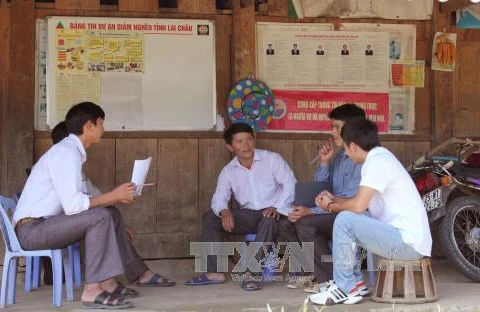
A representative of the People’s Committee in Phu Tho province’s Lai Dong commune said nearly 200 villagers attended vocational training courses in the last five years. After the courses, most of them continued farming.

Ha Thi Lan Huong of Phat 1 Village in the commune said she and 100 other villagers learned how to embroider during three months.

“At first days, all of us hoped we could earn a better living by embroidering,” she said. “But things do not always turn out the way we plan.”

They failed to find buyers for products they made and all quit and went back to farming, she said.

Experts also said a shortage of in-depth training due to short-term courses added to the problem.

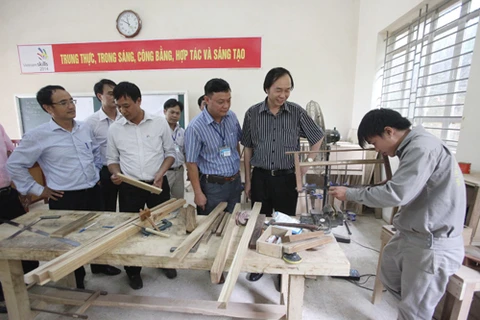
Bui Van Nam of Hoa Binh province’s Tan Lac district said training courses often provide initial skills for a career. But he had to study and practice more before he could make a living in the skill he learned - mechanics.

Vu Van Thinh of the Quang Ninh province’s Coal and Mineral Vocational Training School said many vocational training centres failed to provide clear orientation on how to choose a suitable career.

Many people therefore signed up for courses unsuitable for their locality, he said.

Truong Xuan Cu, deputy head of the Northwest Region Steering Committee, said people in the region now pay more attention to vocational training given that university graduates are failing to get jobs.

Therefore, building a high-quality vocational training school to meet the demand of both learners and the market was necessary, he said.

Deputy Minister of Labour, Invalid and Social Affairs, Huynh Van Ty, said to attract students vocational training schools should reach a commitment by local firms to hire graduates. In the future, he added, training schools or centres would only be allowed to open if they could ensure jobs for students.

In a related move, the General Department of Vocational Training submitted a request to build two high-quality vocational training schools./.
VNA

See more

A performance at the meeting with over 1,000 overseas Vietnamese in Ho Chi Minh City on February 6 evening to celebrate the upcoming Lunar New Year (Tet). (Photo: VNA)

Ho Chi Minh City hosts pre-Tet gathering with overseas Vietnamese

Nguyen Van Duoc, Deputy Secretary of the municipal Party Committee and Chairman of the municipal People’s Committee, attributed the southern metropolis’s socio-economic development achievements partly to important contributions by OV entrepreneurs, scientists, experts, and intellectuals worldwide through investment activities, knowledge transfer, market connection, and promotion of the city’s image.

Aerial view of Co To Island. (Photo: VNA)

Co To to offer free vessel trips to/from island on 29th day of last lunar month

To meet rising demand from residents returning home for Tet and visitors travelling to the island, transport operators in Co To will continue daily passenger and cargo services to/from the island until the 29th day of the last lunar month, with operations resuming from the second day of the first lunar month (February 18).

PM orders stronger transport measures to ensure traffic safety during Tet. (Illustrative photo: VNA)

PM orders stronger transport measures to ensure traffic safety during Tet

To accommodate surging travel demand and keep transport operations running smoothly, the PM instructed relevant bodies to boost transport capacity, particularly public passenger services, to ensure seamless connections at railway stations, airports, bus terminals and ferry ports. Authorities were told to ensure that no travellers are left stranded or delayed in returning home for Tet due to a shortage of transport, while strictly preventing fare gouging and unlawful price hikes. Proactive measures to curb traffic accidents and congestion during the peak holiday period were also highlighted.

Politburo member and Permanent member of the Party Central Committee’s Secretariat Tran Cam Tu presents gifts to the elderly in Da Nang city on February 5. (Photo: VNA)

Permanent member of Party Central Committee's Secretariat pays Tet visit to Da Nang

Politburo member and Permanent member of the Party Central Committee’s Secretariat Tran Cam Tu reaffirmed that the Party and State consistently uphold the principle of placing the people at the centre, stressing that caring for their material and spiritual well-being is both the goal and the driving force of national development.

The delegation Inspects anti-IUU fishing efforts at Hung Thai Port, Long Hai commune. (Photo: VNA )

Ho Chi Minh City's efforts to combat IUU fishing examined

The inspection aimed to identify grassroots-level difficulties, promptly address technical bottlenecks, require telecommunications enterprises to upgrade their systems, and advise the Government and relevant ministries and sectors on refining mechanisms and policies.

Representatives of Hanoi units sign a coordination mechanism for piloting public interest civil litigation (Photo: VNA)

Hanoi launches pilot mechanism for public interest civil litigation

The coordination framework is designed to ensure that the People’s Procuracy can promptly, fully and accurately access information related to public interest civil cases; facilitate the swift and effective verification and collection of documents and evidence; and strengthen the responsibilities of agencies, organisations and individuals in fulfilling their mandates to protect the civil rights of vulnerable groups and public interests.