Trains on Nhon – Hanoi Station metro line to operate at 35kmh on avera

The stations of the Nhon – Hanoi Station urban railway project are located about 1km from each other on average, and the maximum speed will be 35km per hour, equivalent to 2 minutes’ running.

Hanoi (VNA) – The stations of the Nhon – Hanoi Station urban railway project are located about 1km from each other on average, and the maximum speed will be 35km per hour, equivalent to 2 minutes’ running

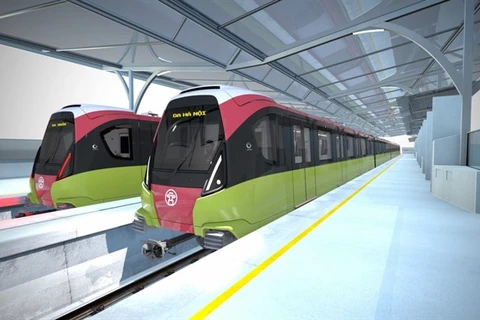
Trains on Nhon – Hanoi Station metro line to operate at 35kmh on avera ảnh 1Design of the Nhon-Hanoi Station urban railway line (Photo courtesy of the Hanoi Urban Railway Project Management Board)
  

The Nhon – Hanoi Station urban railway trains will have an average speed of 35km per hour as they will have to constantly stop to take in and discharge passengers, the stations are located 1km from each other on average and, as a result, the raising of the speed to a too high level will be very costly.

Under the plan, the first train will arrive in Vietnam in July 2020 to meet the progress of the operation of the elevated stage in April 2021 and the whole line in 2022. Upon its arrival in Vietnam, the train will be test operated and integrated into the system, and will not be utilized until all the requirements are met and quality ensured.

A report by the Hanoi Urban Railway Management Board said the trains on the Nhon – Hanoi Station metro line are being assembled in France and the overall progress has been 34.4 percent. There will be 10 trains built of European-standard aluminum alloy. They will be 2.75 – 2.95 metres in width and about 80 metres in length for four-carriage ones (later they will have one carriage added to become five-carriage). The handles on the trains will be customized for Vietnamese.

Once completed and put into operation, the trains will be able to carry 850-950 passengers each, with a density of 6-8 people for each square metre, and run at 35km per hour for commercial operation while their maximum designed speed is 80km per hour, similar to that of those in Paris, Berlin and other urban areas in Asia. This is taken as the standard design of metro lines in the world.

The current speed of the buses in the capital averages 16 – 18 km per hour, and that of BRT, about 23km per hour. With a commercial operation speed of 35km per hour, coupled with considerable advantages such as comfort to passengers, safety level, costs, distance between stops, punctuality and superiority of the journeys compared to the distances, urban railway has become the optimal public means of transport.

Elaborating on the commercial operation speed of 35km per hour, Technical Director of the ALSTOM-COLAS RAIL-THALES Julien Barjou said the Nhon – Hanoi Station line will stretch 12.5km, including 8.5km elevated and 4km under the ground from Kim Ma to the Hanoi Station. Its 12 stations will dot the line with 8 elevated and four under the ground. That is to say the trains will take in and discharge passengers continuously along that 12.5km line, or one station for each km.

For the commercial operation speed of 35 -38 km per hour, the official said the trains will accelerate from 0km per hour from the first station and those along the line to the speed of about 72 – 74 km per hour and slow down to 0km per hour when they arrive at the next station. This process will be repeated to the last station.

He further added that the distance from the Nhon station to the Hanoi station is 11.955km and the time for the journey from Station 1 to Station 12 will be 19.26 minutes for the first leg and 19 minutes for the return.-VNA

 The Nhon-Hanoi Station urban railway project has a total investment of 1.17 billion EUR (about 30,197 billion VND) and is scheduled to be implemented from 2009 to 2022, including the operation of the elevated section in April 2021 and the whole line in December 2022. It stretches 12.5km, including 8.5km above the ground and 4km under ground, crossing the districts of North Tu Liem, South Tu Liem, Cau Giay, Ba Dinh, Dong Da and Hoan Kiem.
 
VNA

See more

An overview of the seminar on the Party’s leadership in ensuring macroeconomic stability, renewing the growth model, restructuring the economy and promoting international integration (Photo: VNA)

Vietnam, Cuba exchange theoretical views on Party’s leadership in macroeconomic stability

The two sides explored in depth the Party’s role in leadership, orientation, oversight and strategic coordination in economic management; approaches to implementing economic restructuring programmes alongside the renewal of the growth model; measures to respond to global economic volatility, inflationary pressures and shifts in global trade; and the building of effective strategic advisory bodies to ensure the Party’s comprehensive leadership in a changing context.

Vietnam’s Ambassador to Australia Pham Hung Tam (Photo: VNA)

Australia–Vietnam Policy Institute serves as bridge for bilateral relations

Established in 2022, AVPI serves as a forum for exchanging ideas among businesses, government agencies, non-profits, universities, and scholars in Australia on Vietnam. The institute acts as a platform for policy dialogue, focusing on research and insights on strategic relations and bilateral economic ties.

General Secretary and Chairman of the NA Office Le Quang Minh chairs the press conference announcing the results of the NA's 10th session (Photo: VNA)

10th session helps strengthen public trust in personnel work, NA’s supreme oversight

Personnel consolidation carried out at the NA's 10th session helps ensure continuous, unified, effective, and efficient leadership of the state apparatus; guarantee smooth and uninterrupted direction and governance; and prevent any leadership gaps in critical areas. All positions elected or approved by the legislature meet the key criteria required within the organisational structure.

An overview of deputies' voting to pass a law as part of the 15th National Assembly's 10th session (Photo: VNA)

National Assembly passes laws on finance, agriculture, environment

The National Assembly (NA) passed the Law on Recovery and Bankruptcy, the law amending and supplementing several articles of the Law on Value-Added Tax, and another law introducing changes to various articles in 15 different laws related to agriculture and the environment.

Party General Secretary To Lam speaks at a nationwide conference reviewing anti-corruption work hosted by the Central Steering Committee for Prevention and Control of Corruption, Wastefulness and Negative Phenomena on December 11, 2025. (Photo: VNA)

Party chief demands relentless anti-corruption drive with no exceptions

Party General Secretary To Lam demanded an unrelenting campaign against corruption, wastefulness and negative phenomena, backed by the strongest political resolve from the central to grassroots levels, to forge a cleaner, more robust Party and political system capable of steering Vietnam through its next stage of development.

Gen. Nguyen Tan Cuong (R), Chief of the General Staff of the Vietnam People’s Army and Deputy Minister of National Defence, meets with Admiral Saito Akira, Chief of Staff of the Japan Maritime Self-Defence Force, in Hanoi on December 11, 2025. (Photo: qdnd.vn)

Vietnam, Japan eye stronger naval cooperation

Gen. Nguyen Tan Cuong highly valued the positive and fruitful cooperation between the Vietnam People’s Navy and the JMSDF, saying that this has helped enhance professional skills and technical expertise while fostering friendship and mutual understanding between the two forces.

A child is given vitamin A at a medical station in Cua Nam ward, Hanoi. (Photo: VNA)

National Assembly passes many laws, resolutions in 10th session’s final sitting

Accordingly, the legislature agreed to expand healthcare benefits and reduce medical costs for the people. It approved a roadmap toward providing free basic hospital services within the coverage of health insurance, in line with the country’s socio-economic conditions, the financial capacity of the health insurance fund, and future premium adjustments.