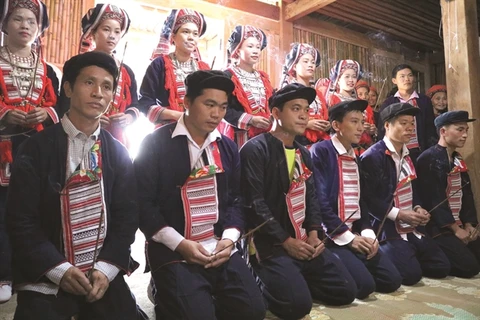
Red Dao women and girl appear in eye-catching traditional outfits. (Photo: VNA)
Hanoi (VNA) – Vietnam has 54 ethnic groups, each of which has its own identity and unique values in terms of customs and traditions, contributing to the shape of cultural diversity in the country.
One of the groups is the Dao ethnic minority people who reside, for the most part, in the mountainous northern provinces of Tuyen Quang, Cao Bang, Ha Giang and Lang Son. The Red Dao are a subgroup of the Dao people, renowned for their colourful traditional costumes that leave an indelible impression on visitors.
Tuyen Quang is home to nearly 91,000 Dao people from nine different subgroups, with the Red Dao people living mostly in the districts of Na Hang and Lam Binh.
For the Red Dao, the way they dress symbolises their ethnicity and distinguishes them from others. They are easily identifiable by the predominance of red in their clothing as the colour is believed to bring luck, happiness, prosperity and positive energy to everybody.
The traditional Red Dao art of costume decoration in the Tuyen Quang districts of Na Hang, Lam Binh, Chiem Hoa, Ham Yen and Son Duong was recognised by the Ministry of Culture, Sports and Tourism as a national intangible heritage last year.
This traditional art has a long history. In the remote villages of the Red Dao people, women still make traditional clothing for themselves and other family members.
 Red Dao women’s traditional costumes are decorated with unique patterns and jewellery. (Photo: VNA)
 It is said that the traditional costume of the Red Dao is the most famous of all in Vietnam, with a typical outfit including a tunic, trousers, headscarf, cloth belt and jewellery.
There are five colours – red, blue, white, yellow and black – needed in making a traditional Red Dao costume, but red should be the most prominent.
With women’s clothing, the most important piece is the long indigo or black tunic with highlighted brocade patterns on the front or cuffs. The blouse, divided into four parts, reaches down to mid-thigh, accompanied by a belt with many different coloured tassels. The embroidered patterns and designs are composed of coloured trees, flowers, mountains and animals. The trousers are often in plain black and tailored with rich patterns, such as squares, rectangles, pine trees and rhombuses, in the lower parts.
 Unique decorative motifs and jewellery on Red Dao women’s traditional outfits. (Photo: VNA)
 The most eye-catching feature must be the colourful headscarf, which is the main thing that differentiates the Red Dao from other minorities. The headscarf is folded to make it thicker and larger than many other ethnic headscarves.
All the patterns on a Red Dao traditional costume are entirely hand-sewn by Red Dao women which takes a tremendous amount of time. Each costume takes at least a year to make, some even up to two years. They are highly individualised yet convey a solid cultural message through each decorative pattern.
The Red Dao girls are taught from the age of nine or ten how to embroider and sew. They will use these skills to attract a future husband and show their value as a wife to their families-in-law.
The men’s traditional outfits are simpler, including only a headscarf, a short tunic, and trousers.
Red Dao costumes vary by region. There are differences in the way Red Dao people in each region wear tunics, headscarves, belts and other accessories. In some places, Red Dao people wear a string of 9 or 11 large red cotton balls around their neck.
They often dress in their most beautiful and colourful outfits during traditional festivals, for weddings or on the occasion of welcoming special guests to their home./.