Vietnam aims to become crucial link in global supply chain of Halal products: PM

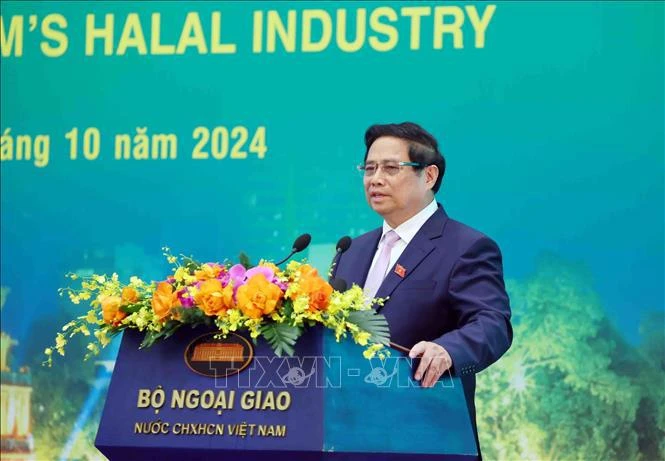
Vietnam aims to turn its Halal industry into a strong economic sector, positioning the country as an indispensable destination on the global Halal map and an important link in the supply chain of Halal products and services worldwide, Prime Minister Pham Minh Chinh stated at a conference held in Hanoi on October 22.

Prime Minister Pham Minh Chinh speaks at the conference on October 22. (Photo: VNA)

Hanoi (VNA) - Vietnam aims to turn its Halal industry into a strong economic sector, positioning the country as an indispensable destination on the global Halal map and an important link in the supply chain of Halal products and services worldwide, Prime Minister Pham Minh Chinh stated at a conference held in Hanoi on October 22.

The conference, co-hosted by the Ministry of Foreign Affairs, the Ministry of Science and Technology, and the Ministry of Agriculture and Rural Development, aimed to create substantive changes and effectively implement the plan on strengthening international cooperation to build and develop Vietnam's Halal industry by 2030. It was the first national-level and also biggest Halal-themed event, attracting about 600 online and in-person participants, including over 50 delegations of international organisations, foreign Halal businesses, and major Halal markets.

PM Chinh highlighted the significance of the event, which contributes to guiding the development strategy for Vietnam's Halal industry, opening up new business and investment opportunities, and promoting economic, cultural and people-to-people connections between Vietnam and other countries through Halal products and services.

He stressed that Vietnam has three important bases for developing the Halal industry, including political and social stability, growing economic potential and scale; the expanding foreign relations and international economic links; geographical advantages and favourable natural conditions for joining more deeply in the supply chains of Halal products and services, experience in and contributions to ensuring global food security, as well as advantages for tourism, including Halal tourism.

Vietnam aims to make Halal "a significant economic cooperation component, a new pillar, and a new motivation" for its relations with other countries, he said, noting that it views Halal as a "golden opportunity" for Vietnamese businesses to enhance their production capacity and effectively participate in the global Halal market.

The country is committed to developing the Halal industry based on the respect for cultural values, especially human culture, and the value of peaceful coexistence, thus demostrating its contribution and sense of responsibility towards the building of a peaceful, diverse, and harmonious world of common development, he went on.

To capitalise on Vietnam's advantages and promote international cooperation in the industry, the PM emphasised the need to promote cooperation in sharing information and experiences; boost negotiations and signing of agreements, memorandums of understanding on cooperation, and those on mutual recognition regarding Halal certification; encourage regional and international partners to invest and do business in Vietnam; increase the introduction and promotion of Vietnamese Halal products, services, and brands along with the opening of markets; and foster people-to-people exchanges, cultural cooperation, and mutual understanding.

At the conference, domestic and international delegates spoke highly of the country's potential, strengths, and strategy for engaging in the global Halal market.

Chairman of Halal India Mohamed Jinna said Vietnam is facing a "bright future" as it approaches an opening global Halal market where Halal certification will serve as a gateway for it to access a market that spans various industries such as food, pharmaceuticals, cosmetics, fashion, and tourism.

For his part, Secretary General of the Standards and Metrology Institute for Islamic Countries (SMIIC) Ihsan Ovut lauded Vietnam's dynamic economic development and its potential for developing the Halal tourism, food, cosmetics, and pharmaceuticals sectors.

Meanwhile, Chairman of the Gulf Cooperation Council (GCC) Accreditation Centre (GAC) Moteb Al-Mezani perceived that Vietnam's policy of developing the Halal industry matches the Gulf countries' interests and orientations for developing cooperative relations.

Addressing the event, Minister of Science and Technology Huynh Thanh Dat emphasised Vietnam's commitment to continuing collaboration with international partners to enhance the standardisation of production processes and improve the country's Halal certification capacity to meet stringent requirements of the international market./.
VNA

See more

Vietnam, RoK expand supply chain, manufacturing cooperation

Vietnam, RoK expand supply chain, manufacturing cooperation

Beyond sourcing products, RoK companies aim to build long-term partnerships with Vietnamese firms through product showcases, business-to-business (B2B) matchmaking, investment opportunities and sustainable supply chain development.

Ho Chi Minh City, GTEL partner on technology transfer for metro network

Ho Chi Minh City, GTEL partner on technology transfer for metro network

The two sides will study and localise key technologies covering signalling, communications, power supply, electromechanical systems (E&M), SCADA, operations control centres (OCC), automatic fare collection (AFC) and platform screen doors (PSD), while advancing technology transfer, workforce development and the capabilities of domestic enterprises.

Vietnamese Ambassador to Laos Nguyen Minh Tam and Lao Deputy Minister of Industry and Commerce Phouthavanh Nanthavong visit a Vietnamese booth at VIETLAO EXPO 2026. (Photo: VNA)

Vietnam-Laos trade targets 10 billion USD

Held on the sidelines of VIETLAO EXPO 2026, the seminar aimed to help businesses explore trade and investment opportunities and foster cross-border production and supply chains.

Standing Deputy Prime Minister Pham Gia Tuc chairs a meeting with representatives of US business associations and companies operating in Vietnam on July 17, 2026. (Photo: baochinhphu.vn)

Standing Deputy PM meets with US business community

Chairing a meeting with representatives of US business associations and companies operating in Vietnam, Tuc praised the US business community for its substantive contributions to Vietnam's socio-economic development as well as the two countries’ relations.

Workers assembles electronic components on the production line at the Bao Sen Co., Ltd. in Bac Ninh province. (Photo: VNA)

Vietnam's economy needs to shift from quantity to quality: ADB experts

Shantanu Chakraborty, ADB Country Director for Vietnam, noted that while achieving strong growth in a single year is encouraging, maintaining both the pace and quality of growth over many years will be essential if Vietnam is to achieve its goal of becoming a high-income country by 2045.

The Long Son Petrochemical Complex, an investment project of Thailand's SCG Group, is located in Long Son commune, Ho Chi Minh City. (Photo: VNA)

Vietnam reshapes FDI strategy with focus on technology, innovation

Politburo Resolution No. 10-NQ/TW, issued on June 8, 2026, recognises the foreign-invested sector as an important component of the national economy, signalling a major shift in the country's investment attraction strategy. Rather than prioritising labour-intensive projects, Vietnam is now seeking high-quality investments capable of driving technological progress, innovation, sustainable development and stronger participation in global value chains.

International tourists love shopping for souvenirs at Hanoi's Old Quarter night market (Photo: VNA)

Hanoi aims to raise tourists' night-time spending to 30%

Hanoi will establish and operate flagship night-time economy zones supported by preferential policies, including heritage and cultural districts in Hoan Kiem, Cua Nam, Ba Dinh, Son Tay and Soc Son; modern entertainment hubs in Tay Ho-West Lake West, My Dinh and Dong Anh; creative economy zones linked to cultural industries such as theatres, cinemas and museums; and cultural tourism and resort destinations in suburban craft villages including Bat Trang, Ba Vi and Huong Son.

Vietnamese Ambassador to Laos Nguyen Minh Tam and Lao Deputy Minister of Industry and Commerce Phouthavanh Nanthavong visit the Vietnamese pavilion at VIETLAO EXPO 2026 (Photo: VNA)

VIETLAO EXPO 2026 helps boost Vietnam-Laos strategic cohesion

The Vietnam-Laos Trade Fair 2026 (VIETLAO EXPO 2026) opened on July 16 in Vientiane, serving as a key platform for businesses from both countries to showcase products, seek partnerships, transfer technologies and expand investment cooperation.

The Vietnam-EFTA FTA is one of the longest-negotiated trade agreements in Vietnam's history. (Illustrative Photo: VNA)

Vietnam-EFTA deal set to further boost bilateral trade growth

The Vietnam-EFTA FTA is one of the longest-negotiated trade agreements in Vietnam's history, reflecting its broad scope of commitments covering trade in goods and services, investment, intellectual property, government procurement, environmental protection, sustainable development, small and medium-sized enterprises (SMEs), and other areas of cooperation.

Passengers and visitors check in at Terminal 1 of Noi Bai International Airport. (Photo: VNA)

Hanoi-Ho Chi Minh City route among world’s busiest

According to IATA’s ranking of global air passenger markets, the US remained the world’s largest market in 2025, with 890.1 million passengers, up 1.6% from 2024. China, the world’s second-largest market, recorded stronger growth of 4.8%, reaching 776.1 million passengers. China is widely forecast to overtake the US and become the world’s largest air passenger market in the 2030s.

An overview of the working session between the Kazakh delegation and the Can Tho City People's Committee on July 16. (Photo: VNA)

Kazakhstan explores agricultural by-product recycling project in Can Tho city

The proposed project would use rice husks as its primary feedstock, with an estimated one million tonnes processed annually using advanced technology developed in Kazakhstan. At present, the top priority is to secure a stable supply of raw materials from rice-producing provinces across the Mekong Delta.