Vietnam aims to rise to ASEAN top half by 2020

Vietnam is striving to boost its development in the ASEAN bloc and rise to the upper half within five years, according to the country's latest strategy on international integration.
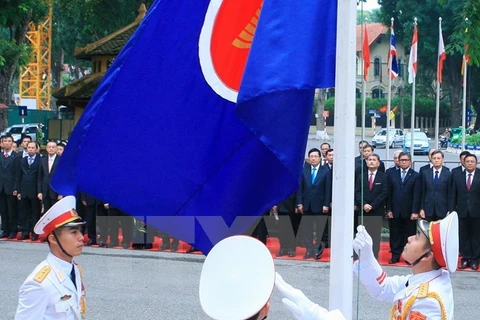
Vietnam aims to rise to ASEAN top half by 2020 ảnh 1Illustrative image (Source: VNA)

Hanoi (VNA) - Vietnam is striving to boost its development in the ASEAN bloc and rise to the upper half within five years, according to the country's latest strategy on international integration.

The long-term strategy, approved by Prime Minister Nguyen Tan Dung recently, set goals for 2020 regarding regional and global integration as well as a long-term vision outlined for 2030.

The ultimate aim is for Vietnam's economy to be shoulder-to-shoulder with the current top four ASEAN countries, including Singapore, Malaysia, Thailand and the Philippines by 2025.

In order to achieve such ambitions, Vietnam would need to keep expanding its market and make good use of foreign investment, technology and management experience to strengthen the competitiveness of domestically-made products, local enterprises and the country's economy as a whole, the strategy indicated.

The strategy was released following a year-end announcement that Vietnam's economy bounced back in 2015 when the GDP growth rate rose to 6.7 percent, the highest it had been in the last five years.

Encouraged by the promising figure, the new GDP growth target for this year was set at the same rate by the National Assembly in November, which was deemed feasible by HSBC in its latest report on the nation's economy. According to the report, Vietnam's export growth has rebounded to double digits, reflecting new investment.

The country's participation in a number of global trade agreements, including the historic Trans-Pacific Partnership (TPP), is also expected to propel a significant development boost to the economy. The World Bank recently predicted that Vietnam would be the biggest beneficiary of the 12 TPP members with a 10 percent GDP gain by 2030.

Apart from economic goals, the five-year strategy on international integration also listed national defence and security as key elements in its plan, especially as tensions escalate with China regarding the East Sea dispute.

One of the general goals of the strategy was to "firmly uphold Vietnam's independence, sovereignty, unity and territorial integrity", which was supported by a handful of sub-goals in which the country would strive to maintain a peaceful environment favourable to development.

Vietnam, according to the strategy, would also make use of "external resources to build up a modern military force" in order to "strengthen its ability to ensure the nation's security and defence".

Vietnamese leadership aims to turn Vietnam into one of the "core members" that would play the leading role in all regional defence co-operation mechanisms by 2030. The country's security and stability will be closely attached to those of the region, the strategy indicated.-VNA

VNA

See more

Canadian Ambassador to Vietnam Nickel James Stafford speaks at the meeting with Can Tho city on November 17, 2025. (Photo: VNA)

Can Tho looks to broaden cooperation projects with Canada

Nguyen Thi Ngoc Diep, Vice Chairwoman of the municipal People’s Committee, expressed appreciation for Canada’s support through the UN Development Programme (UNDP), which has funded the smart climate-resilient coastal community project.

An aerial view of part of Bac Ninh province (Photo published by VNA)

Bac Ninh maps long-term plan to become centrally governed city

Bac Ninh aims to become a major regional hub for high-tech industry, processing and manufacturing, and supporting industries, forming a fully developed industrial ecosystem that serves as a growth engine for both the northern region and Vietnam.

The Bank for Investment and Development of Vietnam (BIDV) and the Japan Bank for International Cooperation (JBIC) exchange their MoU on cooperation at the meetings. (Photo: VNA)

Vietnam, Japan expand cooperation in clean energy transition

To promote energy transition towards Vietnam’s goal of achieving carbon neutrality by 2050, the AZEC/GX Promotion Working Team was established within the AZEC initiative to strengthen cooperation in developing the investment environment and human resources.

Delegates at the signing ceremony (Photo: VNA)

Long An International Port and Japan’s Port of Kobe establish strategic partnership

The establishment of the strategic partnership with the Port of Kobe is expected to open new prospects for cooperation, reflecting the determination of local authorities and enterprises to boost trade, strengthen connectivity, and enhance modern, sustainable domestic industrial capacity, thereby improving supply capability and supporting deeper participation in regional value chains.

Famers harvest coffee. (Photo: VNA)

Forum seeks solutions to build brand for Vietnamese Robusta coffee

VICOFA Vice Chairman Thai Nhu Hiep stated that Vietnam is already the world’s largest producer and exporter of Robusta coffee, with an annual output exceeding 1.8 million tonnes. Vietnamese Robusta coffee has several advantages, including favourable natural conditions and large, concentrated growing areas, which provide a stable supply.

An electric vehicle charging station in Hanoi. (Photo: VNA)

Automakers race toward fierce competition as sector shifts gears

According to the latest figures from the Department of Customs, Vietnam imported 16,343 cars in October. Although this represents a 5.5% drop from the previous month, total imports over the first ten months reached 171,364 units, up 20% year on year. Import turnover neared 4 billion USD, the highest level in the past three years.

The year 2025 has seen the coffee industry form an ecosystem of responsible production, stretching from raw-material regions to processing stages, helping lay the foundation for sustainable growth in the years ahead. (Photo: VNA)

Coffee exports likely to exceed 8 billion USD this year

The Ministry of Agriculture and Environment reported that Vietnam sold 1.3 million tonnes of coffee overseas for 7.41 billion USD between January and October, up 61.8% year-on-year and marking the highest annual value increase to date. The average export price reached 5,653 USD per tonne, a surge of 42.5% from the same period last year. Several markets posted outstanding growth, particularly Mexico, where export value jumped by 34.7 times.