Vietnam Airlines revises down revenue goals for 2019

Vietnam Airlines Group, listed with code HVN, has revised down the projected consolidated revenue for 2019 from over 111.7 trillion VND (4.8 billion USD) as set in the shareholders’ annual general meeting in May to nearly 104.6 trillion VND (4.5 billion USD).
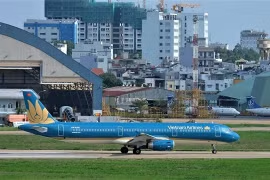
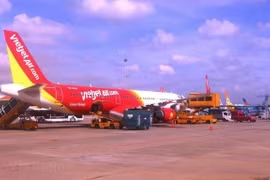
Vietnam Airlines revises down revenue goals for 2019 ảnh 1Illustrative image. (Source: Vietnam Airlines)

Hanoi (VNA) – VietnamAirlines Group, listed with code HVN, has revised down the projectedconsolidated revenue for 2019 from over 111.7 trillion VND (4.8 billion USD) as set in the shareholders’annual general meeting in May to nearly 104.6 trillion VND (4.5 billion USD).

According to the newly released resolution of theairline’s Board of Directors on business plan adjustment for 2019, theprojected revenue of the parent company Vietnam Airlines was also cut from over 82.5billion VND to more than 78.3 billion VND.

The projected number ofpassengers flying with the carrier was lowered from 24.9 million to 23.4million while the volume of cargo it expects to transport this year was reducedby 16,000 tonnes to 357,000 tonnes.

The State-owned group, which includes Vietnam Airlines, Jetstar Pacific andVASCO, earned nearly 52 trillion VND (2.24 billion USD) in consolidated revenue in the first half of this year,marking a year-on-year increase of 5.5 percent.

The group’s consolidated profit for the firsthalf reached 6.45 trillion VND and pre-tax profit nearly 1.79 trillion VND, down 3.5 percent and 3.7 percent year-on-year,respectively.

Over the course of six months, Vietnam Airlinessafely flew over 13.9 million passengers, a 2-percentincrease from 2018, and over 180,000 tonnes of cargo, up 1.6 percentyear-on-year, on 73,650 flights. Its on-time performance (OTP), averaging at 90percent, remained among the highest globally. Demand-responsive load factor ledto significant fuel saving and higher seat utilisation of 80.3 percent.

Having boosted itscharter capital to more than 14.18 trillion VND, Vietnam Airlines hadits own shares (HVN) officially listed on the HoChi Minh StockExchange (HOSE) on May 7, 2019. 

In the second half of the year,Vietnam Airlines plans to push for organisational restructuring, take deliveryand operate the first three wide-body Boeing 787-10, out of its order of eightaircraft, and finalise the investment plan of 50 narrow-body aircraft for the2021-25 period.

The firm said it wouldcontinue to improve customer experience by offering onboard Wi-Fi services,introducing a brand-new Business class menu and rigorously replacing environmentally-unfriendlysupplies onboard.–VNA
VNA
See more

The central province of Nghe An holds an investment promotion conference in Seoul on October 15. (Photo: VNA)

Nghe An seeks stronger tech, clean energy ties with RoK

A Nghe An official affirmed the province's commitment to providing a fair and favourable investment environment, preparing cleared land in the expanded Southeast Nghe An Economic Zone, streamlining administrative procedures, and ensuring clean energy infrastructure for investment projects.

Illustrative image (Photo: VNA)

Vietnam, US propel economic, trade, investment ties

Vietnam considers the US one of its leading strategic partners and wants to continue advancing the Comprehensive Strategic Partnership in a stable, substantive, and effective way for the benefit of its citizens and enterprises, said Deputy Minister of Foreign Affairs Nguyen Minh Hang.

As of the end of August 2026, bilateral trade between Vietnam and the US reached approximately 137.42 billion USD, up 23.4% year on year. (Photo: VNA)

Vietnam, US look to strengthen business, investment ties

Vietnam and the US should further promote business connections and practical cooperation in trade and investment, Deputy Foreign Minister Nguyen Minh Hang told Pamela Phan, former Deputy Assistant Secretary for Asia at the US Department of Commerce, in Hanoi on October 15.

Shoppers at Winmart (Photo: VNA)

National brand programme drives Vietnamese corporate competitiveness

Vietnam’s national brand value reached 462.28 billion USD in 2026, up 45.14% from 2020 and ranking 32nd among 193 countries, according to Brand Finance. The challenge, however, goes beyond climbing the rankings or scaling up. It is turning those gains into lasting competitiveness and getting Vietnamese firms deeper into global value chains.

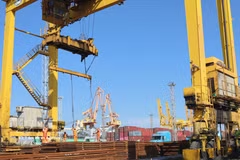
Loading and unloading steel products at Hoang Dieu–Chua Ve Port, Hai Phong city (Photo: VNA)

Hai Phong city seeks to boost inland waterway transport

According to the Hai Phong Maritime Administration, inland waterways carry coal, agricultural products, ores, stone, cement and other bulk cargoes, helping ease pressure on roads, particularly those connecting seaports and industrial parks.

Speakers at the conference (from left): AVPI Advisory Board Chair Dr Le Thu Huong, Australian Ambassador to Vietnam Gillian Bird, and Vietnamese Consul General in Sydney Nguyen Thanh Tung. (Photo: VNA)

Vietnam, Australia turn momentum into practical cooperation

Vietnam and Australia should focus on promoting two-way investment, expanding cooperation linked to APEC 2027 and making better use of people-to-people connections. Vietnam needs capital, skills, technology, infrastructure, and energy transition expertise - areas where Australia could offer valuable support.

The interface of the National E-Procurement System. (Photo: muasamcong.mpi.gov.vn)

Vietnam to move PPP bidding online from 2027

From January 1, 2027, PPP project proposals must be submitted through the National E-Procurement System. From September 1, 2027, investor selection for PPP projects tendered through open bidding will move fully online.

An automated robot-based production line at CAYI Technology Vietnam Co., Ltd. in Yen Phong II-C Industrial Park, Bac Ninh city (Photo: VNA)

EuroCham: Business Confidence Index in Vietnam remains high at 78.3 in Q3

The survey found that 64% of respondents described their current business conditions as good or very good, while 28% maintained a neutral or cautious outlook, reflecting a wait-and-see attitude as international demand remains flat and businesses look for policy momentum to translate into faster procedures and more predictable outcomes.