Vietnam always welcomes Russian enterprises, says PM

Vietnam always welcomes and is willing to create favourable conditions for Russian enterprises to do business and invest in the country, Prime Minister Nguyen Xuan Phuc affirmed.
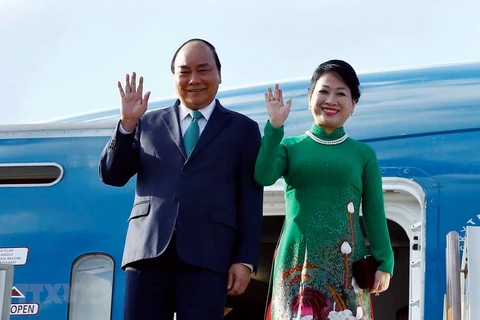
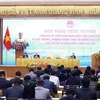
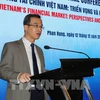
Vietnam always welcomes Russian enterprises, says PM ảnh 1Prime Minister Nguyen Xuan Phuc speaks at the forum (Source: VNA)

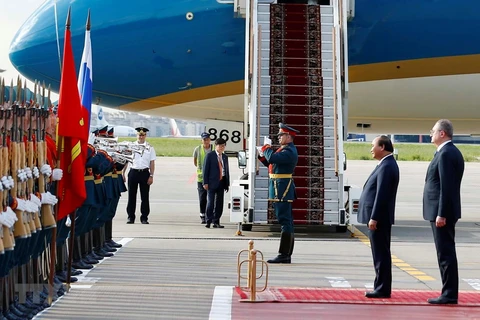
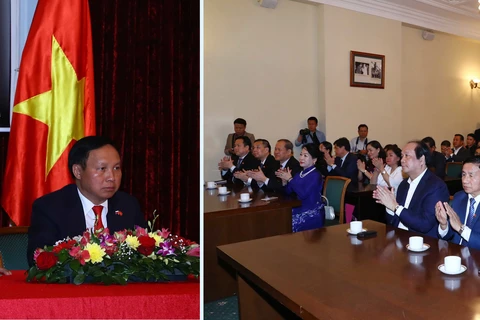
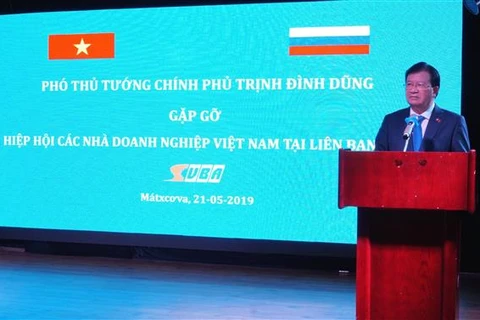
Moscow (VNA) - Vietnam always welcomes and is willing to createfavourable conditions for Russian enterprises to do business and invest in thecountry, Prime Minister Nguyen Xuan Phuc affirmed when addressing the Vietnam-Russia Business Forum held in Moscow on May 22.

PM Phuc, who is on an official visit to Russia from May 21-23, said thatthe forum aimed to seek better and more effective and timely measures to ensurethat bilateral cooperation matches the Vietnam-Russia sound relations.

He briefed participants on Vietnam’s socio-economic achievements aftermore than 30 years of renewal. Last year, the country’s GDP growth rate made an11-year record high at 7.1 percent, while its import-export turnover reachednearly 500 billion USD. Inflation was curbed under 4 percent and themacro-economy remained stable.

According to the government leader, at present, Vietnam has 28,000foreign-invested projects from 131 countries and territories, with a combinedcapital of over 350 billion USD. Last year, the country welcomed 15.5 millionforeign tourists, a year-on-year rise of 20 percent.

PM Phuc attributed these positive results to improvements in Vietnam’sbusiness environment and its efforts to integrate into the global economy bysigning 11 free trade agreements (FTA) and preparing for the signing of an FTAwith the European Union (EU).

He underlined the positive impacts of the Eurasia Economic Union-VietnamFTA on Vietnam’s trade and investment, thus contributing to a 28.6-percentincrease in its trade turnover with Russia to hit 4.57 billion USD in 2018.

Vietnam is now the 23rd biggest trade partner of Russia and is running20 projects worth 3 billion USD in the country, while Russia has 123 projects(excluding those related to oil and gas) totaling 1 billion USD in Vietnam.

However, the PM said that these results have failed to match withpotential of both nations.

He expressed his hope that two-way trade can reach 10 billion USD by2020 after non-tariff barriers on major commodities are removed and a bilateralpayment channel using local currencies is launched.

For his part, Russian Deputy Prime Minister Maxim Akimov noted thateconomic and trade cooperation between Russia and Vietnam has been built on thefirm foundation of the time-honoured bilateral friendship.

Vietnam has affirmed itself as a key partner of Russia in Southeast Asiaas it accounts for one-third of Russia’s imports from the regional countries,the Deputy PM stated.

He suggested that both sides intensify collaboration in high technology,affirming that Russia is willing to support Vietnam in the fields of digitalgovernment and smart city building, as well as cybersecurity.

Earlier the same day, PM Phuc laid flowers in tribute to late PresidentHo Chi Minh at his statue in Moscow.–VNA 
VNA
See more

Illustrative image (Photo: VNA)

Australia announces import conditions for Vietnamese pomelos

Australia’s formal publication provides an important legal basis, marking the completion of the review, assessment and agreement on technical requirements for fresh Vietnamese pomelos. This represents a significant step forward in market access, creating favourable conditions for relevant agencies, localities and businesses to prepare for export activities in the coming time.

Containers of fresh Vietnamese durian for export are subject to a full-chain traceability system. (Photo: VNA)

First “green lane” durian shipment exported to China

​Under the “green lane” process, quality control begins at the cultivation stage, including soil sampling and monitoring, and continues through harvesting and processing, with traceability labels attached to trees and applied to fruit at the time of picking. It also allows plant quarantine procedures and the issuance of certificates of origin (C/O) directly in the localities where the orchards are located.

Delegates at the Vietnam Expo 2026 (Photo: VNA)

Vietnam pushes for deeper auto supply chain ties with RoK

The RoK stood as Vietnam’s largest foreign investor with more than 95.2 billion USD in registered capital as of February 2026, or about 18% of all foreign cash flowing in, with thousands of active projects. In January-February alone, the RoK led the pack with nearly 2 billion USD in pledges, grabbing a whopping 32.7% of total registered capital and showing no signs of slowing down.

More than 600 tourism firms, 15 countries and territories, and 34 provinces and cities are promoting destinations and introducing tourism products at the fair (Photo: VNA)

Digital transformation key to elevating Vietnam’s tourism: official

Speaking at the opening of the Vietnam International Travel Mart (VITM) 2026 in Hanoi on April 10, Deputy Minister of Culture, Sports and Tourism Ho An Phong noted that despite challenges in 2025, Vietnam largely fulfilled its socio-economic development goals. Tourism remained a bright spot, recording 21.5 million foreign arrivals and 135.5 million domestic visitors, with total revenue exceeding 1 quadrillion VND (37.9 billion USD).

A drone sprays fertiliser over rice fields. (Photo: VNA)

Low-altitude economy emerges as new growth driver for Vietnam

The UAV technology is particularly effective in addressing challenges faced by ground infrastructure, especially in densely populated urban areas and remote regions. Smart aerial devices also enable real-time data collection, improving governance, decision-making and digital transformation across industries.

Passengers at Cat Bi Airport in Hai Phong city (Photo: VNA)

Aviation sector ensures fuel supply for April 30–May 1 peak

Aviation fuel suppliers are actively negotiating and diversifying supply sources both domestically and internationally, while strengthening coordination, storage and distribution capacity to meet immediate demand. These efforts aim to support airlines in optimising operations and maintaining stable flight schedules.