Vietnam asks for impartial view on its human rights achievements

Vietnam wants the international community to have an objective, comprehensive, and impartial view on its efforts and achievements in ensuring human rights, said Foreign Ministry Spokesperson Le Thi Thu Hang.
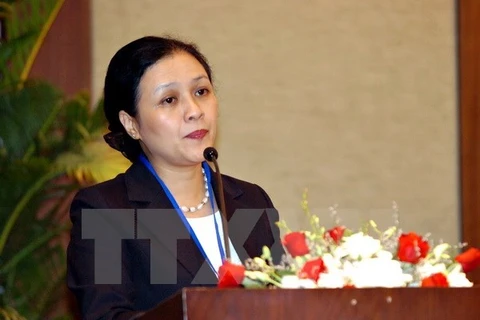
Vietnam asks for impartial view on its human rights achievements ảnh 1Foreign Ministry Spokesperson Le Thi Thu Hang at a regular press conference in Hanoi on January 18 (Photo: VNA)

Hanoi (VNA) – Vietnam wants the internationalcommunity to have an objective, comprehensive, and impartial view on itsefforts and achievements in ensuring human rights, said Foreign MinistrySpokesperson Le Thi Thu Hang.

She made the remark at a regular pressconference in Hanoi on January 18 in response to the Vietnam News Agency’squestion about Vietnam’s viewpoint on some partners having shown interest inthe country’s promotion and protection of human rights recently.

She said: “Human rights are the common value ofmankind, yet there are differences in approaches to and priorities on humanrights due to differences in history, culture, political regimes and developmentlevels. This is a normal fact in international relations, but the importantthing is that we need to be ready to cooperate and dialogue in cooperative andconstructive spirit and with mutual respect.”

Vietnam is maintaining dialogues on human rightswith some countries and partners to enhance mutual understanding, shareexperience, and open up bilateral cooperation opportunities in terms of humanrights, Hang noted.

The spokesperson said Vietnam has made importantprogress in promoting human rights. In the time ahead, it will continueperfecting the legal system to better ensure people’s fundamental rights on thebasis of the 2013 Constitution and the country’s commitments to theinternational community.

The country is going to bolster socio-economicdevelopment to improve conditions and resources for reducing poverty andpromoting people’s material and spiritual life. It will work to boost people’saccess to social welfares and improve the quality of education, includingeducation on human rights to raise public awareness of the issue and improve lawenforcement agencies’ capacity in the field.

Vietnam will also push ahead with promotinggender equality as this is an important factor in creating strong humanresources and boosting the quality of life of each person, each family, and thewhole society, Spokesperson Hang noted.

She said another priority is public health caretowards a healthy society that has access to both physical and mentalhealthcare services.

Meanwhile, the country will also intensifycooperation with all countries, mechanisms, and specialised organisationsrelating to human rights in the region and the world, Hang added.

Also on January 18, the Foreign Ministryreleased the book “Protection and Promotion of Human Rights in Vietnam” writtenin Vietnamese, English and French.

With four chapters, the book provides updatedinformation about Vietnam’s law, policies, efforts, and achievements in humanrights, along with relevant challenges and priorities.-VNA
VNA
See more

Prime Minister Le Minh Hung departs Hanoi on June 16, 2026 to attend the ASEAN–Russia Commemorative Summit and conduct bilateral activities in Kazan, Russia from June 16 to 18. (Photo: VNA)

PM departs for ASEAN – Russia Commemorative Summit

PM Hung’s participation in this summit once again reflects Vietnam’s consistent foreign policy of independence, self-reliance, resilience, peace, friendship, cooperation and development, as well as the diversification and multilateralisation of external relations in line with the spirit of the 14th National Party Congress.

Deputy Defence Minister Senior Lieutenant General Nguyen Truong Thang and the Vietnamese delegation are briefed by a French partner on a combat helicopter model at Eurosatory 2026. (Photo: VNA)

Vietnam promotes defence cooperation at Eurosatory 2026

During the event, the Vietnamese delegation met with major French defence firms, including Airbus and UNAC, to discuss technology transfer, human resource training, technical support and defence industry development. Vietnam also invited international partners to participate in the Vietnam International Defence Expo 2026, scheduled to be held in Hanoi this December.

Party General Secretary and State President To Lam receives Danish Ambassador to Vietnam Nicolai Prytz in Hanoi on June 15, 2026. (Photo: VNA)

Top Vietnamese leader receives outgoing Danish Ambassador

Party General Secretary and State President To Lam emphasised that the friendship nurtured over decades, coupled with shared development visions, particularly in the green economy, maritime economy and circular economy, as well as growing connections in culture, sports, tourism and people-to-people links, will continue to serve as a solid foundation for deeper and more productive relations between Vietnam and Denmark.

Party General Secretary and State President To Lam speaks at the working session with the education sector in Hanoi on June 15. (Photo: VNA)

Top leader urges education sector to make fundamental shift in mindset

Implementation of Resolution 71 must be carried out with strict discipline, regular inspections and continuous monitoring. The Ministry of Education and Training should establish a transparent system for tracking implementation through specific and regularly updated indicators. Each objective must be translated into concrete tasks, resources, timelines and responsible agencies.

Prime Minister Le Minh Hung (R) receives Russian Ambassador to Vietnam Gennady Bezdetko in May 2026. (Photo: VNA)

Vietnam - bridge in advancing ASEAN–Russia relations

Prime Minister Le Minh Hung’s upcoming visit to Russia from June 16–18 for the ASEAN–Russia Commemorative Summit marking 35 years of dialogue relations highlights Vietnam’s commitment to the ASEAN–Russia Strategic Partnership and its role in strengthening cooperation between the bloc and Russia.

A bird's eye view of Hanoi capital (Photo: VNA)

📝 OP-ED: Democracy and happiness – core values for building public trust

At the heart of the model is the principle that all policies must be designed for the people, rooted in the people’s aspirations and dedicated to serving their interests. Citizens will play an active role in governance through access to information, participation in decision-making, oversight of public affairs and equitable access to development outcomes. In this context, democracy and happiness of the people are not only development goals but also the most accurate benchmarks for evaluating the effectiveness of local governance and the capacity of grassroots authorities to serve their communities.