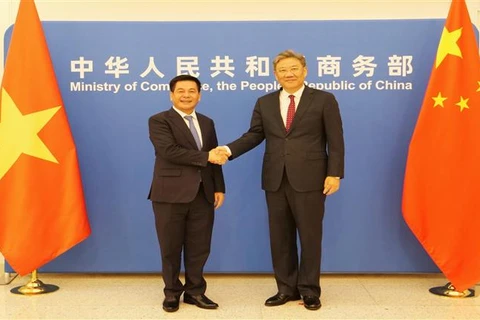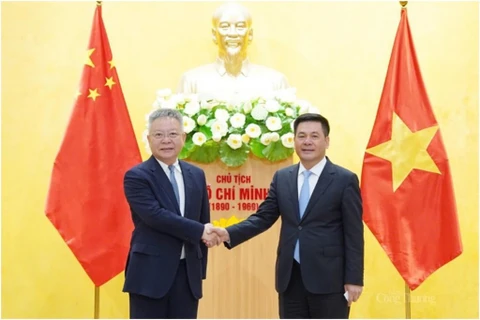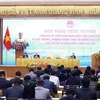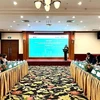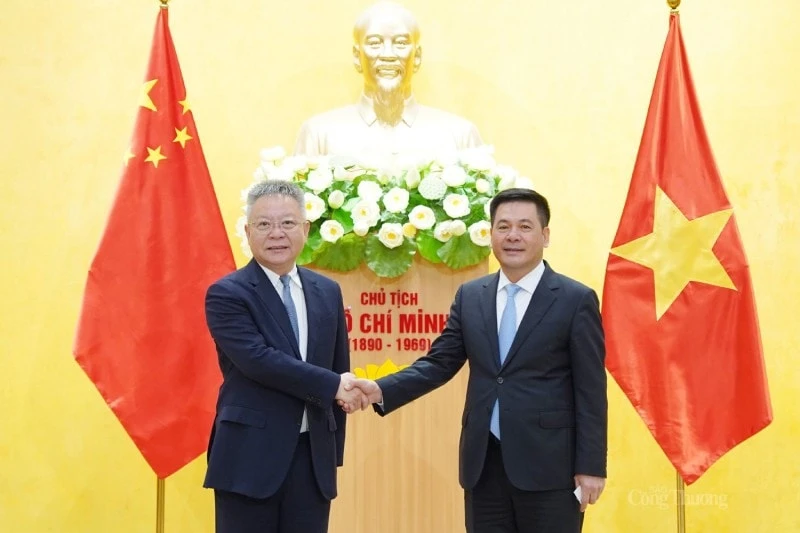
Hanoi (VNA) – Minister of Industry and Trade Do Hong Dien had a working session with China's Minister of Industry and Information Technology Jin Zhuanglong in Beijing on September 30 as part of the Vietnamese official’s trip to China for the 13th meeting of the Vietnam-China Committee for Economic and Trade Cooperation.
Dien said that the Vietnamese delegation's trip to China aims to implement the common perceptions reached by senior leaders of Vietnam and China during Party General Secretary and State President To Lam’s August visit to China, and continue promoting economic, trade and industrial cooperation between the two countries.
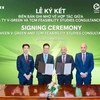
He thanked Jin and Chinese colleagues for their coordination with the Vietnamese side to ink a memorandum of understanding on industrial cooperation between the Ministry of Industry and Trade of Vietnam and the Ministry of Industry and Information Technology of China. The signing of this document is of great significance, which serves as a basis for the two sides to promote the content of cooperation in their strengths for the development in industry, and at the same time develop the cooperative relationship between the two ministries.
Dien said that industrialisation and modernisation is a thorough and consistent policy of the Party and State of Vietnam. After nearly 40 years of Doi Moi (Renewal), especially in the 10-year period from 2011 to 2020, the industrialisation and modernisation process has helped promote Vietnam's economic growth to an average of 6.17% per year year, making Vietnam a middle-income developing country.
He said that Vietnam's industrial sector has been restructured with a reduction in the proportion of the mining industry and an increase in the processing and manufacturing industry's proportion. A number of large-scale industries have been formed with the ability to compete and clinch a solid position in the international market, he noted, adding that the scale of industrial production has been continuously expanded.
Furthermore, infrastructure of industrial parks and industrial clusters has developed, contributing to attracting domestic and foreign investors, especially in industries and fields with potential, advantages, and high added value, said Dien.
Vietnam and China are neighbouring countries, and Vietnam has participated in a series of free trade agreements with major partners, such as the Vietnam-EU Free Trade Agreement (EVFTA), the Comprehensive and Progressive Agreement for Trans-Pacific Partnership (CPTPP), and the Regional Economic Partnership Agreement (RCEP). These agreements have helped bring the production and supply chains between Vietnam and China closer, creating more cooperation opportunities for businesses operating in the industrial sectors of the two countries, the official said.
To promote cooperation in industry between Vietnam and China, Dien suggested that both sides should enhance collaboration in the automotive industry. This includes fostering partnerships with large corporations that have invested in Vietnam and working with domestic companies in the production and assembly of vehicles to align with the government's direction and the Vietnamese market.
Regarding cooperation in the consumer goods industry, he proposed China coordinate to organise workshops to share experience to help Vietnam in upgrading production lines and minimising raw material waste in food processing. He noted that China's food sector is applying advanced technologies such as 5G and artificial intelligence to improve operations in food processing.
Dien also called for increased collaboration on scientific and technical research, as well as technology transfer in the exploration, extraction, processing, and utilisation of minerals to enhance efficiency, reduce resource loss, improve labour productivity, and ensure environmentally friendly products in compliance with Vietnamese laws and standards.
Additionally, both sides need to strengthen exchanges and share experiences and policies at both central and local levels regarding supply chain development as well as promote linkage between Chinese FDI enterprises and domestic Vietnamese companies, he said. He also requested that China enhance support for Vietnamese businesses to deeply engage in supplying products and services to foreign investors, share information, and organise training sessions to assist Vietnamese officials and experts in managing and developing industries.
The Vietnamese government has attractive policies to draw foreign businesses to invest in foundational industries, supporting industries, mechanical technology, manufacturing, and new energy sectors, Dien said. He expressed his wish for both sides to expedite the implementation of three railway routes connecting Vietnam and China, namely Lao Cai-Hanoi-Hai Phong; Lang Son-Hanoi and Mong Cai-Ha Long-Hai Phong lines.
For his part, the Chinese Minister of Industry and Information spoke highly of the memorandum of cooperation recently signed between the two ministries in August this year, suggesting that both sides could establish regular cooperation and exchange mechanisms to further enhance economic and industrial collaboration. Highlighting areas with significant potential for cooperation, Jin said that businesses from both countries could boost collaboration in sectors of mutual interest, such as raw materials, the automotive industry, electrical engineering, and the development of industrial zones.
He held that many major automobile manufacturers in China plan to expand their investments and operations in Vietnam and his ministry is committed to supporting Chinese companies in their investment expansion in the neighbouring country.
Regarding the proposal for cooperation in the mineral sector, Jin affirmed that this area holds significant potential for both sides, and it is ready to collaborate with Vietnam to support businesses of the two countries in researching and implementing joint projects in mineral exploration, exploitation and processing while adhering to the legal policies of both nations.
Affirming that there remains ample room for Vietnam and China to cooperate in terms of industry, he suggested that both sides should promote the development of supply chains in the industry, enhance collaboration in electrical engineering, consumer goods, supporting industries, and foster the development of aerospace technology./.