Vietnam expects to have 15 undersea cable routes by 2030

Vietnam plans to build at least 10 new undersea cable routes by 2030, increasing the total number to 15 with a minimum capacity of 350 Tbps.

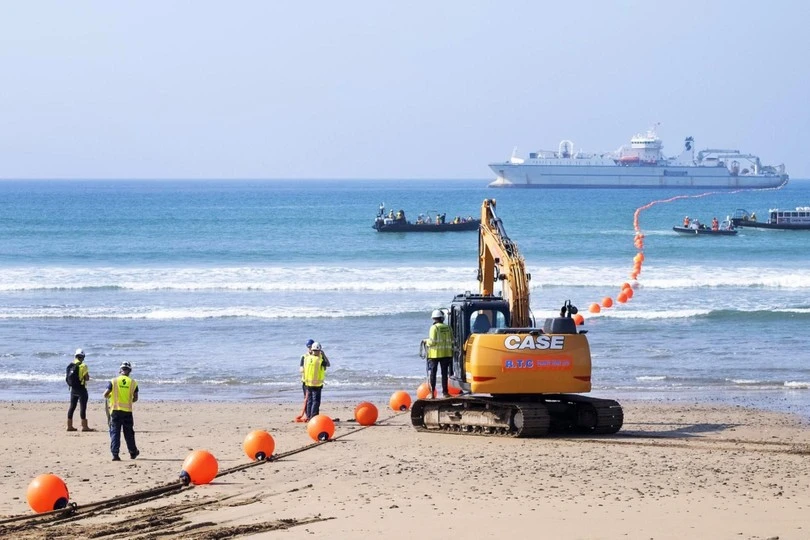
Illustrative photo (Source: internet)

Hanoi (VNA) – Vietnam plans to build at least 10 new undersea cable routes by 2030, increasing the total number to 15 with a minimum capacity of 350 Tbps.

According to the development strategy for the nation’s international fiber optic cable system to 2030 with a vision until 2035, issued by the Ministry of Information and Communications, at least two of these new cables will be owned by Vietnam and will connect directly to regional digital hubs.

By 2027, Vietnam aims to launch four new routes, boosting the total capacity to at least 134 Tbps. The country will continue to ensure that Singapore, Hong Kong (China), and Japan remain the primary digital hubs for connections.

Between 2028 and 2030, six more routes will be added. This phase will aim to maintain up to 90% of the undersea cable capacity linked to four major digital hubs in Asia, with a 10% capacity reserved for backup connections to significant digital hubs in the Americas and Europe.

The international fiber optic cable system is a crucial part of Vietnam’s digital infrastructure, requiring big investments to ensure ultra-high capacity, wide bandwidth, safety, and sustainability. This infrastructure will provide the necessary space for several urban centres to become regional data hubs.

Looking towards 2035, the strategy outlines that the system will be among those leading the region in terms of quantity, capacity, and quality. This development will attract major cloud service providers and facilitate the establishment of large data centres./.
VNA

See more

Participants in the Vietnam–India Innovation Gateway Bootcamp (Photo: VNA)

Vietnam, India boost innovation cooperation

Bui Trung Thuong, Trade Counsellor at the Vietnamese Embassy in India, highlighted the shift in Vietnam–India relations from traditional cooperation to partnerships based on innovation, technology, and digital transformation.

Illustrative photo (Photo: VNA)

Vietnam emerges as new hotspot for AI data centre investment

A wave of investment in artificial intelligence (AI) data centres is sweeping across Vietnam, with both domestic and international corporations announcing multi-billion-USD projects that are set to transform the country into a rising hub in the regional AI infrastructure map.

An overview of the international seminar, themed “Building resilience against online frauds and scams in Southeast Asia: Spotlight on Vietnam". (Photo: VNA)

Experts propose anti-scam solutions suited to Vietnam’s conditions

Vietnam’s digital transformation has achieved remarkable progress. However, similar to other countries in the region, online scams and fraud cases are on the rise. Last year, authorities recorded 10,000 online fraud cases, with estimated losses of nearly 759 million USD.

Minister of Science and Technology Nguyen Manh Hung speaks at the Vietnam Open Technology Forum 2025 in Hanoi on November 3. (Photo: VNA)

Vietnam looks to develop, master digital technology through open standards

Vietnam has chosen to pursue this direction — developing open technologies, open-source software, and open data — to enable individuals and enterprises to co-create new values. With this approach, it will become a technology-driven nation that both benefits from and contributes to global knowledge.

The seminar held in London on October 28 between Party General Secretary To Lam and leading strategists on AI and technology in the UK and the world. (Photo: VNA)

Vietnamese Party chief attends seminar on AI, technology in London

With its aspiration to become a pioneer in digital economy, Vietnam seeks to learn from the UK - the cradle of the Industrial Revolution and the homeland of great minds such as Isaac Newton, John Locke, Adam Smith, Alan Turing, William Shakespeare, and Charles Dickens - to build an innovative, human-centred, and sustainable technological ecosystem.

Int'l press conference highlights key outcomes of Hanoi Convention signing

Int'l press conference highlights key outcomes of Hanoi Convention signing

The Ministry of Public Security and the Ministry of Foreign Affairs jointly held an international press conference to announce the outcomes of the Signing Ceremony and High-Level Conference of the United Nations Convention against Cybercrime (also known as Hanoi Convention) in Hanoi on October 26.

Deputy Minister of Public Security Senior Lieutenant General Pham The Tung addresses the policy discussion in Hanoi on October 26. (Photo: VNA)

Hanoi Convention: Fostering global cooperation in combating cybercrime

A policy discussion focusing on promoting international cooperation in combating cybercrime, with national approaches to implementing the United Nations Convention against Cybercrime (the Hanoi Convention), took place in Hanoi on October 26 on the sidelines of the convention's signing ceremony.