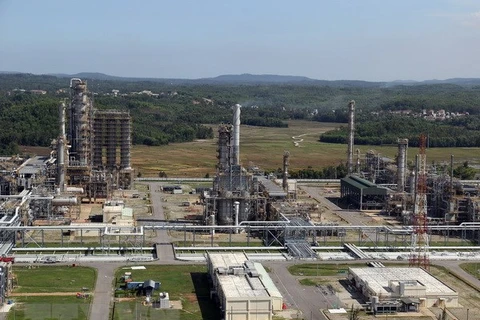
Oil rigs on the Bach Ho oil field. Vietnam's crude oil production is forecast to continue to drop over the coming years (Photo: VNA)
 Hanoi (VNS/VNA) - Vietnam’s self-sufficiency for crude oil could come to an end due to exploitation that could turn the country into a net importer of crude oil for the first time, experts warned.
According to analysts from the Fitch Solutions Macro Research, crude oil production in Vietnam would continue to drop over the coming years, averaging annual declines of 4-5 percent over the next 10 years, as offshore reserves fell and investment in significant new projects slowed.
Data from the General Statistics Office showed the country produced some 247,000 barrels per day (b/d) last year, a decrease of nearly 12 percent on year, some way short of State-owned Vietnam Oil and Gas Group (PetroVietnam)'s target of 14.2 million tonnes, equivalent to 285,000b/d.
PetroVietnam has also maintained a pessimistic outlook towards the sector, forecasting in late-2018 its crude oil production to decline by as much as 10 percent annually to 2025, as output declines from some of its most mature domestic fields, namely Bach Ho - Vietnam's largest oilfield and responsible for 60 percent of total production.
According to experts, the start of Ca Tam oil field, a satellite development for the aging Bach Ho, in February could see a modest uptick in near-term output as it ramps up to peak output of 23,000 b/d, although it would still be insufficient to stem the broader structural decline.
“Nascent efforts by the Government to revise the outdated domestic oil and gas law, and introduce better incentives for upstream contractors, could go a long way to reigniting investor sentiment into Vietnam’s oil and gas, though contribution to future oil output growth could be limited, given the gas-heavy nature of PetroVietnam’s current projects pipeline,” Fitch’s analysts said, noting the result would see Vietnam’s self-sufficiency in crude oil come to an end.
In fact, Vietnam’s crude oil imports expanded by more than three times in 2018 to 5.3 million tonnes, and look poised to expand further over the coming years following the full commissioning of Nghi Son, the country’s second refinery and petrochemicals complex.
Meanwhile, crude oil exports headed in the other direction, declining by 41 percent on year, mirroring the declines in domestic production.
After running at an average operating rate of 103 percent last year, the Dung Quat oil refinery is expected to continue to maintain elevated runs, both to meet strong domestic demand and to fend off competition from Nghi Son.
Fitch’s analysts also said the outlook for refining capacity growth in Vietnam remained upbeat, although this would come at the cost of even greater dependence on crude oil imports going forward.
They explained that following a final investment decision in 2017, the long-delayed construction of the 200,000 b/d Long Son refining and petrochemicals complex is finally underway, spearheaded by Thailand’s Siam Cement Group (SCG), the third stand-alone facility marked down for start-up in 2023.
In addition, Dung Quat refinery operator Binh Son Refining and Petrochemical Company (BSR) is also moving forward with steps to upgrade and expand its facility for 1.8 billion USD by 2021, securing an environmental impact assessment from the Ministry of Natural Resources and Environment in March.
In light of a widening domestic crude deficit, Vietnam unveiled plans to manage its oil import bill by maximising exports of its low sulphur Bach Ho crude, which often fetches a strong premium in the Asia crude market while substituting crude feedstock for own consumption with competitively priced US crude.
As for crude oil imports, Vietnam is just one of a growing number of countries in Asia that are opening their doors to more US crude inflows, both to capitalise on favourable US-Asia arbitrage, but also to deepen energy ties and improve trade relations with the US.
PetroVietnam received its first-ever cargo of US crude in May, comprising of 950,000bbl (barrels) of US West Texas Intermediate (WTI). Experts said more imports could be on the cards, depending on prices and the grade’s compatibility with the refinery.-VNS/VNA
According to analysts from the Fitch Solutions Macro Research, crude oil production in Vietnam would continue to drop over the coming years, averaging annual declines of 4-5 percent over the next 10 years, as offshore reserves fell and investment in significant new projects slowed.
Data from the General Statistics Office showed the country produced some 247,000 barrels per day (b/d) last year, a decrease of nearly 12 percent on year, some way short of State-owned Vietnam Oil and Gas Group (PetroVietnam)'s target of 14.2 million tonnes, equivalent to 285,000b/d.
PetroVietnam has also maintained a pessimistic outlook towards the sector, forecasting in late-2018 its crude oil production to decline by as much as 10 percent annually to 2025, as output declines from some of its most mature domestic fields, namely Bach Ho - Vietnam's largest oilfield and responsible for 60 percent of total production.
According to experts, the start of Ca Tam oil field, a satellite development for the aging Bach Ho, in February could see a modest uptick in near-term output as it ramps up to peak output of 23,000 b/d, although it would still be insufficient to stem the broader structural decline.
“Nascent efforts by the Government to revise the outdated domestic oil and gas law, and introduce better incentives for upstream contractors, could go a long way to reigniting investor sentiment into Vietnam’s oil and gas, though contribution to future oil output growth could be limited, given the gas-heavy nature of PetroVietnam’s current projects pipeline,” Fitch’s analysts said, noting the result would see Vietnam’s self-sufficiency in crude oil come to an end.
In fact, Vietnam’s crude oil imports expanded by more than three times in 2018 to 5.3 million tonnes, and look poised to expand further over the coming years following the full commissioning of Nghi Son, the country’s second refinery and petrochemicals complex.
Meanwhile, crude oil exports headed in the other direction, declining by 41 percent on year, mirroring the declines in domestic production.
After running at an average operating rate of 103 percent last year, the Dung Quat oil refinery is expected to continue to maintain elevated runs, both to meet strong domestic demand and to fend off competition from Nghi Son.
Fitch’s analysts also said the outlook for refining capacity growth in Vietnam remained upbeat, although this would come at the cost of even greater dependence on crude oil imports going forward.
They explained that following a final investment decision in 2017, the long-delayed construction of the 200,000 b/d Long Son refining and petrochemicals complex is finally underway, spearheaded by Thailand’s Siam Cement Group (SCG), the third stand-alone facility marked down for start-up in 2023.
In addition, Dung Quat refinery operator Binh Son Refining and Petrochemical Company (BSR) is also moving forward with steps to upgrade and expand its facility for 1.8 billion USD by 2021, securing an environmental impact assessment from the Ministry of Natural Resources and Environment in March.
In light of a widening domestic crude deficit, Vietnam unveiled plans to manage its oil import bill by maximising exports of its low sulphur Bach Ho crude, which often fetches a strong premium in the Asia crude market while substituting crude feedstock for own consumption with competitively priced US crude.
As for crude oil imports, Vietnam is just one of a growing number of countries in Asia that are opening their doors to more US crude inflows, both to capitalise on favourable US-Asia arbitrage, but also to deepen energy ties and improve trade relations with the US.
PetroVietnam received its first-ever cargo of US crude in May, comprising of 950,000bbl (barrels) of US West Texas Intermediate (WTI). Experts said more imports could be on the cards, depending on prices and the grade’s compatibility with the refinery.-VNS/VNA
VNA