Vietnam, India eye textile cooperation

There is a lot of potentials for cooperation between Vietnam and India in the textile and garment sector, a Vietnam-India business meeting heard in Ho Chi Minh City last week.
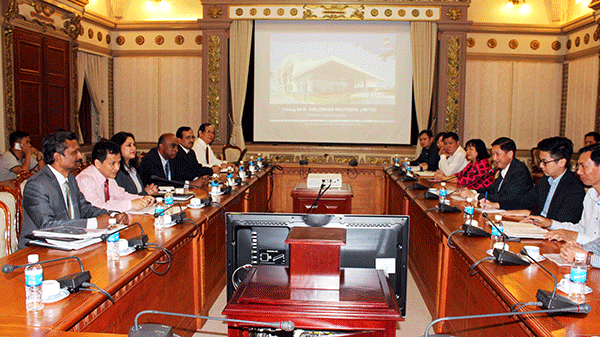
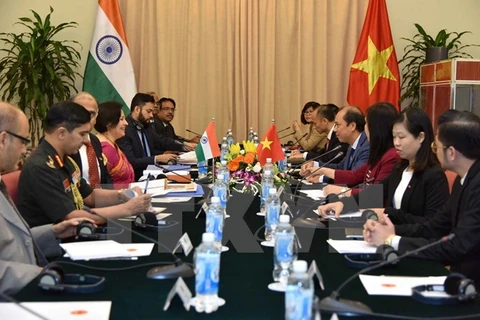
Vietnam, India eye textile cooperation ảnh 1Vietnam, India discussed co-operation opportunities in the garment and textile industry at an event in HCM City on November 23 (Photo VNA)

HCM City (VNA) -
Thereis a lot of potentials for cooperation between Vietnam and India in the textileand garment sector, a Vietnam-India business meeting heard in Ho Chi Minh City lastweek.

K Srikar Reddy, Indian Consul Generalin the city, said Vietnam is among the top five textile and clothing exportingcountries along with India.

But it has to import a lot ofthe raw materials, while “India’s textile industry has developed a completeproduct supply chain and India is also one of the suppliers of high-qualitymaterials and fabrics at competitive prices in the world.”

Cooperation between the twocountries would help Vietnamese enterprises diversify their raw materialsources and sell high-quality products in the international market, he added.

Nguyen Thi TuyetMai, Deputy General Secretary of the Vietnam Textile and Garment Association,concurred with him, saying Vietnam has a shortage of cotton, fabric and yarn while India hasan abundant supply of these products, making them perfect partners.

The General Statistics Officeestimates that Vietnam spent 18.5 billion USD to import cotton, un-spun fibre,fabric and auxiliary materials last year and around 15.5 billion USD in thefirst nine months of this year.

Vietnamimported all is cotton needs, with the US and India being the largestsuppliers, besides alsoimporting fabric and yarn from India.

Shailesh Martis, joint directorof the Cotton Textiles Export Promotion Council, said last year India was thesixth largest supplier of textiles to Vietnam, but only accounted for a 1.83 percentmarket share, while China and the Republic of Korea, the largestsuppliers, accounted for 65.4 percent.

India’s export of textiles to Vietnam,especially fabrics, is very low but it is the second biggest supplier of cottonyarn after China, according to the director.

“Vietnam has established itself as one ofthe leading garment makers to the world, not only to major markets like EU andthe US but also to newly emerging large importers China and the Republic ofKorea.”

India is the world’s largest producerof jute and the second largest producer of cotton and silk, and accounts for 22percent the world’s spindle capacity, he said.

“Vietnam needs huge quantitiesof right-priced, quality woven and knitted fabrics to continue its growthmomentum.

“India could be an economicalsource of quality yarns and fabrics to bridge the gap and make Vietnam’sgarments even more competitive.”

He also suggested ways toincrease bilateral trade, including exchange of technicalknow-how, trade-related information and demand – supply trends forimportant product groups on a regular basis.

The event attracted nine Indiancompanies that export cotton, fancy yarns, viscose/blended yarns, fabrics,staple fibre and others, who are also participating in the Vietnam International Textile & Garment IndustryExhibition in HCM City from November 22 to 25, besides local firms.-VNA
VNA
See more

Vietnam, RoK expand supply chain, manufacturing cooperation

Vietnam, RoK expand supply chain, manufacturing cooperation

Beyond sourcing products, RoK companies aim to build long-term partnerships with Vietnamese firms through product showcases, business-to-business (B2B) matchmaking, investment opportunities and sustainable supply chain development.

Ho Chi Minh City, GTEL partner on technology transfer for metro network

Ho Chi Minh City, GTEL partner on technology transfer for metro network

The two sides will study and localise key technologies covering signalling, communications, power supply, electromechanical systems (E&M), SCADA, operations control centres (OCC), automatic fare collection (AFC) and platform screen doors (PSD), while advancing technology transfer, workforce development and the capabilities of domestic enterprises.

Vietnamese Ambassador to Laos Nguyen Minh Tam and Lao Deputy Minister of Industry and Commerce Phouthavanh Nanthavong visit a Vietnamese booth at VIETLAO EXPO 2026. (Photo: VNA)

Vietnam-Laos trade targets 10 billion USD

Held on the sidelines of VIETLAO EXPO 2026, the seminar aimed to help businesses explore trade and investment opportunities and foster cross-border production and supply chains.

Standing Deputy Prime Minister Pham Gia Tuc chairs a meeting with representatives of US business associations and companies operating in Vietnam on July 17, 2026. (Photo: baochinhphu.vn)

Standing Deputy PM meets with US business community

Chairing a meeting with representatives of US business associations and companies operating in Vietnam, Tuc praised the US business community for its substantive contributions to Vietnam's socio-economic development as well as the two countries’ relations.

Workers assembles electronic components on the production line at the Bao Sen Co., Ltd. in Bac Ninh province. (Photo: VNA)

Vietnam's economy needs to shift from quantity to quality: ADB experts

Shantanu Chakraborty, ADB Country Director for Vietnam, noted that while achieving strong growth in a single year is encouraging, maintaining both the pace and quality of growth over many years will be essential if Vietnam is to achieve its goal of becoming a high-income country by 2045.

The Long Son Petrochemical Complex, an investment project of Thailand's SCG Group, is located in Long Son commune, Ho Chi Minh City. (Photo: VNA)

Vietnam reshapes FDI strategy with focus on technology, innovation

Politburo Resolution No. 10-NQ/TW, issued on June 8, 2026, recognises the foreign-invested sector as an important component of the national economy, signalling a major shift in the country's investment attraction strategy. Rather than prioritising labour-intensive projects, Vietnam is now seeking high-quality investments capable of driving technological progress, innovation, sustainable development and stronger participation in global value chains.

International tourists love shopping for souvenirs at Hanoi's Old Quarter night market (Photo: VNA)

Hanoi aims to raise tourists' night-time spending to 30%

Hanoi will establish and operate flagship night-time economy zones supported by preferential policies, including heritage and cultural districts in Hoan Kiem, Cua Nam, Ba Dinh, Son Tay and Soc Son; modern entertainment hubs in Tay Ho-West Lake West, My Dinh and Dong Anh; creative economy zones linked to cultural industries such as theatres, cinemas and museums; and cultural tourism and resort destinations in suburban craft villages including Bat Trang, Ba Vi and Huong Son.

Vietnamese Ambassador to Laos Nguyen Minh Tam and Lao Deputy Minister of Industry and Commerce Phouthavanh Nanthavong visit the Vietnamese pavilion at VIETLAO EXPO 2026 (Photo: VNA)

VIETLAO EXPO 2026 helps boost Vietnam-Laos strategic cohesion

The Vietnam-Laos Trade Fair 2026 (VIETLAO EXPO 2026) opened on July 16 in Vientiane, serving as a key platform for businesses from both countries to showcase products, seek partnerships, transfer technologies and expand investment cooperation.

The Vietnam-EFTA FTA is one of the longest-negotiated trade agreements in Vietnam's history. (Illustrative Photo: VNA)

Vietnam-EFTA deal set to further boost bilateral trade growth

The Vietnam-EFTA FTA is one of the longest-negotiated trade agreements in Vietnam's history, reflecting its broad scope of commitments covering trade in goods and services, investment, intellectual property, government procurement, environmental protection, sustainable development, small and medium-sized enterprises (SMEs), and other areas of cooperation.

Passengers and visitors check in at Terminal 1 of Noi Bai International Airport. (Photo: VNA)

Hanoi-Ho Chi Minh City route among world’s busiest

According to IATA’s ranking of global air passenger markets, the US remained the world’s largest market in 2025, with 890.1 million passengers, up 1.6% from 2024. China, the world’s second-largest market, recorded stronger growth of 4.8%, reaching 776.1 million passengers. China is widely forecast to overtake the US and become the world’s largest air passenger market in the 2030s.