Vietnam needs centre to boost innovation: experts

Vietnam needs to build up the National Innovation Centre to create a technological start-up ecosystem and upgrade the national innovation system, said experts.
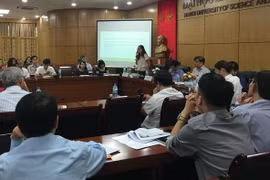
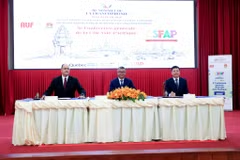
Vietnam needs centre to boost innovation: experts ảnh 1Experts said Vietnam needs to build up the National Innovation Centre to create a technological start-up ecosystem and upgrade the national innovation system (Photo: cand.com.vn)

Hanoi (VNA) - Vietnam needs to build up the National InnovationCentre to create a technological start-up ecosystem and upgrade the nationalinnovation system, said experts.

The centre plays an important role in bringing new technologies to businessesand individuals, Nguyen Dinh Cung, head of the Central Institute for EconomicManagement (CIEM), said at a workshop on establishing the National InnovationCentre (NIC) held by the CIEM in Hanoi on October 31.
 
Vietnam’s innovation centres can help convert the country into aninnovation-driven society based on Industry 4.0 technology, he stressed, addingthe NIC will have an advanced development model to create aninternational-level ecosystem for tech start ups.

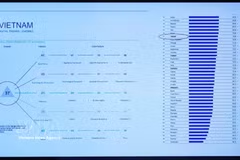
Dang Quang Vinh, deputy head director the CIEM’s Business Environment andCompetitive Ability Department, said innovation centres in Vietnam haveremained outside the world ranking. In the past 10 years, centres supportingstart-up enterprises did not succeed in creating a billion-dollar company.

The NIC will be the hub for the innovation ecosystem in Vietnam, Vinh said. Inits first stage, the NIC will focus on hardware and software in fields such assmart cities, digital industry (games, advertising, movies and music) andnetwork security.

The CIEM proposed the NIC as a social enterprise with 100 per cent privateinvestment under the provisions of the 2014 Enterprise Law.

The NIC will enjoy business incentives including a 20-year exemption of landuse fees, preferential credit and permission for domestic and foreignenterprises in the same field to rent space.

The centre will be located on a 23ha area of Hoa Lac Hi-tech Park. Theinvestment capital is expected to reach 1.9 trillion VND (82 million USD), 1.7trillion VND of which will be used to build its facilities. Construction willbegin in 2019 and should be finished within three years. The centre can beginoperating during the second year of construction.

Le Hai Mo, deputy head of the Institute of Financial Strategy and Policy underthe Ministry of Finance, said the NIC should be developed under an open modelrather than an administrative model.

Cung said the centre must have a high income to attract talented people whohave options in other countries.

The centre will contribute to the improvement of the country’s innovationsystem and to the implementation of the National Strategy for the Fourth Industrial Revolution. TheNIC will have pilot programmes for improving cooperation between the State andbusinesses for social purposes and the implementation of innovative policies toadapt governance to the Fourth Industrial Revolution. - VNA
VNA
See more

Vietnamese Deputy Minister of Science and Technology Tran Trung Tinh speaks at the event. (Photo: Published by VNA)

Vietnam, RoK seek to expand cooperation in AI and semiconductor sectors

Vietnamese Deputy Minister of Science and Technology Tran Trung Tinh stressed that the Politburo's Resolution No. 57-NQ/TW identifies science and technology, innovation and digital transformation as leading breakthroughs and key drivers of rapid and sustainable development. Semiconductors and artificial intelligence (AI) are among the strategic technologies prioritised for development.

Representatives of Cambodia’s Ministry of Education, Youth and Sport (MoEYS), the Agence Universitaire de la Francophonie (AUF) and Viettel Cambodia (Metfone) sign a tripartite agreement to strengthen cooperation and accelerate digital transformation in Cambodia’s higher education sector. (Photo: khmertimeskh.com)

Vietnamese company joins Cambodia’s digital transformation efforts

The agreement establishes a cooperation framework to modernise higher education through digital governance, digital learning, artificial intelligence (AI) applications, and capacity building through training and knowledge sharing. It also aims to expand internship, employment and scholarship opportunities for students.

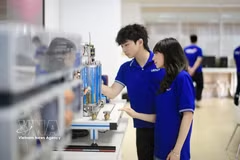
USTH students access modern equipment (Photo: VNA)

Vietnam’s AI ambition runs into talent wall

AI is becoming a foundational technology, cutting across industrial production, healthcare, education, finance, governance and public service delivery. But turning technological potential into practical value requires a workforce able to study, master and apply AI to Vietnam’s real-world problems.

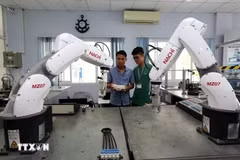
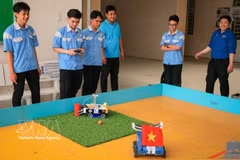
Trainees practise programming and operating robots at the Ho Chi Minh City High-Tech Park Training Centre. (Photo: VNA)

Vietnam, Malaysia hold potential for cooperation in robotics industry

Businesses from both countries should lead joint research and field-testing projects in areas such as electronic component inspection, warehouse transport, agricultural monitoring and medical logistics, said Samirul Ariff Othman, a policy, economic and business analyst at Global Asia Consulting and visiting lecturer at Universiti Teknologi PETRONAS.

Illustrative image (Photo: SGGP)

Ericsson establishes R&D capability in Vietnam

This initiative builds on Ericsson’s growing software engineering and testing capabilities in the country, and will further strengthen Vietnam’s contribution to Ericsson’s global technology development.

An AI-powered robot at the 2026 Seoul AI Conference. (Photo: VNA)

RoK’s AI robotics drive opens cooperation opportunities with Vietnam

Dao Tuan Hung, President of the Business Association of Vietnamese in Korea (BAVIK), said Vietnam should adopt a practical approach by prioritising specialised robots, including autonomous mobile robots (AMR/AGV), collaborative robots and machine vision systems, in sectors such as agro-fishery processing, textiles and garments, electronics and logistics.

Russian survey vessel Akademik M.A. Lavrentyev (Photo: VNA)

Russian survey vessel docks in Hai Phong

This is the third joint marine scientific survey in Vietnamese waters, running from November 4 - December 12, and one of the opening field activities under the Vietnam–Russia roadmap for marine scientific research cooperation for 2026-2035.

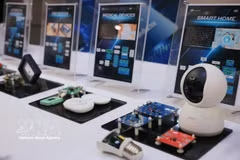
Smart products, chips and semiconductor materials are displayed at the launch ceremony of the national semiconductor chip prototyping support centre in Hanoi on June 26, 2026. (Photo: VNA)

Vietnam-Japan semiconductor cooperation paves the way for high-tech investment

The two countries are implementing five semiconductor research projects involving leading universities, with funding agreements signed in July. The projects cover three-dimensional integrated circuits, advanced semiconductor materials, secure artificial intelligence (AI) chips and power electronic components.

An exhibition space at the “Da Nang Semiconductors and High-Tech 2026” conference, organised by the Da Nang People’s Committee. (Illustrative photo: VNA)

Mobilising international resources to drive Vietnam’s technology development

Vietnam previously focused mainly on attracting overseas experts and intellectuals to work in the country over the long term, but this approach encountered certain difficulties. Cooperation methods are now shifting towards greater flexibility, allowing experts to take part in conferences and scientific seminars, contribute to addressing major national challenges, or participate in short-term training and research programmes.

Assoc. Prof. Dr. Dinh Ngoc Thach, lecturer and researcher in automatic control theory and robotics at the French National Conservatory of Arts and Crafts (Cnam) (Photo: VNA)

Core technologies key to sustainable robotics development in Vietnam: expert

Vietnam should select suitable robotic platforms and gradually build capacity in core technologies, including sensing, environmental perception, positioning, state estimation, AI, control and system integration. This will help develop technologies applicable across multiple sectors while avoiding fragmented investment and dependence on a single product category.

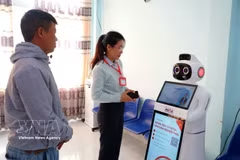
AI robots have become effective assistants in providing administrative services and reducing the workload of officials in Lam Dong province (Photo: VNA)

AI robots help streamline administrative procedures

Operating around the clock, AI robots provide information on administrative procedures, required documents, processing times, fees and relevant regulations, complementing assistance from civil servants.