Vietnam needs policy changes to adapt in industrial revolution

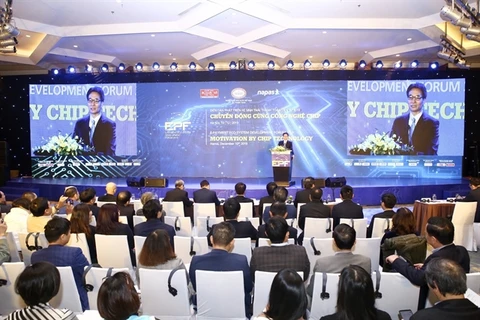
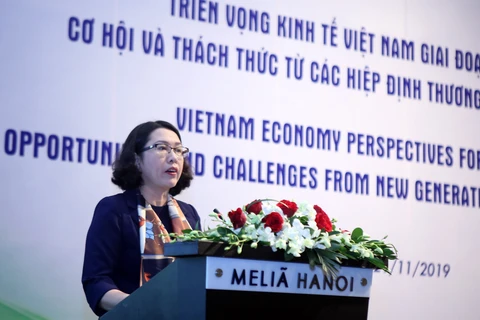
Vietnam needs a “revolution in its policy-making mind-set” before it can take advantage of the fourth industrial revolution, said Pham Xuan Hoe from the Banking Strategy Institute, at a forum in Hanoi on January 7.
Vietnam needs policy changes to adapt in industrial revolution ảnh 1If Vietnam can catch up with the revolution in time, the digital economy can help the country close the gap with other nations around the world, an expert has said (Photo: VNA)

Hanoi (VNS/VNA) - Vietnam needs a “revolution inits policy-making mind-set” before it can take advantage of the fourthindustrial revolution, said Pham Xuan Hoe from the Banking Strategy Institute,at a forum in Hanoi on January 7.

Attending the forum held by the Vietnam Institute forEconomic and Policy Research (VEPR), Hoe said: “If Vietnam can catch up withthe revolution in time, the digital economy can help the country close the gapwith other nations around the world.”

However, he was concerned about policies to help boostdigital transformation, saying: “Vietnam still applies outdated policies in anew economic context.”

Economist Nguyen Tri Hieu told the forum: “Since 2016, thecountry has talked a lot about the advantages from the fourth industrialrevolution but, after four years, I don’t see where it is in such a revolution.”

Responding to both comments, Ho Tu Bao from the JapanAdvanced Institute of Science and Technology, said: “Vietnam is in the initialstages of the revolution,” adding that each revolution takes between 50 tohundreds of years.

Bao said the fourth industrial revolution is one of digitaltransformation, which helps close the gaps in social relationships, ease theburden on labour and remove the role of intermediaries to develop the economy.

He is working with the Ministry of Health on a plan toconnect the medical records of more than 50 million people with their healthinsurance details and another plan with the Ministry of Transport to connecttransport records of 1.2 million vehicles.

“Some ministries go fast and some go slower in digitaltransformation, however, the awareness of many leaders has been improved.Digital transformation is a long term project, and should take at least 10years,” Bao said.

Hosting the forum, VEPR director Nguyen Duc Thanh agreed thatthe economy is changing.

Recognising the Government’s efforts, the VERP’s directorsaid Vietnam is spending on building an e-Government but the process is slow.Half of the country’s ministries are not yet digitalised.

Thanh told the forum: “The transformation will take time asthe people (who make decisions) are still the same. There is no other way thanto wait for them to change their minds.”

According to the Central Institute for Economic Management(CIEM), the implementation of the fourth industrial revolution can help boosteconomic growth by 28.5 - 62.1 billion USD, equivalent to 7-16percent of GDP over the next ten years./. 
VNA
See more

In the Kim Long Motor Hue factory (Photo: VNA)

Hue courts capital to turn industrial zones into growth engine

The economic and industrial zones in Hue city host more than 200 active investment projects worth over 152 trillion VND (5.84 billion USD), with 139 already operational. Since the start of 2026, they have generated about 32 trillion VND, contributed 4.2 trillion VND to the state budget and brought in 730 million USD in exports, while employing more than 46,000 workers.

An overview of a meeting between Politburo member and Secretary of the Hanoi Party Committee Tran Duc Thang and representatives of Saint Petersburg businesses. (Photo: VNA)

Saint Petersburg’s metro expertise valuable for Vietnam

As Hanoi implements its master plan with a 100-year vision, in which metro lines are identified as the backbone of the capital city’s transport network, Secretary of the municipal Party Committee Tran Duc Thang met with representatives from several Saint Petersburg companies specialising in urban rail development.

An art performance at 2026 Dak Lak Durian Festival. (Photo: VNA)

Dak Lak Durian Festival seeks to elevate Vietnam’s agricultural brand globally

Dak Lak has about 41,000ha of durian, with this year’s output estimated at nearly 500,000 tonnes. The province has 280 growing-area codes covering around 7,500ha, along with 41 packing facilities approved for export. In 2025, Dak Lak’s durian sector contributed about 1.1 billion USD to the country’s export turnover.

Delegates cut the ribbon to inaugurate the Ho Chi Minh City-Shenzhen direct air route. Photo: baodautu.vn

Vietravel Airlines launches direct Ho Chi Minh City-Shenzhen route

Vietravel Airlines' new route connects Tan Son Nhat International Airport (SGN) in Ho Chi Minh City with Shenzhen Bao'an International Airport (SZX), meeting growing demand for travel between the two markets for investment, trade, tourism and visiting relatives.

Thanks to digital transformation among local officials, Tam Dao commune of Phu Tho province has achieved an almost 100% on-time rate for processing administrative applications, helping improve public services for residents. (Photo: VNA)

Institutional reform fuels private sector's growth in Phu Tho province

The private sector is increasingly emerging as a key growth engine of the economy. To unleash its potential and ensure sustainable development, the northern province of Phu Tho is stepping up institutional and administrative reforms to cut costs, shorten procedures, and build a more transparent, business-friendly investment climate.

Hoa Phat Wharf inside the Dung Quat Economic Zone (Photo: VNA)

Dung Quat EZ, Quang Ngai IPs draw nearly 19.4 bln USD

The Dung Quat Economic Zone and Quang Ngai industrial parks have so far attracted 441 projects worth around 19.4 billion USD, according to the Dung Quat Economic Zone and Quang Ngai Industrial Parks Authority (DEZA).

Processing cashew nuts for export at Nguyen Thong Co., Ltd. in Dak Lak province. (Photo: VNA)

Vietnam’s exports to New Zealand post strong growth

According to the Customs Department, two-way trade reached 844 million USD in the first half of 2026, of which Vietnam’s exports to New Zealand totaled 399.7 million USD, up 18.8% year-on-year, while imports stood at 444 million USD.

Starting from September 2026, agricultural products from the Mekong Delta are expected to be transported directly from Cai Cui Port to Guangxi, China. (Photo: VNA)

Investing in logistics to boost agricultural production and exports

Logistics is increasingly becoming a major bottleneck for exports as transport costs rise and requirements for data management, low emissions and supply chain transparency become more stringent, requiring coordinated investment in logistics infrastructure, data infrastructure and transport capacity.