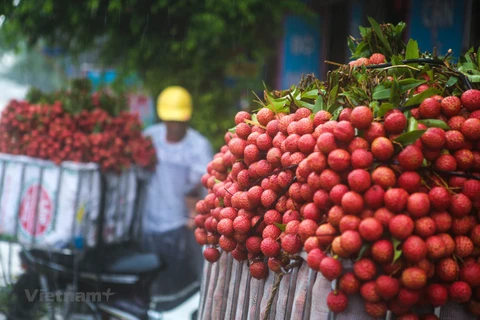
Vietnamese fresh lychees (Photo: VNA)
 Hanoi (VNA) - The Ministry of Industry and Trade (MoIT) has proposed Japan’s Ministry of Agriculture, Forestry and Fisheries (MAFF) to consider special and creative solutions solving difficulties for Vietnam’s export of fresh lychees to Japan.
The proposal was sent by Minister of Industry and Trade Tran Tuan Anh after the MAFF announced that it was impossible to send experts to Vietnam to inspect and recognise the disinfection treatment system of fresh lychee exported from Vietnam due to the impact of the COVID-19 pandemic, therefore, the export of Vietnam’s fresh lychee to the Japanese market for the first time would not be implemented in the 2020 lychee harvest.
In the proposal, Anh said the handling of such difficulties would be suitable with the ASEAN–Japan Economic Ministers' Joint Statement on Initiatives on Economic Resilience in Response to the Corona Virus Disease (COVID-19) Outbreak.
The MoIT leader has also asked the Vietnamese Ambassador in Japan to work with the MAFF to persuade them to consider other solutions instead of having to send experts to Vietnam to inspect disinfection facilities.
The solutions include giving temporary authority to independent inspection organisations in Vietnam to inspect disinfection facilities in the short term or coordinating with the Ministry of Agriculture and Rural Development of Vietnam to implement remote inspection measures (checks on files and via livestream of disinfection facilities).
The ministry has also sent document to its branches in the northern provinces of Hai Duong and Bac Giang, which are hubs of Vietnamese lychees, asking them to closely coordinate with its agencies to solve difficulties for the export of lychees to Japan.
According to Director of the Ministry of Agriculture and Rural Development’s Plant Protection Department Hoang Trung, all the technical issues to ship lychees to Japan have been completed, including growing area codes, the issuance of codes for packaging facilities, especially the building of disinfection treatment facilities following the Japan’s request.
The lychee is currently growing well, Trung said, adding that his department has sent officials to localities, conducting a food hygiene programme for lychees.
This year, Bac Giang province has over 28,000ha of lychees with an estimated output of over 160,000 tonnes, an increase of 10,000 tonnes year-on-year.
To prepare for the first fresh lychee batch exported to Japan, Bac Giang authorities have coordinated with the Plant Protection Department to select and propose the Japanese side to approve 19 growing area codes with a total area of 103ha, with an estimated output of 600 tonnes in Yên The and Luc Ngan districts.
Meanwhile, Hai Duong province has 9,700ha with an estimated output of 45,000 tonnes. The province has built 23 lychee and longan growing areas, which met standards of Japanese, American, Australian and EU markets for plant quarantine and food safety./.
VNA