Vietnam sees falls in HIV/AIDS patients for 8 years in a row

The numbers of HIV carriers, AIDS patients and AIDS-related deaths in Vietnam have decreased for the eighth consecutive year in 2015 thanks to great effort in HIV/AIDS prevention, treatment and care.
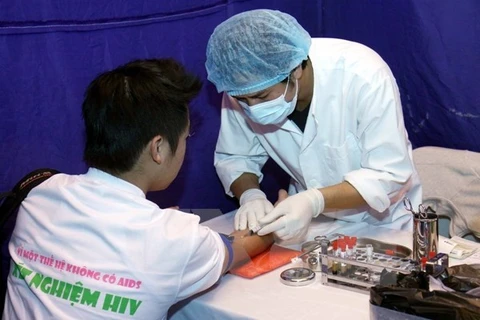
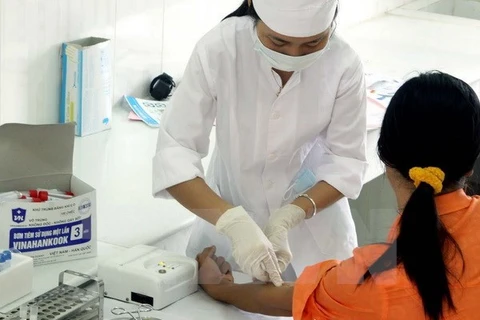
Vietnam sees falls in HIV/AIDS patients for 8 years in a row ảnh 1A nurse collects blood sample for HIV testing (Photo: VNA)

Bac Ninh (VNA) – The numbers of HIV carriers, AIDS patients and AIDS-related deaths in Vietnam have decreased for the eighth consecutive year in 2015 thanks to great effort in HIV/AIDS prevention, treatment and care.

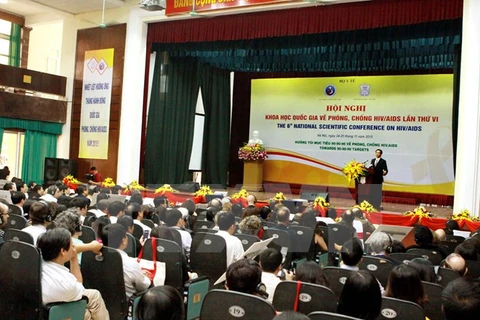
The achievement was highlighted at a meeting in Bac Ninh City, northern Bac Ninh province on November 29 in response to the national action month for HIV/AIDS prevention and control in 2015, themed “Towards 90-90-90 target to end AIDS epidemic in Vietnam”, and the World AIDS Day (December 1).

The event, organised by the Ministry of Health, the Ho Chi Minh Communist Youth Union (HCYU) Central Committee and the provincial People’s Committee, brought together youth and medical workers from ten provinces in northern Vietnam.

In his remarks, Deputy Health Minister Nguyen Thanh Long said HIV/AIDS has remained a major threat to human health across the globe and a great burden to economic development and security. The world today has about 36.9 million HIV-positive patients and approximately 40 million people have died of AIDS, Long stated.

Vietnam has delivered a comprehensive set of services for HIV prevention, treatment care and support, notably the mobile HIV testing and consulting programme in community settings, the official said, adding that the country is on the right track to achieve the 90-90-90 target for HIV/AIDS prevention and control by 2020, towards the ending of the epidemic by 2030 as set by the United Nations.

The UN’s 90-90-90 Plan aims at: 90 percent of people living with HIV will know their status, 90 percent of people who know their status are on regular antiretroviral (ARV) treatment and 90 percent of all people on treatment will have undetectable levels of HIV in their body (known as viral suppression) by 2020.

In 2014, Vietnam was the first Asian-Pacific country responding to the plan . Since 1990, approximately 230,000 Vietnamese people have been found living with HIV, of whom 85,000 were died of AIDS.-VNA

VNA

See more

The number of foreign tourists coming to Ho Chi Minh City for travel combined with medical check-ups is increasing. (Photo: VNA)

Vietnam looks to unlock medical tourism potential with national strategy

The draft strategy aims to position Vietnam as a trusted healthcare destination in Southeast Asia by 2030 and eventually among Asia's leading medical tourism hubs. The plan marks a shift from viewing medical tourism as an untapped opportunity to making it a national development priority.

Delegates at the conference. (Photo: VNA)

Vietnam to produce first homegrown next-generation vaccines from 2028

Under the agreement, Sanofi will transfer technology to VNVC to manufacture selected high-demand vaccines for children and adults at VNVC Vaccine and Bioproduct Plant. The first next-generation vaccines produced in Vietnam are expected to roll off production lines in 2028.

Eric and Alysha joyfully welcome their baby through Mini IVF after more than 10 years of waiting. (Photo: Hong Ngoc Phuc Truong Minh General Hospital)

Vietnam - a destination for journeys to parenthood

An increasing number of international families are choosing Vietnam for infertility treatment, embarking on journeys to parenthood that transcend geographical distance and differences in nationality.

Prime Minister Le Minh Hung delivers remarks at the inauguration ceremony for Viet Duc University Hospital's second campus in Ninh Binh province. (Photo: VNA)

PM urges modern restructuring of healthcare network

The PM stressed that throughout the country’s development process, people have consistently been regarded as the centre, the driving force, the objective and the most important resource for national development. Sustainable and rapid development requires not only a healthy, knowledgeable and skilled population but also a modern, equitable, efficient, sustainable and accessible healthcare system.

Thu Duc General Hospital, with a capacity of 1,000 beds, was inaugurated and put into operation in April 2025 (Photo: VNA)

Ho Chi Minh City moves to expand robotic surgery to gateway hospitals

According to the municipal Department of Health, developing gateway hospitals is a key pillar of the city's strategy to establish a regional specialised healthcare system. The network is designed to permanently relieve overcrowding at major downtown hospitals while strengthening strong inter-regional emergency care and treatment network.

Doctors conduct health screenings for children in Tru Van Tho commune, Ho Chi Minh City. (Photo :VNA)

Ho Chi Minh City moves closer to universal health check-ups

Achieving universal health check-ups in 2026 will lay the foundation for a new healthcare model in which every resident has an electronic health record, receives regular screenings, benefits from lifelong health management and gains access to early intervention through primary healthcare services.

Illustrative photo: Internet

Dengue cases rise, outbreaks become more unpredictable

Vo Hai Son, Deputy Director of the ministry's Administration of Disease Prevention, said dengue fever is no longer following previous epidemiological trends. In 2025, infections remained elevated through November and December rather than declining at the end of the year as had traditionally been the case, indicating a shortening outbreak cycle.