Vietnam should tap Halal market's potential: Deputy Minister

Vietnam should strive to tap the potential Halal market considering its location in Southeast Asia - South Asia - South Pacific region, which is home to 860 million Muslims, accounting for 66 percent of the total Muslim population in the world, Nguyen Quoc Dung, Deputy Minister of Foreign Affairs said.
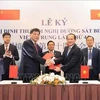
Vietnam should tap Halal market's potential: Deputy Minister ảnh 1At the event (Photo: VNA)

Hanoi (VNA) – Vietnam should strive to tap the potential Halal market considering its location in Southeast Asia - South Asia - South Pacific region, which is home to 860 million Muslims, accounting for 66 percent of the total Muslim population in the world, Nguyen Quoc Dung, Deputy Minister of Foreign Affairs said.

Dung made the call at a workshop held on December 20 by the Ministry of Foreign Affair in collaboration with theMinistry of Agriculture and Rural Development on exports to the Halal market.

"Even in the domesticmarket, the demand for Halal products is also growing as the number of Muslimscoming to Vietnam to travel, work and study is on the rise. The Muslim communityin Vietnam is also increasing day by day," hesaid.

The deputy minister noted that however, only about 50 Vietnamese companies are granted Halal certificates each year. Currently, Vietnam has about 20 items exported to the Halal market, a very small number compared to the potential, Dung said, adding that up to 40 percent of Vietnamese localities do not have Halal-certified products.

Phung Duc Tien, Deputy Minister of Agriculture and Rural Development said 50 percent of Vietnamese agriculturalproducts such as rice, vegetables, tea, coffee, cashew and pepper are consideredvery suitable for the Halal market.

But participants at the eventsaid enterprises are facing many difficulties in exploiting this market due todifferences in business culture, consumer tastes and especially Halalcertification. The existence of many Halalsystems and different standards for each product is also a problem, they said.

Samina Naz, the Bangladeshi Ambassador to Vietnam, said Bangladesh is a large market with high potential. The ambassador wanted theBangladeshi business community in Vietnam to participate in the production andsupply of food to Bangladesh. She also said Vietnameseinvestors can go to Bangladesh to invest in cattle breeding because this isan area of great demand in the country and can grow very quickly.

Meanwhile, Tran Viet Thai,Vietnamese Ambassador to Malaysia said the number of Vietnamese agriculturalproducts exported to Malaysia is still limited, most of them haven’t beenprocessed and the export is made via Thai traders, so the value is not high. According to him, long-term strategies are needed to penetrate the Halal market./.

VNA

See more

Chili peppers are on the list of essential goods in Indonesia (Photo: VNA)

Indonesia reduces imports of strategic food commodities

In 2026, Indonesia is expected to have approximately 12 million tonnes of rice carried over from the previous year, supported by annual production of around 34.7 million tonnes. With projected consumption of 31.1 million tonnes, national rice reserves could reach approximately 16 million tonnes by the end of the year.

Hanoi’s roadmap to implement low-emission zones from July is providing a strong boost to the electric two-wheeler market (Photo: VNA)

Low-emission zone roadmap drives electric two-wheeler boom in Hanoi

From July 1, Hanoi will introduce time-based or area-based restrictions on petrol-powered motorcycles within Ring Road 1, with plans to expand coverage across the entire zone by 2028 and extend to areas within Ring Road 3 by 2030. The policy is expected to reshape travel habits for millions of urban residents.

Delegates at the opening ceremony of the Made in Da Nang Expo 2026 (Photo: VNA)

Nearly 300 firms join Made in Da Nang Expo 2026

Speaking at the opening ceremony, Vice Chairman of the Da Nang People’s Committee Tran Chi Cuong said the exhibition is a large-scale trade promotion event aimed at showcasing products, connecting markets, and helping businesses enhance competitiveness while expanding domestic and export markets.

 Green production, standardised value chains key to fruit, vegetable sector growth

Green production, standardised value chains key to fruit, vegetable sector growth

Facing mounting pressure from increasingly stringent domestic and international standards, Vietnam’s fruit and vegetable sector is accelerating its shift toward green, safe, and sustainable production models. Beyond changing farming practices, localities and businesses are stepping up efforts to standardise value chains and build brands to achieve growth targets for 2026.

Hiep Phuoc Industrial Park in Ho Chi Minh City. (Photo: VNA)

Southern industrial real estate enters strategic growth phase

Key industrial hubs in the south, including Ho Chi Minh City, Dong Nai and Tay Ninh, are transitioning from a period driven largely by supply expansion and rising land prices to a more refined growth model. This new phase is shaped by infrastructure upgrades, supply chain restructuring, product improvement and greater emphasis on operational performance.

The launch of the Vietnam National Brand Week 2026 on April 16 (Photo: VNA)

Vietnam National Brand Week 2026 opens

Running from April 16 to 23 nationwide, the Vietnam National Brand Week 2026 marks the 18th anniversary of Vietnam Brand Day (April 20, 2008 – 2026).

Ca Mau is currently home to more than 5,200 fishing vessels, including nearly 1,900 boats measuring over 15 metres in length, and all have been equipped with vessel monitoring systems. (Illustrative photo: VNA)

Ca Mau drives changes among fishermen to tackle IUU fishing

Ca Mau is stepping up communication campaigns to disseminate legal regulations on IUU fishing, highlight recent enforcement results, and convey recommendations from the European Commission (EC)’s fifth inspection mission to fishing communities and relevant stakeholders.