Hanoi (VNS/VNA) - Vietnam continues to demonstrate resilience amid the current geopolitical uncertainties and the pressing impacts of climate change, but concerns remain as the country moves forward, according to Ramla Khalidi, United Nations Development Programme (UNDP) in Vietnam.
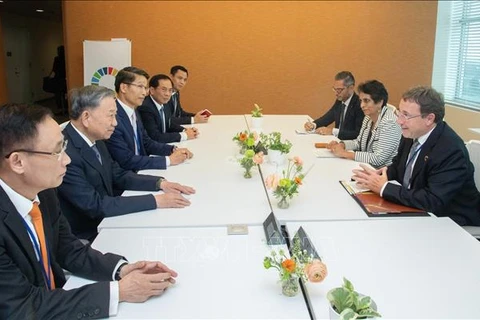
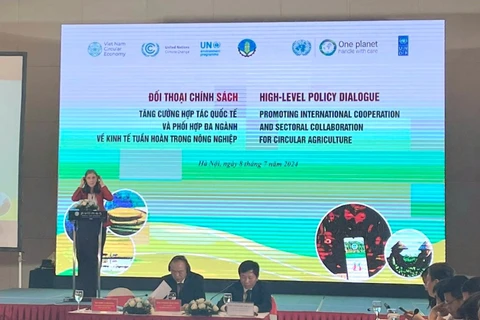
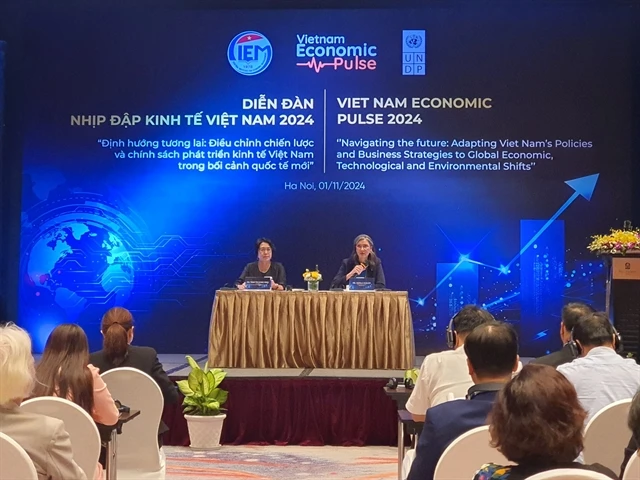
She made the remarks at the fourth Vietnam Economic Pulse (VEP) held in Hanoi on November 1, which gathered leaders and experts from across government, business and academia to discuss Vietnam’s evolving policy landscape amid global economic uncertainties, rapid technological change and the intensifying impacts of climate change.
Jointly organised by the Central Institute for Economic Management (CIEM - under the Ministry of Planning and Investment) and the United Nations Development Programme (UNDP), the event has become a collaborative annual forum for exploring policy directions resonating with emerging trends in technology and environmental sustainability.
The UN official said: “While there is optimism around Vietnam’s economy, there are also remaining cautions. The experience of successful case studies in Asia suggests that Vietnam has yet to achieve the focused policy results needed to sustain high rates of economic growth.
“Efforts to improve Vietnam’s economic performance and transformations in the global economy must meet the increasingly stringent environmental requirements.”
Addressing the event, CIEM Director Tran Thi Hong Minh said: “Today’s forum underscores our commitment to fostering a resilient, sustainable and inclusive economic pathway for Vietnam.
“As we navigate an increasingly complex global landscape marked by geopolitical shifts and environmental challenges, this platform allows us to chart a forward-looking course, positioning Vietnam as a leader in green technology, innovation and sustainable growth.”
Vietnam's economy in the period from 2024 to 2025 faces a pivotal juncture, marking the final stages of the 2021-2025 socio-economic development plan, she stressed. The achievement of Vietnam’s economic goals hinges on outcomes in these two years, saying that concentrated effort during this “drop point” will be crucial.
Growth prospects
Presenting Vietnam’s current economic status and outlook for the next year, Nguyen Huu Tho, Head of the CIEM’s Economic Analysis and Forecast Department said the country has regained the growth momentum similar to the pre-COVID period, at a relatively high rate of 6.8-7%.
The International Monetary Fund (IMF) also considered Vietnam’s growth rate this year to be the highest among ASEAN countries, he added.
He noted Vietnam’s deep integration with the global economy, implying that international developments will significantly impact the country’s economic trajectory. Although he anticipates global geopolitical instability, he projects a positive outlook for global economic growth due to a potential recovery in trade and improved inflation control.
Domestically, there are encouraging signs within the business sector. Orders for 2024 already show notable improvement over 2023, fostering optimism for increased productivity and enterprise expansion. However, the dynamics of enterprise turnover highlight challenges: for every 100 new businesses entering the market in previous years, 50 left, resulting in a net gain of 50. By contrast, in 2024, 89 enterprises exited for every 100 newcomers, leaving only 11 to carry forward, illustrating the volatility in business retention that may impact Vietnam's growth objectives.
The expert’s insights highlight a balanced outlook for Vietnam's economy in 2025. Although Foreign Direct Investment is anticipated to remain robust, its economic impact is uneven across Vietnam, with 74% concentrated in 14 provinces and cities, including Hanoi and Ho Chi Minh City. This concentration reflects FDI’s focus on import-processing for export, leading to limited direct contributions to domestic growth.
Domestically, purchasing power is expected to see little change in 2025, with income levels yet to achieve a breakthrough. However, international tourism is projected to grow, positively impacting GDP growth, although the benefits may vary across regions.
Exports are forecasted to perform well, contingent on stable global geopolitical conditions. Rising trade defence measures present a challenge, with an increasing number of trade defence cases per billion US dollars in trade. Infrastructure development, both digital and transport, along with institutional reforms, are seen as significant contributors to Vietnam's economic resilience in the coming year. Accordingly, inflation is expected to remain controlled and GDP growth could surpass 2024 by up to 0.4%.
Reform needed
To sustain economic momentum, the Central Institute for Economic Management (CIEM) emphasises institutional reform, focusing on reducing business conditions and administrative procedures. By 2030–2040, it aims for a stable institutional framework to minimise frequent amendments. For resource allocation, CIEM recommends prioritising emerging and resilient businesses, such as those returning to the market or producing import-substitute goods, to maximise growth support in a resource-limited environment.
However, there is an increasing disparity between the domestic and the FDI sectors from 2010 to 2024, meaning the domestic economy is not adequately robust to expand its presence in international markets.
So challenges remain and the domestic economic sector, for instance, lacks the strength to expand significantly in international markets. While structural shifts toward modernisation are underway, progress is slower than anticipated. Furthermore, key economic hubs —Vietnam's 'economic locomotives'—have shown signs of slowing down. To sustain momentum into 2025, the economy will need notable advancements and strategic progress, experts told the forum.
Meanwhile, the structural transition towards modernisation (increasing proportions of industry and construction sectors) is happening at a slower pace than expected.
Entering 2025, FDI, export and infrastructure are projected to be the highlights of Vietnam’s economy. International forecast agencies also predict that inflation will be well-controlled, while the country should boast a growth rate equal to or at 0.2-0.4% higher than 2024.
Perfecting institutions, mobilising resources, developing infrastructure and devising support policies for business and export are part of the key recommendations for economic growth going forward, the CIEM representative said.
Domestically, purchasing power is expected to see little change in 2025, with income levels yet to achieve a breakthrough. However, international tourism is projected to grow, positively impacting GDP growth, although the benefits may vary across regions.
At the event, experts also discussed Vietnam’s readiness for green transition and how to leverage international environment standards for the country’s competitive exports, as well as enhancing efficiency, productivity and technological advancements to bolster Vietnam’s long-term economic performance./.