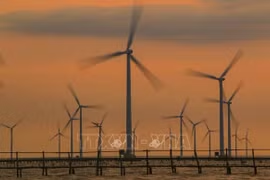
Wind turbines at the off-shore Dong Hai wind power plant in southern Tra Vinh province. ( Photo: VPG)
This is to establish a comprehensive hydrogen energy industryecosystem from production to storage, transportation, distribution, and utilisationof hydrogen, Minister of Industry and Trade Nguyen Hong Dien said at a recentgovernment meeting on Vietnam's hydrogen and off-shore energy development.
Dien said the Ministry of Industry and Trade (MoIT) has started aprocess to gather feedback and opinions provided by economic experts andcontinued to study and consolidate reports from competent authorities toestablish timely policy mechanisms for addressing current challenges andobstacles.
He said the country's draft Hydrogen Production Strategy by 2030,with a vision towards 2050, aims to strive for hydrogen production capacityfrom renewable energy, producing green hydrogen and other processes with carboncapture reaching 100,000-500,000 tonnes by 2030 and targeting around 10 - 20million tonnes by 2050.
Off-shore
Regarding the development of offshore wind and gas power,according to Power Plan VIII, by 2030, the total additional electricitycapacity from gas projects (30,424MW) and offshore wind projects (6,000MW) willconstitute about half of the Southeast Asian economy's electricity capacity.
The development of gas and offshore wind power sources will help Vietnamfulfil its commitment to carbon neutrality by 2050. Gas projects provide astable foundation for flexible and reliable electricity, supporting wind andsolar power projects to ensure a stable power supply.
Hoang Tien Dung, Director of the Electricity and Renewable EnergyDepartment under the MoIT, said the practical implementation of gas powerprojects, including investor selection, feasibility study approval, powerpurchase agreement negotiations, capital arrangement, and EPC contractexecution, requires 7-8 years. For offshore wind projects, the implementationperiod is around 6-8 years from the survey phase.
"Deploying gas and offshore wind projects to meet theoperational deadline before 2030 will likely prove to be a significantchallenge," said Dung.
Pham Van Phong, CEO of Vietnam Gas Corporation (PV GAS), said Vietnamhas yet to implement a financial policy, a consumption mechanism for gas power,or a mechanism for converting gas prices to electricity prices. This lack ofclarity and direction in the investment projects results in uncertainty aboutcapital recovery and investment arrangement, hindering progress.
"So far, the country has only completed an LNG storage andport complex at the Thi Vai area in the southern Ba Ria-Vung Tau province,ready to supply regenerated LNG to consumers in the Southeast region. Otherport facilities, including some planned in LNG power projects, are facing manydifficulties and challenges, including technical and regulatory issues,"Phong said.
Infrastructure
Industry experts and insiders have long voiced their concerns overthe country's current LNG import infrastructure, which has been consideredlargely insufficient to meet the goals set in Power Plan VIII. Furthermore, thelack of consideration for connecting LNG import infrastructure with powerplants will not optimise resources, reducing investment efficiency and wasting Vietnam'smaritime resources.
"Except for hydrogen, the current sectors related to theimplementation of Power Plan VIII under PVN's responsibility are beingimplemented. However, due to the lack of mechanisms and policies for gas andoffshore wind power, there are high risks for investors," said Le Manh Hung,Chairman of the Vietnam Oil and Gas Group (Petrovietnam).
He said, for domestic gas-fired power using natural gas, the statebenefits significantly, with nearly 505 of the revenue from 1kWh going towardsvarious taxes and fees. However, incomplete mechanisms increase risks duringthe implementation process.
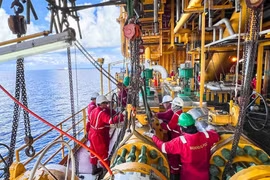
"As for offshore wind power, due to similarities withoffshore oil and gas activities globally, such as seabed surveys andinvestigations, Petrovietnam is fully capable. However, the current issue isthe lack of mechanisms, policies, planning, and a responsible agency to approvedecisions," he said.
Pham Duc Hieu, permanent member of the Economic Committee of theNational Assembly, advised the Government to form a group of experts fromrelevant ministries to review cross-sectoral policies along with independentexperts to propose amendments to harmonise legal documents. The EconomicCommittee's standpoint is not to create standalone legal documents.
Nguyen Quoc Thap, Chairman of the Vietnam Petroleum Association(VPA), said there is a need to allow ministries, sectors, and businesses toimplement projects simultaneously with the process of refining legalframeworks.
He suggested that, given the current circumstances, majoramendments are required, from investment law to electricity law, price law, andbidding law. Waiting for these laws to be amended will take a long time.Therefore, MoIT, as the leading advisory agency for the Government, needs topropose to the National Assembly a comprehensive resolution on equal rights todeploy all sources of electricity, such as offshore wind power, gas power, and LNGpower./.
VNA