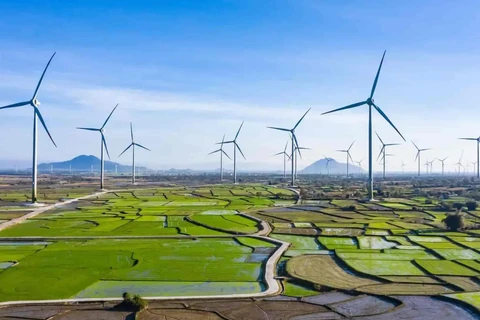
A floating solar farm in Binh Thuan province. (Photo: VNA)
 The new criteria would serve as a foundation for governmental ministries, agencies, local authorities and industry to filter and select investment projects, as well as to allocate resources, said Deputy Minister of Planning and Investment Nguyen Thi Bich Ngoc.
Investors should refer to the criteria as a guideline for governmental preferential policies and available financial resources.
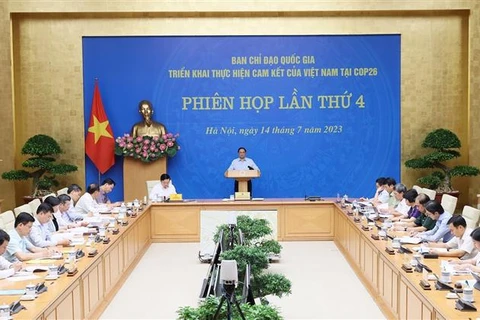
Ngoc said developing green industries remained a top priority for the Vietnamese government as part of the country's commitment to global efforts to fight climate change. Following the 26th UN Climate Change Conference (COP26), the National Green Growth Strategy for the 2021-2030 period with a vision to 2050 has been approved by the Prime Minister.
She said the strategy was to play a vital role in the Southeast Asian country's objective of net-zero emission by 2050, and its Nationally Determined Contributions (NDC), self-defined national climate pledges under the Paris Agreement.
Major stakeholders such as governmental ministries and agencies, local authorities and industrial sectors would be required to do their parts in the promotion of the country's shift to sustainable and clean energy, the development of energy-efficient industrial zones and electric vehicles.
The ministry stressed the importance of foreign investors and stronger cooperation and exchange of ideas, technologies and financial resources.
Ngoc said greener industrial development was a global movement that should be embraced by all, especially developing nations despite current challenges and limitations.
The MPI advised the government to quickly establish a business environment that is conducive to sustainable and green development with policies and tools designed to encourage and mobilise financial resources from all stakeholders, including the private sector.
In addition, growth could only be achieved and sustained by focusing on creating breakthroughs in efficient energy management, limiting the production and consumption of fossil-fuel-based transportation, building green infrastructure, carbon-neutral structures, construction materials, and waste management.
In order to speed up the process, the ministry strongly recommended a solid legal framework to be put in place in the near future, as well as strong incentive programmes to attract investments.
Meanwhile, the country's economy must also start viewing its green development as part of the international community and therefore, Vietnam's legal mechanisms and policies must be in line with that view.
Ngoc said MPI had been instructed by the central government to start making a plan to introduce stronger incentives to encourage international organisations and partners to take a more proactive part in the development of green industries in Vietnam.
In recent decades, Vietnam has been at the forefront of green development among the world's developing nations as the country pushed for greater investment in renewable energy, environmental protection, circular economy, sustainable agriculture and green infrastructure while signing up for numerous international agreements on reducing carbon footprint and climate change.
In the recently approved Power Development Plan 8 (PDP8), the country aimed to draw a minimum of 30.9% of its energy from renewable sources, increasing to 67.5% by 2050./.
VNA