Apple assembler Foxconn is planning to build a 40 million USD factory in Dong Mai Industrial Park in Quang Ninh prvince. (Photo: 9tomac)
 Hanoi (VNS/VNA) - Vietnam needs stronger human resources to serve the growing integrated circuit (IC) industry to create greater investment opportunities.
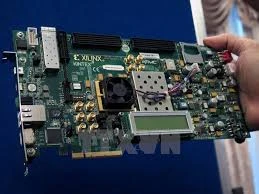
Mai Anh Tuan from the National Centre for Technological Progress under the Ministry of Science and Technology, said: "IC is at the heart of all electronic devices. The industry offers core support to other industries such as information technology, telecoms, and mechanical and automated engineering.”
Tuan said that “The US-China trade war will rearrange global industrial production. Vietnam is one of best equipped countries in the region to attract a hi-tech production investment wave.”
Big IC companies such as Samsung, LG, Sharp and Foxconn are reported to be planning to expand in the country.
With 20 years of experience in the industry, Terry Teh, director at Advinno Technologies Pte Ltd, Singapore could also see the opportunities for Vietnam.
“Vietnam is strong in IC design so a lot of multi-national companies are coming to the country,” he said.
Teh also said Vietnam could build an ecosystem with the Government, universities and companies involved to boost development in the country.
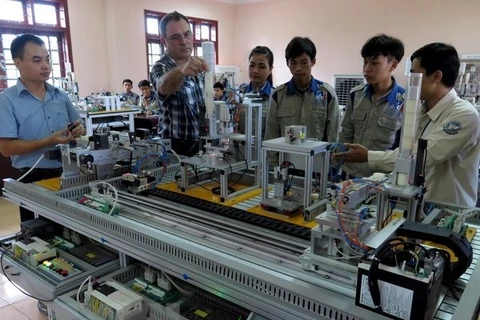
However, Tuan, who runs the IC Microfabrication Laboratory and Pilot Plant Center at Hoa Lac High-tech Park, said: “Vietnam is lacking well trained IC engineers.”
There are about 100,000 fresh under-graduate engineers each year, but they are still far behind the middle- and high-level IC engineers needed in the country over the next five years as the industry rapidly grows.
There are now more than 300,000 enterprises in HCM City and the number is forecast to reach 500,000 in 2020, raising the demand for high-quality labour.
The demand for highly skilled workers has grown at least 20 percent per year in the last three years, but labour supply cannot meet demand.
Tuan said to fill the gap Vietnam should also introduce IC training at local vocational and short-term training centres, as well as colleges and universities.
According to Tran Phu Duy, a research associate at Future Industries Institute, University of South Australia, Vietnam and Australia are cooperating in technology and innovation, and Australia will help Vietnam to grow its technology workforce to serve the 4.0 era. Thus, Vietnam has a good opportunity to develop its IC engineers.”
Duy, who is an expert in sensor and microchip research, is co-operating with the Vietnam Institute of Technology Application to research and manufacture biochemical sensors with ultra-high sensitivity that can quickly detect the risk of pre-eclampsia.
He said that human resources were both an advantage and challenge for Vietnam.
“It is a challenge to train IC staff but it is more difficult to keep them once they are skilled,” said Duy, adding that the country needed a mechanism to attract knowledgeable experts and researchers who could train adjacent engineers to develop the IC industry.
Agreeing with Duy, Tuan said few people worked in the industry and those that did keep switching jobs for higher salaries, causing instability in the local industry.
He said: “Vietnam should create better conditions to train more IC engineers as well as to attract Vietnamese IC experts who are working in Japan, South Korea, Taiwan and the US to serve their country.”
As a first step to solving the problem, Phenikaa Group has decided to spend 500 billion VND (21.5 million USD) on a fund for research and training human resources in IC design. President of the group Ho Xuan Nang made the announcement at a workshop which gathered 100 international and domestic experts in Hanoi this month.
The workshop on IC Design and Fabrication (We Fab) was held for the second time in Hanoi to discuss IC simulation and modelling; specialised IC design and manufacturing; sensor technology; and Industry 4.0 and its impacts on Vietnam’s future industry./.
VNA