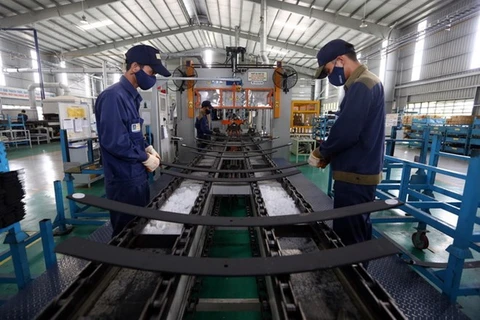
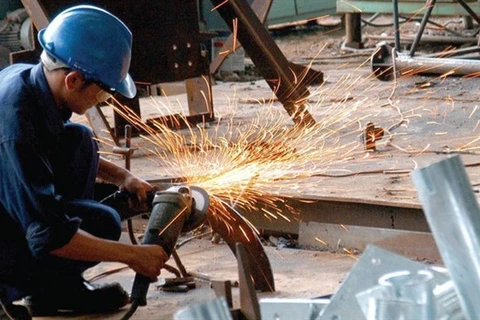
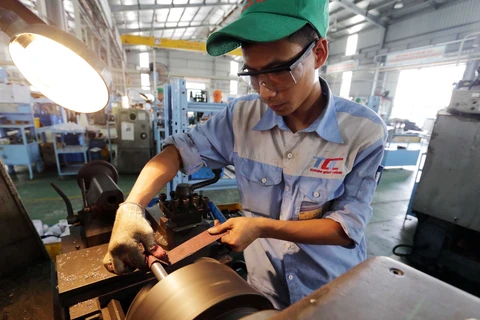
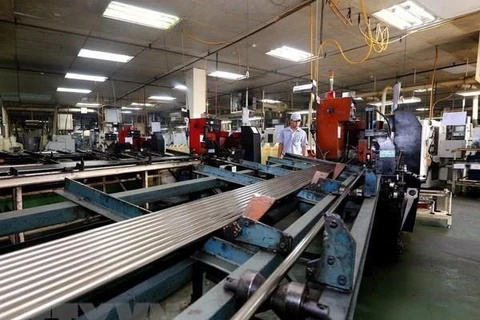
A mechanical factory in the Chu Lai Open Economic Zone, Quang Nam province (Photo: VNA)
 Hanoi (VNA) - Vietnam needs to adjust its development strategy for the mechanical engineering industry to ensure it develops sustainably.
So said business associations at a conference promoting Vietnam's mechanical engineering industry, held in Hanoi on May 14 by the National Assembly's Committee for Science, Technology and Environment.
At the conference, they said the nation should create technical infrastructure for the economic and industrial sectors to produce a number of technical products instead of joining to foreign production chains.
To develop the local mechanical engineering industry, they said the State should have appropriate, protective policies. Vietnamese mechanical enterprises have lost much of their domestic market share, according to the association.
Representatives of the Vietnam Association of Mechanical Industry (VAMI) and some businesses said that since 2013, the industry has begun to see development slow, with the exception of automobile and motorcycle manufacturing, which has maintained a high growth rate.
Reasons for the slowdown included a wider economic slowdown and high interest rates for loans.
Despite that, the State and the private sectors have in recent years invested billions of US dollars in buying equipment, machinery and production tools to develop technical infrastructure and build many new factories.
Speaking at the conference, Chairman of the NA’s Committee for Science, Technology and Environment Phan Xuan Dung said the State has given priority to developing the industry.
Dung said the industrial production value of the mechanical industry has increased year by year and many mechanical products are now made in Vietnam.
The mechanical industry is considered a key factor in sustaining rapid national industrialisation, he said. To become an industrialised country, the Government has issued policies to encourage investment and development of the support industry and localise production of components and accessories at foreign direct investment (FDI) enterprises.
This is considered an inevitable direction for small- and medium-sized enterprises in Vietnam during the integration process.
The State has promoted the development of national research programmes for the industry and opened research and development centres to increase the number of products made in Vietnam and the localisation rate of some products, he said.
However, there are still many obstacles in the industry’s development process, Dung said. The engineering and manufacturing industry has not yet played as central a role in the national economic development as expected.
FDI enterprises are finding it difficult to coordinate with eligible domestic suppliers to reduce production costs and increase the localisation rates of their products.-VNA
VNA