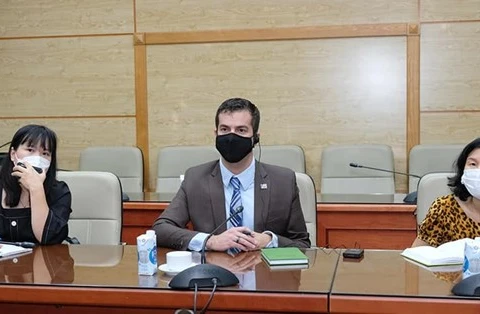
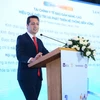
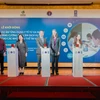
At the working session (Photo: VietnamPlus)
 Hanoi (VNA) – Amid the spread of dangerous epidemics around the world, the Vietnamese Ministry of Health (MoH) and the US Centre for Disease Control and Prevention (CDC) will further expand cooperation to cope with the challenges of the future.
The MoH suggested the US CDC continue helping Vietnam carry out programmes on the prevention and control of dangerous epidemics such as influenza, COVID-19, animal-borne diseases, HIV/AIDS, infectious diseases, nosocomial infections, antibiotic resistance, and the Global Health Security Agenda (GHSA) in Vietnam.
Acting Health Minister Dao Hong Lan made the suggestions during her working session with the US CDC's Vietnam Country Director Eric Dziuban in Hanoi on September 6.
Lan stressed that over the past time, the US Government, the Department of Health and the CDC had assisted the Vietnamese Government and people in the fight against COVID-19, especially with medical equipment and COVID-19 vaccines.
 US CDC's Vietnam Country Director Eric Dziuban (Photo: VietnamPlus)
 Medical cooperation between Vietnam and the US has been growing over the past 25 years, in which cooperation with the US CDC is extremely important content, focusing on important areas such as fighting infectious diseases, HIV/AIDS, zoonotic diseases, nosocomial infections, antibiotic resistance, and improving test capacity at labs.
The US CDC has been carrying out the GHSA, the field epidemiology training programme, supporting the establishment and operation of the Public Health Emergency Operation Centre (EOC) in the MoH and four regional institutes.
The Acting Minister said via funding and technical support projects, the US CDC has contributed to improving the efficiency of epidemics forecasting, prevention and control, particularly COVID-19, HIV/AIDS, tuberculosis, antibiotic resistance, and the GHSA in Vietnam.
With the permission of the Vietnamese Government and on the back of effective cooperation between the US CDC and Vietnam, the CDC Regional Office in Southeast Asia has been set up in Hanoi, which proves trust in collaboration and ensures health security in the region and the world.
The office, based in Ngo Quyen street in downtown Hanoi, is one of the CDC's four in the world, together with the East Europe/Central Asia office in Gruzia, the Middle East/North Africa office in Oman, and the South America office in Brazil.
It will strengthen the CDC's ability to meet its mission of protecting Americans and the region's people by responding more rapidly to health threats wherever they occur and building key relationships to tackle shared health priorities.
The Southeast Asia regional office is led by a Regional Director, the most senior CDC official in the region. It serves as the CDC Director's representative, responsible for ensuring a coordinated and cohesive approach to the agency's global health strategy.
Dziuban, for his part, underlined the achievements of Vietnam's medical sector in the fight against COVID-19.
As the public health context is ever-changing, work must continue to ensure that Vietnam has been equipped with the best foundation, he said, adding that the US CDC pledges further to strengthen medical coordination between Vietnam and the US and commits to the common goal of further promoting domestic health care system.
According to him, the US CDC is offering continuous technical support when Vietnam is preparing guidelines for the supervision, diagnosis and treatment of monkeypox – an emerging disease worldwide.
Since early June, when warnings of monkeypox began spreading globally, and the World Health Organisation (WHO) declared its outbreak a Public Health Emergency of International Concern, the US CDC has worked closely with the MoH to ensure Vietnam's readiness in response to the epidemics.
The US CDC is also providing technical assistance in Vietnam National CDC development plans to strengthen further the country's health system capacity and response to emergency and non-emergency situations./.