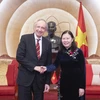
Prime Minister Nguyen Xuan Phuc (fifth from right) and Indian Vice President Venkaiah Naidu (sixth from right) (Source: VNA)
 Hanoi (VNA) – Vietnam welcomes India’s investment in the fields of information technology, infrastructure, energy and hi-tech agriculture, Prime Minister Nguyen Xuan Phuc has said.
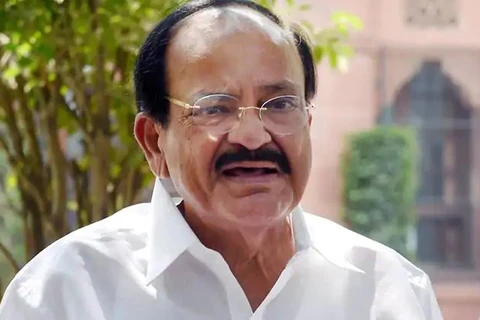
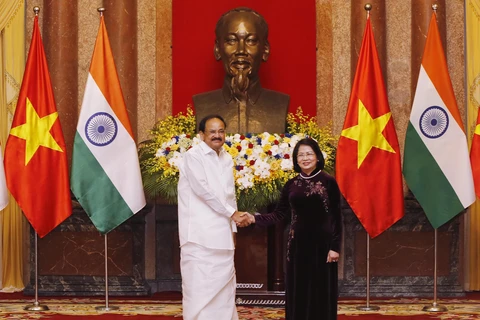
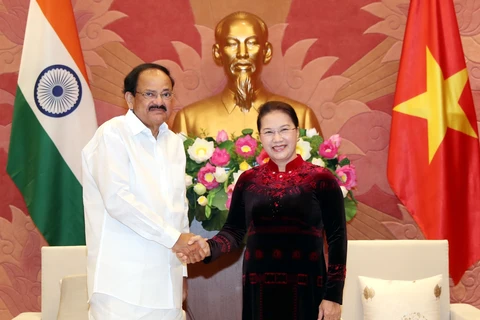
Receiving Indian Vice President Venkaiah Naidu, who is also Chairman of the Rajya Sabha (Upper House) of the Parliament of India, in Hanoi on May 11, PM Phuc voiced his belief that the visit will contribute to maintaining high political trust and boosting collaboration in all spheres between the two countries.
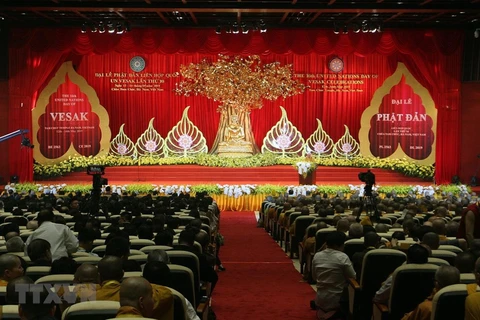
Vice President Naidu appreciated Vietnam’s efforts and contributions to religious and Buddhist activities, believing that the 16th UN Day of Vesak hosted by the country would be a success.
The leaders agreed to maintain the exchange of all-level delegations and meetings, people-to-people exchanges and existing cooperation mechanisms.
They emphasised the importance of bilateral cooperation in defence and security. PM Phuc proposed India continue assisting Vietnam in human resource training, boosting collaboration between the two armies and sharing experience in UN peacekeeping operations.
Both leaders held that economic and trade cooperation remains a pillar in bilateral relations and agreed to lift the two-way trade value to 15 billion USD in the time to come. They consented to consider the opening of the Indian market for Vietnam’s longan, grapefruit, rambutan and durian, and allowing India’s pomegranate, grapes and millet to enter the Vietnamese market.
The leaders highlighted the need for intensifying collaboration in other fields such as development cooperation, information technology, science-technology, culture, tourism and people-to-people exchanges.
The leaders pledged to create favourable conditions for Vietjet, Indigo and other airlines to soon launch direct air routes connecting the two nations.
PM Phuc and Vice President Naidu exchanged opinions on regional and international issues of mutual concern and agreed to maintain close coordination and mutual support at regional and international forums, particularly within the framework of the United Nations.
Regarding the East Sea issue, both leaders agreed upon the importance of peace, stability, as well as safety, security and freedom of aviation and navigation, and settlement of disputes through peaceful measures, respecting international law, including the 1982 UN Convention on the Law of the Sea (UNCLOS), and soon completing an effective Code of Conduct (COC) in the East Sea.-VNA
VNA