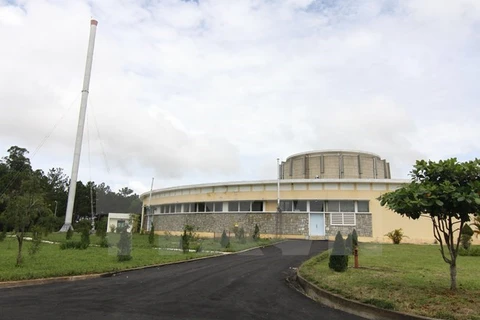
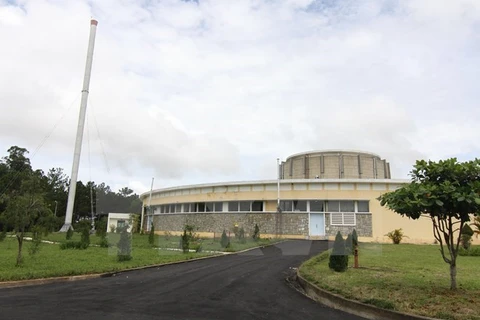
Vietnam has originally planned to start building the Ninh Thuan 1 nuclear plant in 2014 and start operations in 2020 with help from Russia's state nuclear firm Rosatom. (Source: EPA)
 Hanoi (VNA) - Vietnam has been developing a legal framework on atomic energy for the safe and effective development of nuclear power in the country.
Since the Law on Atomic Energy was adopted by the National Assembly in June 2008 and took effect in 2009, the Government has passed relevant decrees.
For example, one decree in 2010 concretises regulations and instructions on implementing the Atomic Energy Law. Another decree deals with articles in the Atomic Energy Law relating to nuclear power plant, while a third decree regulates fines for atomic energy violations.
The Prime Minister approved the establishment of the National Steering Committee on the Ninh Thuan Nuclear Power Plant Project under the decree 580/2010/ND-CP.
He also approved a plan for the development of nuclear power in Vietnam through 2030 under another decree.
In 2010, the Prime Minister approved nuclear power plans and applications for peace purposes in Vietnam until 2020.
The Ministry of Sciences and Technology also issued circulars that help to manage and control radiation security, radiation measurement and environmental observations as well as scenarios responding to nuclear power problems.
Head of Vietnam Agency for Radiation and Nuclear Safety Vuong Huu Tan said that after the Fukushima disaster in 2011, Vietnam had emphasised the importance of legal bases to prepare for its first nuclear power to be built.
However, he said there remained much work to do. He noted that Vietnam did not have clear regulations for agencies to inspect and examine the safety of nuclear power plants.
Nuclear power management was not licensed and was not an independent entity in accordance with international norms, he said.
Pham Gia Chuong, Vice Head of the Legal Affairs Department under the Ministry of Sciences and Technology, said that there were diversified legal documents relating to nuclear power directly and indirectly as well as domestically and internationally.
Vietnam has ratified international treaties and conventions including the Treaty on the Non-Proliferation of Nuclear Weapons in 1982, the Convention on the Early Notification of a Nuclear Accident and Convention on Assistance in a Nuclear Accident or Radiological Emergency in 1987 and the Comprehensive Nuclear-Test-Ban Treaty.
Chuong said Vietnam needed to continue studying other international treaties such as The Convention on the Physical Protection of Nuclear Materials, the Vienna Convention on Civil Liability for Nuclear Damage and The Joint Protocol Relating to the Application of the Vienna Convention and the Paris Convention.
Director General of the Vietnam Atomic Energy Agency Hoang Anh Tuan said at a seminar last month that Vietnam would start the construction of its first nuclear power plant in Ninh Thuan in 2020, six years later than scheduled, to ensure safety and efficiency.
After the Fukushima disaster, the Vietnamese Government ordered a review on the project's safety, causing the delay in construction, he said.
Tuan said Vietnam attached great importance to safe and effective nuclear power development in order to ensure it is in line with the recommendations of the international Atomic Energy Agency.
The country sent experts to Russia to be trained on the VVER-TOI technology and was producing relevant legal documents in a bid to safely operate nuclear power plants in the future, he said.
Vietnam has originally planned to start building the Ninh Thuan 1 nuclear plant in 2014 and start operations in 2020 with help from Russia's state nuclear firm Rosatom. The country also picked a Japanese consortium to develop a second nuclear power plant.
The Ninh Thuan 1 nuclear project will be built with an estimated investment of 200 trillion VND (8.9 billion USD). Most of the capital has been loaned from Russia.
Once completed, the plant will have a capacity of 4,000MW, contributing between 3 and 4 percent of the total capacity of national power.
Under the country's energy development plan, by 2030 nuclear power will provide 15,000-16,000MW of power representing 10 percent of the total installed capacity in Vietnam.-VNA