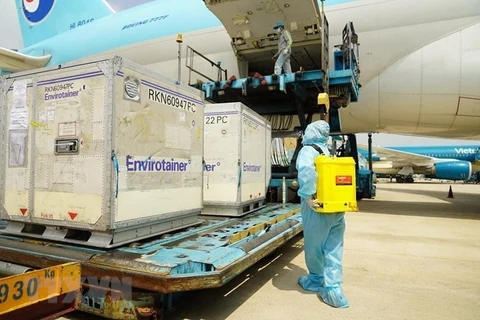
A plane carrying the first batch of 117,600 doses of COVID-19 vaccine landed at Tan Son Nhat airport, Ho Chi Minh City, on February 24. (Photo: VNA)
 Hanoi (VNA) – Vietnam’s COVID-19 vaccination will be conducted in line with the Government’s resolution, thus ensuring equal access to the vaccines, heard a recent meeting between the Health Ministry and WHO and UNICEF representatives.
The meeting took place after the first batch of COVID-19 vaccines, jointly studied and produced by AstraZeneca pharmaceutical company and the UK’s Oxford University, arrived in Vietnam on February 24.
Health Minister Nguyen Thanh Long expressed his thanked for efforts by the COVAX Facility programme to help Vietnam soon approach the vaccines.
Vietnam wishes to get quality vaccines at suitable prices and matching the country’s storage capacity, he said, pledging that his ministry will promptly deal with procedure-related issues to facilitate the delivery of COVID-19 vaccines under the COVAX Facility programme.
The ministry has assigned relevant agencies to put forth communication plans for the vaccination.
Representatives from the international organisations agreed on the need to mobilise the involvement of different economic sectors in the storage of certain vaccines like Pfizer that must be kept at minus 70 degree Celsius and can be refrigerated for only five days.
This has been the biggest vaccination campaign in Vietnam so far, with more than 100 million doses, Long said, informing that the ministry has promptly charted scenarios and mobilised the participation of all units both and outside the medical sector in this campaign.
The participants also stressed the significance of supervising and assessing the body’s reactions to the vaccine.
A plane carrying the first batch of 117,600 doses of COVID-19 vaccine landed at Tan Son Nhat airport, Ho Chi Minh City, on February 24.
Deputy Health Minister Truong Quoc Cuong highlighted the significance of the vaccine delivery at a time when the COVID-19 pandemic is erupting in Hai Duong, Hai Phong and Quang Ninh.
With the delivery, Vietnam has become one of the first countries in Asia to access a prestigious vaccine in the world.
Result from clinical trials showed that 22 days after the first shot, AstraZeneca vaccine could fully protect people from serious illness, hospitalisation and death caused by the novel coronavirus. Within 90 days, the vaccine’s potency could reach 76 percent.
Analyses showed that the vaccine could reduce infection risk by two thirds for cases without symptoms./.
The meeting took place after the first batch of COVID-19 vaccines, jointly studied and produced by AstraZeneca pharmaceutical company and the UK’s Oxford University, arrived in Vietnam on February 24.
Health Minister Nguyen Thanh Long expressed his thanked for efforts by the COVAX Facility programme to help Vietnam soon approach the vaccines.
Vietnam wishes to get quality vaccines at suitable prices and matching the country’s storage capacity, he said, pledging that his ministry will promptly deal with procedure-related issues to facilitate the delivery of COVID-19 vaccines under the COVAX Facility programme.
The ministry has assigned relevant agencies to put forth communication plans for the vaccination.
Representatives from the international organisations agreed on the need to mobilise the involvement of different economic sectors in the storage of certain vaccines like Pfizer that must be kept at minus 70 degree Celsius and can be refrigerated for only five days.
This has been the biggest vaccination campaign in Vietnam so far, with more than 100 million doses, Long said, informing that the ministry has promptly charted scenarios and mobilised the participation of all units both and outside the medical sector in this campaign.
The participants also stressed the significance of supervising and assessing the body’s reactions to the vaccine.
A plane carrying the first batch of 117,600 doses of COVID-19 vaccine landed at Tan Son Nhat airport, Ho Chi Minh City, on February 24.
Deputy Health Minister Truong Quoc Cuong highlighted the significance of the vaccine delivery at a time when the COVID-19 pandemic is erupting in Hai Duong, Hai Phong and Quang Ninh.
With the delivery, Vietnam has become one of the first countries in Asia to access a prestigious vaccine in the world.
Result from clinical trials showed that 22 days after the first shot, AstraZeneca vaccine could fully protect people from serious illness, hospitalisation and death caused by the novel coronavirus. Within 90 days, the vaccine’s potency could reach 76 percent.
Analyses showed that the vaccine could reduce infection risk by two thirds for cases without symptoms./.
VNA