Vietnamese bamboo species conserved in Dong Thap province

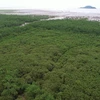
More than 60 bamboo varieties of Vietnam have been planted in the Gao Giong eco-tourism site in Cao Lanh district, the Mekong Delta province of Dong Thap, as part of the site’s bamboo conservation project.
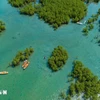
Vietnamese bamboo species conserved in Dong Thap province ảnh 1A road flanked by bamboos in the Gao Giong eco-tourism site in Dong Thap province (Photo: baodongthap.com.vn)

Dong Thap (VNA) – More than 60 bamboo varietiesof Vietnam have been planted in the Gao Giong eco-tourism site in Cao Lanhdistrict, the Mekong Delta province of Dong Thap, as part of the site’s bambooconservation project.

Huynh Thanh Hien, deputy head of the Gao Giongcajuput forest management board, said the bamboos, including tre gai (Bambusabambos (L.) Voss), tam vong (Thyrsostachys Siamensis), and soc vang(Bambusa vulgaris Schrader ex Wendl), have been planted since 2014.

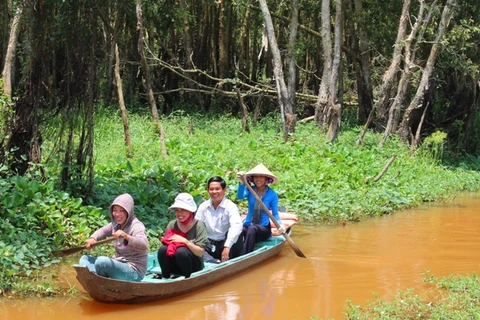
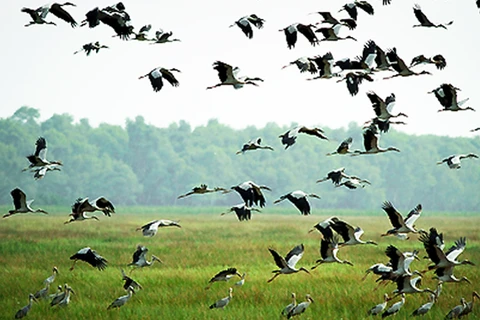
Tre gai is the most popular type of bamboo heresince it provides habitat for birds and can also be used as a material to buildhouses and make fishing tools.

Hien said the bamboo varieties are collectedfrom all corners of the country, and most of them have adapted to local soilconditions well, creating a new attraction for tourists in Gao Giong.

The collection is also meant to protectVietnamese bamboo species and serve foreign scientists who come to study localbamboos, he noted, adding that the forest management board is also collectingbamboo species from other Southeast Asian and European countries.

In 2018, the board plans to plant bamboos toform a map of Vietnam covering 15 hectares in the Gao Giong eco-tourism area.

It will also continue the bamboo conservationproject with many activities like creating a bamboo maze, a bamboo museum, abamboo nursery, and a bamboo handicraft workshop, Hien said.-VNA
VNA
See more

A graphic image of the Nui Thoong high-tech waste treatment and waste-to-energy plant project. (Photo: hanoimoi.vn)

Hanoi breaks ground on 200-million-USD waste-to-energy plant

Designed to process 2,000 tonnes of waste per day and generate 45MW of electricity for the national grid, the project is the first high-tech waste-to-energy plant in southwestern Hanoi, where large-scale solid waste treatment facilities have long been lacking.

After undergoing health checks, all three sea turtles are released back into their natural habitat in the presence of authorities, local residents and tourists. (Photo: VNA)

Quang Tri authorities release three endangered sea turtles back to the wild

The three turtles, each weighing around 1.5 kilogrammes with shells measuring about 25 centimetres long and 20 centimetres wide, are green sea turtles. They were accidentally caught in fishing nets and found drifting at sea near Con Co waters on May 16 by fisherman Bui Dinh Thuy in Cua Viet commune during a fishing trip.

A rare turtle is transported to Cuc Phuong National Park for care and rehabilitation ahead of its eventual release back into the wild. (Photo published by VNA)

Rare turtles returned to Vietnam under CITES

The shipment includes several endangered Vietnamese species such as the Indochinese box turtle (Cuora galbinifrons), Bourret’s box turtle (Cuora bourreti), keeled box turtle (Cuora mouhotii), and black-breasted leaf turtle (Geoemyda spengleri), all considered highly endangered and increasingly threatened in the wild by habitat destruction, poaching, and illegal trade.

Representatives of the Ngoc Lam Border Guard Station under the Nghe An Border Guard Command and Son Lam commune's police hand over a pangolin voluntarily surrendered by a local resident to the wildlife conservation centre at Pu Mat National Park. (Photo: VNA)

Nghe An residents voluntarily hand over rare pangolins for conservation

On May 11, the Quy Chau Forest Protection Department, along with local police and authorities, took in a critically endangered pangolin, handed over by a resident. The animal was discovered a day earlier by Thai Doan Tuan, from Viet Huong village in Quy Chau commune, after it wandered into his garden. Recognising it as a protected Sunda pangolin, he contacted authorities for assistance.

A 2kg pangolin is released back into the wild at the Pu Huong Nature Reserve on May 6, 2026. (Photo published by VNA)

Nghe An releases rare pangolin back to the wild

Pangolins, scaly mammals capable of curling into a ball for self-defence, are classified as critically endangered and are strictly protected under both Vietnamese and international law.

At the working session (Photo: Vietnam Meteorological and Hydrological Administration)

Vietnam, Sri Lanka share experience in hydrometeorology

Both sides expressed confidence that continued dialogue and knowledge-sharing will deepen cooperation in hydrometeorology, helping enhance disaster response capacity and climate change adaptation in the years ahead.