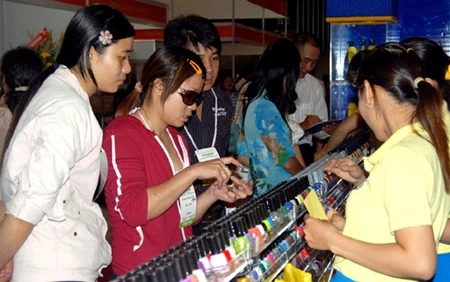
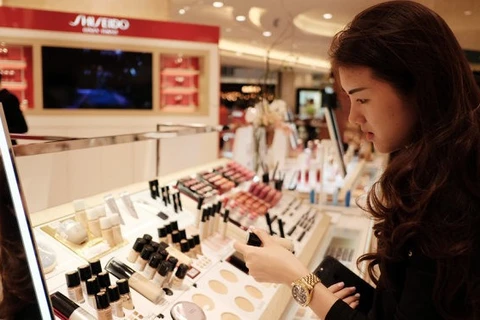
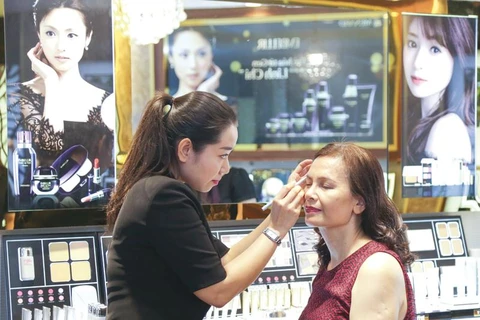
Customers at a cosmetics store in HCM City’s district 1. With its strong growth in recent years, Vietnam’s cosmetics market is attractive to local and foreign enterprises. (Source:VNA)
HCM City (VNS/VNA) - The Vietnamese cosmetics market has grown strongly in recent years given the rapid economic growth and large young population, the Vietnam Association of Essential Oils, Aromatherapy and Cosmetics has said.
According to Nguyen Van Minh, the association’s deputy chairman, the market is worth around 86 trillion VND (nearly 3.7 billion USD) a year.
Many famous foreign cosmetic brands have entered Vietnam by opening representative offices, companies and factories and through agents and distributors, including high-end brands like Esteé Lauder, Lancome, Shiseido, Fendi, Lower, Clairins, and L'Oreal.
“Some local cosmetics brands such as Thorakao, Saigon Cosmetic, Lana, Biona, Xmen, and Sao Thai Duong have achieved a certain position in the market though they just account for small market shares,” he said.
He quoted Nielsen Market Research Company as saying Vietnamese spend only 20 USD per person per month compared to 38 USD in Thailand.
Tran Quang Thang, Director of the HCM City Institute of Economics and Management, said: “The middle class, who spend a lot on cosmetics, is set to grow to 33 million by 2020.” This points to huge potential for growth, he said.
Realising this, many foreign companies are coming to exhibitions and fairs in Vietnam looking for partners to distribute their products.
Vicky Huang, a representative of Taiwan-based Ammon International Inc, participated in the Comobeaute expo held recently in HCM City and said: “We are very excited about Vietnam's cosmetics market, which is very hot now.
“By participating in the fair, we want to introduce our new products – the highly effective fish collagen peptide with Japanese sakura extract helps reduce and minimise the appearance of future dark spots – and look for agents in HCM City.”
Suky Lim, CEO of the Republic of Korea’s Threedayslove Co Ltd, said her company had so far focused on exporting its products to China due to its large population. Recently it had studied the Vietnamese market and realised it was growing fast, and so decided to enter the market, she said.
“This is the first time my company is participating in the exhibition to introduce our high-quality cosmetic lines to Vietnamese consumers.
“Vietnam has a large number of young people with high demand for beauty products, offering a good opportunity for Korean cosmetics brands.”
According to the Vietnam Association of Essential Oils, Aromatherapy and Cosmetics, the country has 400 cosmetics businesses, of which 100 are foreign but account for 90 percent of sales. This is a big challenge to Vietnamese brands.
Minh said products such as perfumes, facial cleansers and shampoos made by local brands like Saigon Cosmetic, Thorakao and Viet Huong were of very good quality, but they focused exclusively on quality and paid less attention to packaging, design and marketing leading to low brand identification.
"Most are targeted at the middle-income market segment, and so their earnings are not very high," he said.
He urged local cosmetics firms to “pay more attention to improving their packaging, designs, marketing, and promotions so that they can capitalise on market opportunities.”-VNS/VNA
VNA