Vietnamese gymnast has his move officially added to code

Vietnamese gymnast Pham Phuoc Hung has made history after one of his techniques was officially named and added to the Men's Gymnastics Code of Points of the International Gymnastics Federation.
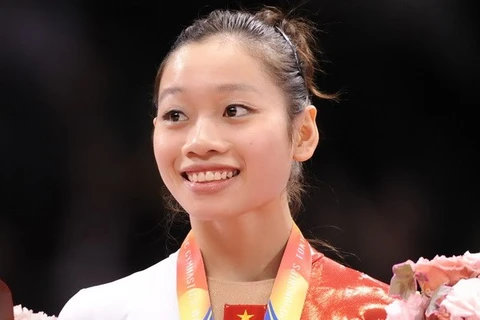
Vietnamese gymnast has his move officially added to code ảnh 1Pham Phuoc Hung has his name on one of the new techniques of the International Gymnastics Federation. (Source: VNA)

Hanoi (VNA) - Vietnamese gymnast Pham Phuoc Hung has made history after one of his techniques was officially named and added to the Men's Gymnastics Code of Points of the International Gymnastics Federation.

His new creation is one of eight new elements recognised by the International Gymnastics Federation (FIG) Men's Technical Committee it was confirmed on February 14 following a meeting at their headquarters in Lausanne.

At the FIG World Championships in Scotland, last November, Hung took those in attendance at the Glasgow's SSE Hydro exhibition centre by surprise as he successfully completed an unprecedented technique in the rings event.

The Vietnamese pulled with straight arms and body through a momentary front lever through cross to support the scale for two seconds.

Having never been done by any athlete before, his technique has been included in the Code of Points and competition system under the name of "PHAM" with a difficulty rating of D.

Athletic careers are finite, but showing a skill that has never been done before in gymnastics is a way for gymnasts to achieve immortality in the sport. The gymnast who successfully performs a new skill has the honour of having the element bear his or her name in the Code of Points, according to FIG.

Even if Olympic glory is the main objective for gymnasts leading up to this summer's Games in Rio, the lure of doing something new and innovative is equally tantalising. After being submitted to the FIG for consideration, prospective new moves are evaluated for difficulty and given a difficulty rating between A and H, with A elements being the easiest and H elements being the hardest.

After that, it is up to the gymnast to complete the skill without a large error at an approved competition, including the World Championships or Olympic Games. Submitted elements completed successfully at smaller competitions may also be approved later by the FIG.

Hung is one of two Vietnamese seeking berths in the coming Rio de Janeiro this summer.

The 27-year-old will join his female teammate Phan Thi Ha Thanh in Brazil in a month's time for the Olympic qualification tournament.

Other athletes who received the honour are Japanese Kenzo Shirai and Koji Yamamuro, Australian Naoya Tsukahara, American Jacob Dalton, and Venezuelan Jose Luis Fuentes, along with Finn Tomi Tuuha.-VNA
VNA

See more

A performance at the opening ceremony of the Hung Kings Temple Festival and the 2026 Ancestral Land Culture and Tourism Week on late April 17 (Photo: VNA)

Hung Kings Temple Festival, associated tourism week kick off

The annual festival serves as a major national cultural event, offering an opportunity for people across Vietnam and overseas Vietnamese communities to pay tribute to their ancestors, express gratitude, and strengthen the great national solidarity.

A ritual at Hue Nam Temple Festival (Photo: VNA)

Hue Nam Temple Festival: From imperial relic to distinctive cultural celebration in Hue

Historically known as Ngoc Tran Son Tu, the temple was renamed Hue Nam during the reign of King Dong Khanh in the late 19th century, symbolising royal gratitude to the Mother Goddess. It is also the only temple in Hue that harmoniously combines royal ceremonial elements with folk religious practices, creating a distinctive blend of court ritual and popular belief.

Participants in the 20th Cong hien (Devotion) Awards presentation ceremony in Hanoi on April 15 (Photo: VNA)

Devotion Awards mark two decades of honouring excellence in music, sports

Nguyen Thien Thuat, Editor-in-Chief of the The Thao & Van Hoa newspaper and Head of the organising board of the awards, said, noting that their achievements reflect the spirit of the Politburo’s Resolution No. 80, which emphasises preserving national cultural values while selectively absorbing the essence of world culture.

Artisans and students take part in cultural activities and exchanges in the Xoan singing performance space at Hung Lo ancient communal house in Phu Tho province (Photo: VNA)

Ancestral legends revived through contemporary performance

Beyond cultural value, well-organised festival programmes linked with tourism and media can contribute to the development of cultural industries and enhance Vietnam’s cultural soft power, positioning heritage-based events as distinctive national cultural brands in the international arena.

Khue Van Cac (Khue Van Pavilion) stands as a defining cultural symbol of Hanoi, closely associated with Vietnam’s long-standing tradition of valuing education and honouring knowledge. (Photo: VNA)

Greater efforts needed for heritage to shape Hanoi’s identity

As suggested by UNESCO experts, heritage should be approached as an integrated system encompassing space, people and everyday life. This perspective can inform urban planning, cultural tourism development and the creation of clear economic drivers.

Participants at the gathering (Photo: VNA)

Lao, Cambodian students welcome traditional New Year in Ho Chi Minh City

In his speech, Vice Chairman of the municipal People’s Committee Nguyen Manh Cuong said the municipal Party organisation, authorities and people always value the close ties and solidarity among Vietnam, Laos and Cambodia. He described the three nations’ longstanding ties, forged through shared hardships, as an invaluable spiritual asset and a bedrock for sustainable development.

Vietnamese kickboxers win 32 gold medals at the Kickboxing World Cup 2026. (Photo: Vietnam Kickboxing Federation)

Vietnam finish third at Kickboxing World Cup 2026

According to Vu Duc Thinh, President of the Vietnam Kickboxing Federation, the strong results reflected careful preparation by local training centres and the determination of Vietnamese fighters. The team’s participation, funded largely through socialised and local resources, also demonstrated growing support for the development of kickboxing in Vietnam.